
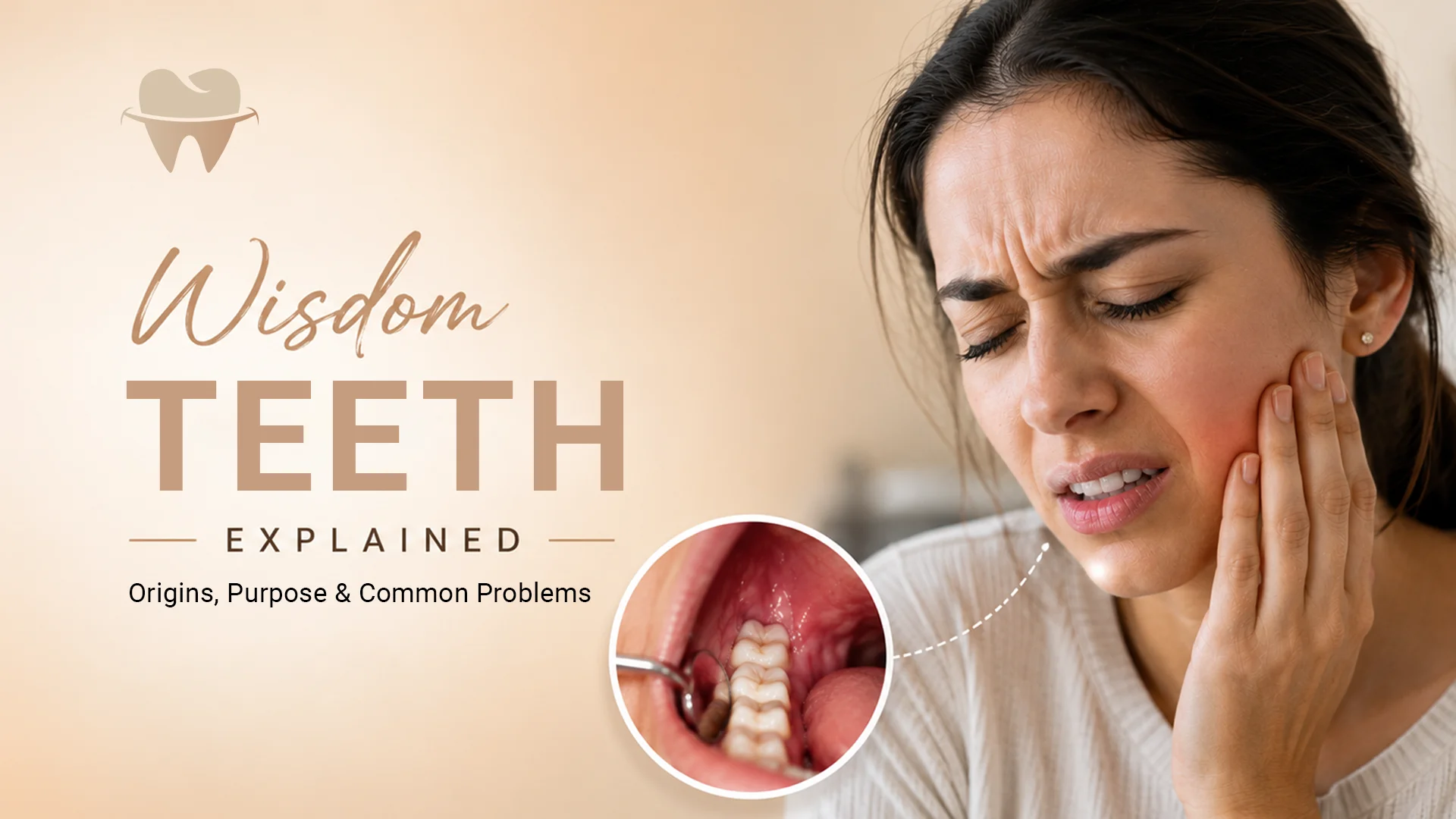
It usually starts with a dull ache at the back of your mouth. At first, you ignore it. Then comes swelling, discomfort while chewing, and suddenly, you find yourself searching online for answers.
Wisdom teeth are one of the most discussed and often feared aspects of dental health. But what exactly are they? Why do we even have them? And why do they cause so many problems for so many people?
Understanding the wisdom teeth and their purpose is to help you recognize early warning signs and make informed decisions about your oral health. Let’s break it down in a simple, clear, and comprehensive way.
Disclaimer: This article is for informational purposes and does not replace professional dental advice.
What Are Wisdom Teeth?
Wisdom teeth are the third and final set of molars that typically appear at the back of your mouth. Most adults have four wisdom teeth, one in each corner of the mouth, behind the second molars.
These teeth are the last permanent teeth to erupt, completing the full set of 32 adult teeth. Unlike your other molars that arrive during childhood and early teenage years, wisdom teeth wait until young adulthood to make their appearance.
Why are wisdom teeth called wisdom teeth? The name comes from the age at which they typically emerge. It is tied to the fact that they erupt between ages 17 and 25, a period often associated with gaining maturity and wisdom.
Quick fact: The term “wisdom tooth” has been used since the 17th century and is a direct translation from the Latin dens sapientiae, reflecting the age of maturity when these teeth typically appear.
Wisdom Tooth Age: When Do They Appear?
Wisdom teeth age range is typically between 17 and 25 years old. However, this is not a strict rule. Some people develop wisdom teeth earlier, some later, and some never develop them at all.
Typical eruption age variations include:
- Early eruption: Some individuals see wisdom teeth as early as age 14 or 15
- Typical eruption: Most commonly between ages 17 and 21
- Late eruption: Some wisdom teeth appear in the late 20s or even early 30s
- Never: Approximately 5-10% of people are born without one or more wisdom teeth
The wide wisdom teeth age range is completely normal. Genetics play a significant role in determining not only when but whether your wisdom teeth will develop.
Wisdom Tooth Age – Quick Summary Table
|
Age Range |
Status |
What to Expect |
|
14-16 years |
Early development |
Wisdom tooth buds visible on X-rays |
|
17-21 years |
Typical eruption age |
Most common time for emergence or removal |
|
22-25 years |
Late eruption |
Still normal, symptoms may appear now |
|
25+ years |
Delayed or absent |
May never erupt; monitoring recommended |
|
Lifetime |
Never develop |
5-10% of people born without one or more |
Why Do We Have Wisdom Teeth?
Thousands of years ago, human diets were very different from what we eat today. Early humans consumed raw plants, nuts, roots, and tough, uncooked meat that required intense, heavy chewing.
Wisdom teeth served an important evolutionary purpose:
- They acted as extra grinders for breaking down tough foods
- Helped compensate for tooth loss common in pre-modern humans
- Supported jaw strength and chewing efficiency
Back then, humans also had larger jaws with more space, making room for these additional molars without difficulty.
Then vs. Now – Quick Comparison
|
Factor |
Ancient Humans |
Modern Humans |
|
Diet |
Raw plants, tough meat, nuts |
Cooked, processed, soft foods |
|
Jaw Size |
Larger, more spacious |
Smaller, less room |
|
Tooth Loss |
Common due to wear/disease |
Rare due to modern dentistry |
|
Wisdom Teeth Need |
Essential for chewing survival |
Vestigial – no longer necessary |
|
Common Outcome |
Fit easily |
Often impacted or problematic |
So, Why Are They a Problem Now?
Over time, human evolution has changed dramatically:
- Our diets became softer thanks to cooking, processing, and modern utensils
- Jaw sizes became smaller as we no longer needed massive chewing muscles
- Dental care improved significantly, so fewer teeth are lost early in life
As a result, wisdom teeth often don’t fit properly anymore. They have become what scientists call “vestigial”—a body part that has lost most or all its original function through evolution.
Do You Actually Need Wisdom Teeth?
Short answer: No, not really.
Wisdom teeth are considered vestigial structures, meaning they no longer serve an essential function in modern humans. Most people live perfectly healthy lives without their wisdom teeth and many have them removed preventively.
However, not all wisdom teeth are problematic. Some people:
- Have enough space in their jaw for normal eruption
- Experience a complete, straight eruption without complications
- Can keep their wisdom teeth for life without any issues
Others, however, face significant complications that require professional intervention.
Common Problems Caused by Wisdom Teeth
Here are the general issues caused by wisdom teeth:
1. Impacted Wisdom Teeth
This is the most common issue associated with wisdom teeth. An impacted tooth is one that fails to fully emerge from the gums due to lack of space, incorrect angle, or blockage by other teeth.
Impacted wisdom teeth may:
- Grow sideways toward the second molars
- Grow backward toward the back of the mouth
- Grow tilted forward or backward at various angles
- Stay completely trapped under the gum (bony impaction)
- Partially erupt through the gum (soft tissue impaction)
Each type of impaction can lead to different symptoms and complications.
2. Pain and Swelling
As wisdom teeth push through the gums or press against neighboring structures, they can cause significant discomfort.
Wisdom teeth symptoms include:
- Dull, persistent jaw pain at the back of the mouth
- Gum tenderness and redness around the erupting area
- Swelling around the jaw or cheek
- Pain that radiates to the ear, head, or neck
The signs of wisdom tooth problems can range from mild and intermittent to severe and constant.
3. Infection (Pericoronitis)
When a wisdom tooth only partially erupts, a flap of gum tissue often remains covering part of the tooth. This flap creates a perfect trap for food particles and bacteria.
This condition, called pericoronitis, can lead to:
- Gum infection with redness and swelling
- Bad breath or foul taste from bacterial buildup
- Difficulty opening the mouth (trismus)
- Fever and general malaise in severe cases
- Pus drainage from the infected area
Pericoronitis often recurs until the problematic tooth is addressed.
4. Crowding of Other Teeth
Wisdom teeth, especially those growing at angles, can push against neighboring teeth over time. This pressure can cause:
- Misalignment of otherwise straight teeth
- Crowding in the front of the mouth
- Shifting of previously orthodontically straightened teeth
This is particularly frustrating for people who have worn braces or aligners and invested significantly in their smile alignment.
5. Tooth Decay and Gum Disease
Because wisdom teeth are located at the very back of the mouth, they are harder to clean properly with regular brushing and flossing.
This difficulty increases the risk of:
- Cavities on the wisdom tooth itself
- Decay on the adjacent second molar
- Gum disease around the wisdom tooth area
- Plaque buildup leading to tartar formation
Even wisdom teeth that erupt normally can develop decay due to poor access for cleaning.
6. Cysts and Tumors (Rare but Serious)
In rare cases, an impacted wisdom tooth can lead to the development of a dentigerous cyst—a fluid-filled sac that forms around the crown of the unerupted tooth.
These cysts can:
- Damage the jawbone by expanding and eroding bone
- Damage nearby teeth and their roots
- In very rare cases, develop into tumors requiring more extensive surgery
This is why dentists monitor impacted wisdom teeth with regular X-rays even when no symptoms are present.
Wisdom Teeth Problems – At a Glance
|
Problem |
Cause |
Key Symptom |
|
Impacted Tooth |
Lack of space, wrong angle |
Pain, inability to erupt fully |
|
Pericoronitis |
Food/bacteria trapped under gum flap |
Swelling, infection, bad taste |
|
Crowding |
Pressure against adjacent teeth |
Shifting, misalignment |
|
Decay |
Difficulty cleaning back teeth |
Cavities on wisdom or second molars |
|
Cysts |
Fluid sac forms around impacted tooth |
Bone damage (visible on X-ray) |
Wisdom Teeth Symptoms: When to Pay Attention
Not sure if your wisdom teeth are causing trouble? Look out for these common symptoms:
- Persistent pain at the back of the mouth or jaw
- Swollen or bleeding gums around the last molars
- Difficulty or pain when chewing food
- Jaw stiffness or difficulty opening the mouth wide
- Bad taste in the mouth or bad breath that won’t go away
- Headaches or ear pain without another clear cause
- Redness and swelling of the gums near the back teeth
- Visible food trapping behind the last tooth
If you experience any of these signs, it’s best to consult a dentist for a proper evaluation and X-rays.
Wisdom Teeth Symptoms – Quick Checklist
|
Symptom |
What It Feels Like |
Action Needed |
|
✓ Jaw pain |
Dull ache at the back of mouth |
Monitor; see dentist if persistent |
|
✓ Swollen gums |
Redness, tenderness around last tooth |
Schedule evaluation |
|
✓ Difficulty chewing |
Pain when biting down |
Dental visit recommended |
|
✓ Jaw stiffness |
Cannot open mouth fully |
Urgent dental consult |
|
✓ Bad breath/taste |
Persistent despite brushing |
Likely infection – see dentist |
|
✓ Headache/ear pain |
Radiating discomfort without clear cause |
Dental evaluation needed |
When Should Wisdom Teeth Be Removed?
Not every wisdom tooth requires extraction. However, removal is commonly recommended in specific situations.
Extraction Is Usually Advised If
- The tooth is impacted (cannot erupt properly)
- There is pain or infection related to the tooth
- It is damaging nearby teeth or roots
- There is a cyst or significant gum disease present
- It is likely to cause future problems based on its position and angle
- The tooth is decayed and cannot be restored properly
- You are undergoing orthodontic treatment, and wisdom teeth may cause crowding
Preventive Extraction
In some cases, dentists suggest removing wisdom teeth early—even before symptoms appear—to avoid complications later. This is called prophylactic or preventive removal.
Benefits of earlier wisdom teeth removal include:
- Faster recovery in younger patients (typically teens or early twenties)
- Less complicated surgery because roots are not fully formed
- Lower risk of nerve damage or other complications
- Avoidance of future pain, infection, or damage to other teeth
The decision to remove wisdom teeth preventively should be made after a thorough discussion with your dentist or oral surgeon.
Wisdom Teeth Removal – Decision Guide
|
Scenario |
Removal Recommended? |
Reason |
|
Fully erupted, straight, no decay |
Not usually |
Can remain if maintained properly |
|
Partially erupted (soft tissue impaction) |
Yes |
High risk of pericoronitis infection |
|
Completely impacted under bone |
Often yes |
Risk of cyst formation, damage to adjacent tooth |
|
Causing pain or swelling |
Yes |
Active problem requiring intervention |
|
Damaging second molar |
Yes |
To preserve healthy adjacent tooth |
|
Preventive (teens/early 20s) |
Often advised |
Faster recovery, less complicated surgery |
What Happens During Wisdom Teeth Removal?
The idea of surgery can sound intimidating, but extraction is one of the most common procedures performed in dental medicine. Millions of people undergo it every year with excellent outcomes.
Here’s What Typically Happens:
- Examination and Imaging: Your dentist takes X-rays (often a panoramic X-ray) to assess the position, angle, and root development of each wisdom tooth.
- Anesthesia: The dentist or oral surgeon administers local anesthesia to numb the area completely. For more complex cases or anxious patients, sedation or general anesthesia may be offered.
- Tooth Removal: An incision may be made in the gum tissue to access the tooth. The tooth is carefully loosened and removed. In some cases, especially with impacted teeth, the tooth may be cut into smaller pieces for easier removal.
- Cleaning and Closure: The area is thoroughly cleaned of any debris. Stitches may be placed to help the gum heal, though many cases use self-dissolving stitches.
Recovery Time and Aftercare
- Mild recovery period: 2–3 days of significant healing
- Full healing of gum tissue: 1–2 weeks
- Complete bone healing: Several months (but you won’t feel this)
Patients are typically advised to:
- Avoid hard, crunchy, or sticky foods for several days
- Use ice packs on the cheek to reduce swelling
- Maintain gentle oral hygiene while avoiding the extraction sites
- Take prescribed or recommended pain relievers as needed
- Avoid using straws or spitting forcefully to prevent dry socket
- Attend follow-up appointments if stitches need removal
Most people return to work, school, and normal activities within 2-3 days after wisdom teeth extraction.
Recovery Timeline – Quick Summary
|
Time Period |
What to Expect |
Care Instructions |
|
Day 1 (Procedure day) |
Numbness wears off; gauze needed |
Rest, ice packs, no rinsing |
|
Days 2-3 |
Swelling peaks; mild discomfort |
Soft foods, prescribed pain relief |
|
Days 4-7 |
Swelling subsides; healing progresses |
Gentle rinsing, resume light activities |
|
Week 2 |
Most healing complete |
Normal diet gradually, avoid hard foods |
|
Week 3-4 |
Extraction site closes |
Full oral hygiene, monitor for any issues |
Can You Prevent Wisdom Tooth Problems?
While you cannot stop wisdom teeth from developing or growing, you can significantly reduce complications by:
- Visiting your dentist regularly for check-ups and monitoring
- Getting routine X-rays to track wisdom tooth development and position
- Maintaining excellent oral hygiene to prevent tooth decay and gum disease
- Addressing symptoms early rather than waiting for them to worsen
- Discussing preventive removal with your dentist if you are in the high-risk age range
Early detection through regular dental visits is the most effective way to avoid painful complications from wisdom teeth.
Conclusion
Wisdom teeth are a fascinating reminder of human evolution, but they are not always your mouth’s best friend. While some people never face issues, many others experience pain, crowding, infection, or damage due to lack of space in modern, smaller jaws.
Understanding and knowing the typical eruption age range, recognizing early wisdom teeth signs, and understanding when wisdom tooth removal is necessary empowers you to take control of your oral health.
Taking care of your oral health today ensures a pain-free, confident smile tomorrow.
Experiencing wisdom teeth pain or unsure if yours need attention? At Teeth and Gums, our expert dental team provides thorough evaluations, gentle extractions, and personalized care for wisdom teeth at any stage. Don’t wait for complications to develop.
Schedule your wisdom teeth consultation at Teeth and Gums today and take the first step toward a pain-free, healthy smile.
Frequently Asked Questions
What is the wisdom teeth and why do we have them?
Wisdom teeth are the third and final set of molars that typically emerge between ages 17 and 25. They were originally useful for our ancestors who ate tough, raw foods and often lost teeth early. Today, they are considered vestigial and no longer serve an essential function.
Why are wisdom teeth called wisdom teeth?
Why are wisdom teeth called wisdom teeth? The name comes from the age at which they erupt—between 17 and 25 years old, traditionally considered the “age of wisdom” when a person transitions into adulthood and maturity.
What is the typical wisdom teeth age for eruption?
Wisdom teeth age range is typically 17 to 25 years old. However, some people develop them earlier (as young as 14), some later (into their 30s), and approximately 5-10% of people never develop wisdom teeth at all.
What are common wisdom teeth symptoms that indicate a problem?
Common wisdom teeth signs include persistent jaw pain, swollen or bleeding gums, difficulty chewing, jaw stiffness, bad breath, bad taste, headaches, ear pain, and visible swelling near the back of the mouth. Any of these signs warrant a dental evaluation.
When is wisdom teeth removal necessary?
Wisdom tooth extraction is typically necessary when teeth are impacted, causing pain or infection, damaging nearby teeth, developing cysts, or likely to cause future dental problems. Your dentist will recommend removal based on X-rays and clinical examination of your specific situation.
Quick takeaway: Not everyone needs wisdom teeth removal. But regular monitoring through dental X-rays is essential to catch problems before they become painful or damaging.


0 Comments