SUMMARY
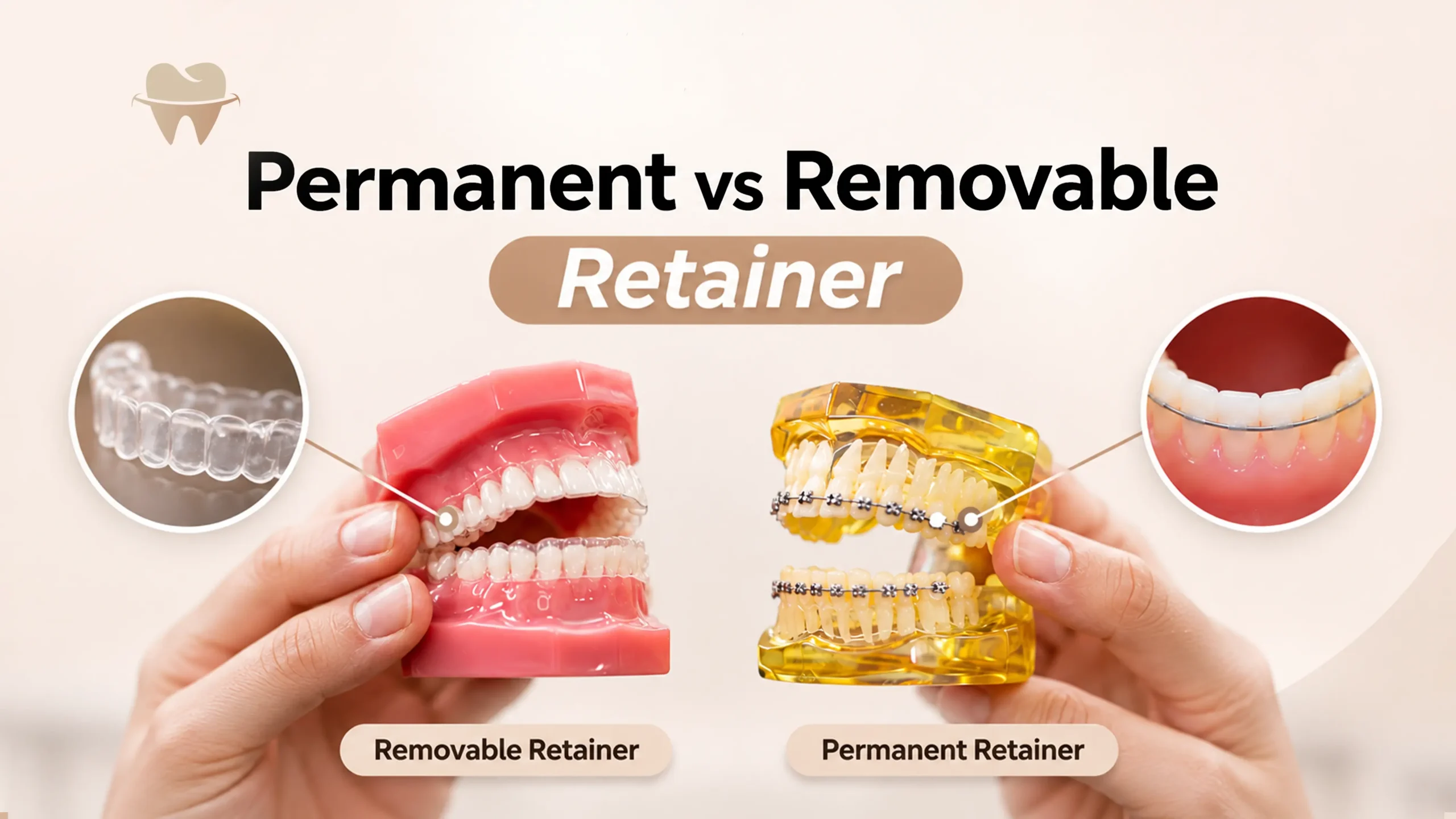
- A permanent retainer is a thin wire bonded behind your teeth. A removable retainer is a Hawley or clear plastic appliance that you take out.
- Neither type wins on every measure. The best choice depends on your teeth, habits, gum health and budget.
- A 2023 Cochrane review of 47 studies found low-certainty evidence, so no single retainer can be called best for everyone.
- Fixed retainers cannot be lost. But they are harder to clean and can break or come loose.
- Removable retainers are easier to clean. But they only work if you wear them.
- Some patients use both. Many orthodontists advise wearing a retainer for years, and often for life.
One retainer you take out. One you cannot. Which will actually protect your smile?
Your braces are off. Your teeth look great. Then your orthodontist asks a simple question: fixed or removable?
Most patients do not know what to say. Both options sound sensible. Both are widely used. And both come with trade-offs that nobody explains well in a short appointment.
This guide explains the differences, benefits and disadvantages of each. It covers types of dental retainers, cleaning, how long to wear them, costs in Lahore and what the latest research says.
Why You Need a Retainer After Braces
Teeth have a memory. After braces, they want to drift back toward their old positions. Dentists call this relapse.
Why does it happen? The bone and gum fibres around your teeth need time to settle. Even after that, teeth keep moving slowly through life. Normal biting, ageing and tongue pressure all play a part.
A retainer holds teeth in place while the tissues stabilise. It is part of treatment, not an optional extra. Skipping it can undo months or years of work.
Teeth retainers after braces are standard care in orthodontics. The only real question is which type suits you.
Types of Dental Retainers
There are three main types of dental retainers in everyday use.
Type | What It Is | Removable? | Typical Material |
Fixed wire retainer | Thin wire bonded behind front teeth | No | Stainless steel or similar wire |
Hawley retainer | Acrylic plate with a front wire | Yes | Acrylic and metal |
Clear retainer (Essix or vacuum-formed) | Transparent tray over the teeth | Yes | Clear thermoplastic |
Other fixed designs exist. Some use fibre-reinforced composite. Some are made by computer from a nitinol wire. Your orthodontist chooses based on your case.
What Is a Permanent Retainer?
A permanent dental retainer is a thin wire glued to the inside surfaces of your teeth. It is also called a fixed orthodontic retainer, bonded retainer or lingual retainer.
Most are placed behind the lower front teeth, from canine to canine. Some patients also have one on the upper teeth. The wire is hidden from view. Most people will not know it is there.
A fixed wire retainer is usually made from multistrand stainless steel. The orthodontist bonds it to each tooth with dental adhesive. Fitting often takes between 30 minutes and an hour.
It stays in place day and night. You cannot take it out. A dentist removes it when you no longer need it.
Permanent Retainer Benefits
- Nothing to remember. It works all the time.
- Cannot be lost. No more retainers wrapped in napkins.
- Invisible. It sits behind the teeth.
- Good for stubborn areas. Lower front teeth relapse easily. A fixed wire guards them well.
- No effect on speech after a short adjustment. Most people adapt fast.
Permanent Retainer Disadvantages
- Harder to clean. Plaque and tartar collect around the wire.
- Gum and decay risk. Poor cleaning can lead to gum inflammation.
- It can break or detach. A loose wire lets teeth move without you noticing.
- Needs repair visits. Fixing it takes appointment time.
- Can feel strange at first. The tongue notices the wire.
- Food can catch. Floss threaders become a daily habit.
A 2016 systematic review in Progress in Orthodontics reported failure rates of about 25 to 29 percent for lower fixed retainers over follow-up periods of 6 to 36 months. Failure meant detachment or breakage. Removable retainers failed less often in that review.
What Is a Removable Dental Retainer?
A removable dental retainer is an appliance you can take out of your mouth. You wear it for the hours your orthodontist advises. You clean it outside the mouth.
There are two common kinds.
Hawley retainer. An acrylic plate sits against the palate or inside the lower arch. A metal wire crosses the front teeth. It is durable and can be adjusted. Read our full guide to the Hawley retainer.
Clear retainer. A transparent plastic tray fits over the teeth. It is nearly invisible. It is usually thinner and less durable than a Hawley.
Removable Retainer Benefits
- Easy to clean. You brush your teeth and the retainer separately.
- Better gum health. Studies suggest less gum bleeding than with fixed wires.
- Easy to replace. A lost or broken one can be remade from your records.
- Good for upper teeth. Many orthodontists prefer removable retainers for the upper arch.
- Adjustable (Hawley). The wire can be tweaked as needed.
Removable Retainer Disadvantages
- You must wear it. Missed nights mean relapse.
- It can be lost or broken. Pets, pockets and bin bags are common culprits.
- It can affect speech briefly. This usually settles in days.
- Clear types wear out. They may crack, stain or warp.
- It can feel bulky. Hawley acrylic can feel thick at first.
Permanent vs Removable Retainer: Side-by-Side Comparison
Here are the main differences between permanent and removable retainers.
Factor | Permanent (Fixed) | Removable (Hawley or Clear) |
Can you take it out? | No | Yes |
Visibility | Hidden behind teeth | Hawley wire visible; clear nearly invisible |
Patient effort | Low for wear, high for cleaning | High for wear and cleaning |
Cleaning | Harder | Easier |
Gum health | More plaque risk | Generally better |
Risk of loss | None | Moderate |
Risk of breakage | Wire can snap or detach | Hawley sturdy; clear can crack |
Eating | Normal, avoid very hard foods | Remove before eating |
Speech | Short adjustment | Short adjustment |
Replacement | Dentist repair or rebond | Remake from records |
Typical use | Lower front teeth, long term | Upper arch, night wear |
Fixed Retainer vs Clear Retainer
Fixed retainer vs clear retainer is a common comparison. Here is how they differ.
Factor | Fixed Wire Retainer | Clear Retainer |
Appearance | Hidden | Almost invisible |
Wear time | Always on | Usually nights, after a full-time phase |
Compliance needed | Very low | High |
Cleaning | Floss threaders, interdental brushes | Brush and rinse |
Gum health | More plaque trapping | Better |
Durability | Can detach | Can crack or wear |
Protects against grinding | No | Helps cushion mild grinding |
Bite feel | Normal | Slightly altered while worn |
Clear retainers cover the teeth, so they can double as a mild night guard. But they are not a substitute for a proper guard if you grind heavily.
What the Research Says
The best summary is a Cochrane review updated in 2023. It looked at 47 studies with 4,377 children and adults.
Here are its main points, in plain language.
- The evidence is low to very low certainty. The authors could not say that one approach is clearly better.
- If a removable retainer is worn full time, tooth movement may be no different from a fixed retainer.
- Part-time clear plastic retainers may allow slightly more movement than a fixed retainer. The difference was small and may not matter.
- Clear plastic removable retainers may give better gum health than fixed retainers. No difference in decay was found.
- In one trial, Hawley retainers failed less often than clear plastic ones. But they were less comfortable at six months.
- Clear plastic retainers may satisfy patients more but be less likely to last than Hawley retainers.
- Fibre-reinforced fixed retainers may fail earlier and cause more gum problems than multistrand wire.
The takeaway is simple. Both types can work. The best retainer is the one you will use and maintain.
Which Retainer Is Better?
There is no universal winner. Use this guide as a starting point and talk to your orthodontist.
If You… | Often Better Choice |
Worry about forgetting to wear it | Fixed retainer (lower teeth) |
Struggle with flossing and hygiene | Removable retainer |
Had crowded lower front teeth | Fixed retainer, often with a removable one on top |
Grind your teeth at night | Hawley or clear retainer that also protects teeth |
Have gum disease or gum recession | Removable retainer, based on your dentist’s advice |
Play contact sports | Fixed retainer, plus a sports guard |
Lose things often | Fixed retainer |
Want the lowest upfront cost | Removable retainer |
Want the simplest daily routine | Fixed retainer, if you can keep it clean |
Many patients combine both. A fixed wire guards the lower front teeth. A removable retainer holds the upper arch. This is a very common set-up.
How Long to Wear Retainers
How long to wear retainers is the question patients ask most. The honest answer is: longer than you think.
Removable Retainer Schedule
Phase | Typical Wear |
First 3 to 6 months | Full time, about 22 hours a day, removed only to eat and clean |
Months 6 to 12 | Often reduced to nights only |
After 1 year | Nights, sometimes a few nights a week |
Long term | Many orthodontists advise lifelong part-time wear |
Fixed Retainer Schedule
A fixed retainer stays on all the time. Many orthodontists advise leaving it in for years, and often for life, if it is intact and clean.
The Cochrane review found low-certainty evidence that part-time and full-time Hawley wear gave similar results. But the study was small. Do not cut back on your own. Follow your orthodontist’s schedule.
Teeth keep changing for life. Retainers are cheap insurance for an investment that took months or years.
Retainer Maintenance and Cleaning
Good retainer maintenance extends life and protects your gums. Retainer cleaning differs for fixed and removable types.
Cleaning a Permanent Retainer
- Brush along the wire twice a day.
- Use floss threaders or super floss to clean between teeth, under the wire.
- Try interdental brushes if there is space.
- A water flosser helps flush debris.
- Attend professional cleanings. Tartar builds up on the wire.
- Check the wire often with your tongue. Report any rough spot or loose area.
Cleaning a Removable Retainer
- Rinse it after you remove it.
- Brush it daily with a soft brush and mild soap.
- Avoid toothpaste. It scratches acrylic and plastic.
- Never use hot water. Heat warps plastic and acrylic.
- Soak it weekly in a retainer cleaning solution.
- Store it dry in its case when not in the mouth.
- Keep it away from heat, pets and napkins.
Quick Retainer Care Table
Task | Fixed | Removable |
Daily brushing | Yes, along the wire | Yes, separately |
Flossing | Threader or superfloss | Normal flossing |
Soaking | Not applicable | Weekly |
Hot water | Not applicable | Never |
Storage | Not applicable | Case, always |
Dentist checks | Every 6 months | Every 6 to 12 months |
Troubleshooting Common Retainer Problems
A fixed retainer feels loose or sharp. Call your orthodontist. A loose wire lets teeth drift. A sharp end can cut your tongue.
A fixed retainer has broken. Do not remove it yourself. Book a repair visit.
A removable retainer feels tight. If you missed a few nights, teeth may have shifted. Wear it as advised and see your orthodontist if it will not seat.
A removable retainer is lost. Order a replacement quickly. Teeth can move within days.
A clear retainer is cracked. Replace it. A cracked tray does not hold teeth well.
Your gums are red or bleeding around a fixed wire. Improve cleaning and book a hygiene visit.
Cost of Retainers in Lahore
Retainer prices vary by clinic and type.
Retainer | Typical Cost in Lahore (PKR) |
Removable retainer (listings) | About 3,900 up to 10,000 on public directories |
Hawley retainer, single arch | About 8,000 to 14,000 at established clinics |
Clear retainer | Quote from your clinic |
Fixed wire retainer | Quote from your clinic. Sometimes included in a braces package |
Repair or rebonding of a fixed wire | Quote from your clinic |
Figures are public directory listings and market estimates and prices vary. Ask your orthodontist for a written quote.
A fixed retainer may cost more at the start because of the bonding procedure. But it cannot be lost, so some patients save on replacements. A removable retainer costs less upfront. Replacing lost ones adds up.
Many braces packages include the first retainer. Ask what is covered before treatment begins.
Can You Have Both? Can You Switch?
Yes, to both.
Using both. Many patients wear a fixed wire on the lower teeth and a removable retainer on the upper teeth. This gives full protection.
Switching from fixed to removable. Your dentist can remove the fixed wire and take impressions for a removable retainer. Do this before removal so your teeth do not move.
Switching from removable to fixed. Possible if your teeth are still well aligned. A new impression is taken and the wire is bonded.
Never remove a fixed retainer yourself. The adhesive can damage enamel.
When to See Your Orthodontist
Book a visit if you notice:
- A loose, broken or sharp fixed wire
- A removable retainer that no longer fits
- Teeth that look crooked again
- Red, swollen or bleeding gums near the retainer
- A bad taste or smell from the retainer
- Cracks, warping or rough areas
- Pain when you wear it
Small problems are simple to fix. Waiting turns them into relapse.
Final Word
Fixed or removable? The honest answer is that both work when used well. A fixed wire asks little of you each day but needs careful cleaning. A removable retainer is easier to clean but needs discipline.
The research agrees on one thing. Retention matters, and the best retainer is the one you will use and maintain. Your orthodontist can match the choice to your teeth, your gums and your habits.
Do not stop wearing your retainer because your teeth feel fine. Feeling fine is the retainer doing its job.
Retainers at Teeth & Gums, DHA Phase 6
At Teeth & Gums in DHA Phase 6, Lahore, our team discusses retention before your braces come off. We explain both options, check your gum health and recommend the plan that suits your teeth and lifestyle.
We provide removable retainers, including Hawley and clear types, and advise on fixed options where suitable. We check retainers at review visits so small problems do not become relapse.
Book an orthodontic consultation at Teeth & Gums
Frequently Asked Questions
What is the difference between a permanent retainer and removable?
A permanent retainer is a thin wire bonded behind your teeth, so you cannot take it out. A removable retainer, such as a Hawley or clear tray, can be taken out for eating and cleaning. Fixed needs less effort to wear; removable is easier to clean.
Which is better: a permanent or removable retainer?
Neither is best for everyone. Research shows both can hold teeth, and the evidence is low certainty. A fixed retainer suits people who forget to wear removable ones. A removable retainer suits people who want easier cleaning and better gum health.
How long does a permanent retainer last?
A fixed retainer can last for many years if it stays intact and clean. Some patients keep one for a decade or more. Wire can loosen or break, and failure rates in studies were around 25 to 29 percent over one to three years.
How long do you need to wear a removable retainer after braces?
Most patients wear it full time for the first three to six months, then switch to nights. Many orthodontists advise night wear for years, and often for life. Follow your orthodontist’s schedule and do not stop on your own.
Can you eat normally with a permanent retainer?
Mostly yes. Because it is fixed, you can eat normally. Avoid very hard or sticky foods such as hard sweets, ice and chewy toffee, which can break the bond. Clean carefully after meals so food does not collect.
Is a permanent retainer harder to clean than a removable retainer?
Yes. Plaque and tartar collect around the wire, and you need floss threaders or superfloss to clean beneath it. A removable retainer comes out, so you can brush your teeth and the retainer separately. Regular hygiene visits help with fixed ones.
Can a permanent retainer cause gum problems?
It can if cleaning is poor. Plaque and tartar can build up around the wire and inflame the gums. Studies suggest slightly more gum bleeding with fixed retainers. Good brushing, threading floss and regular cleanings keep gums healthy.
Can you sleep with a removable retainer?
Yes. Nighttime wear is standard, and most patients switch to sleeping in a retainer after the full-time phase. It is safe and comfortable for most people. Keep it clean and store it in its case when you wake.
What happens if you stop wearing your removable retainer?
Your teeth start to shift back toward their old positions. This can begin within days and worsen over months. A retainer that no longer fits is a sign of movement. See your orthodontist before relapse needs new treatment.
Can you switch from a permanent retainer to a removable retainer?
Yes. Your dentist takes impressions, makes a removable retainer, and then removes the fixed wire. Doing this in order stops teeth moving between steps. Never remove a fixed retainer yourself, because the adhesive can damage enamel.
Which retainer is more comfortable?
Fixed retainers are often more comfortable day to day because you cannot feel a tray. Some patients notice the wire with the tongue at first. Removable retainers can feel tight or bulky early on. A Cochrane trial found Hawley retainers less comfortable at six months.
Are permanent retainers more expensive than removable retainers?
Often a little more upfront because of the bonding visit, though some braces packages include one. Removable retainers usually cost less to make but may need replacing if lost. Ask your orthodontist for a written quote for both.
Can you have both permanent and removable retainers?
Yes, and many patients do. A fixed wire often guards the lower front teeth while a removable retainer holds the upper arch. This gives strong protection and lets you manage each arch in the way that suits it best.