KEY TAKEAWAYS
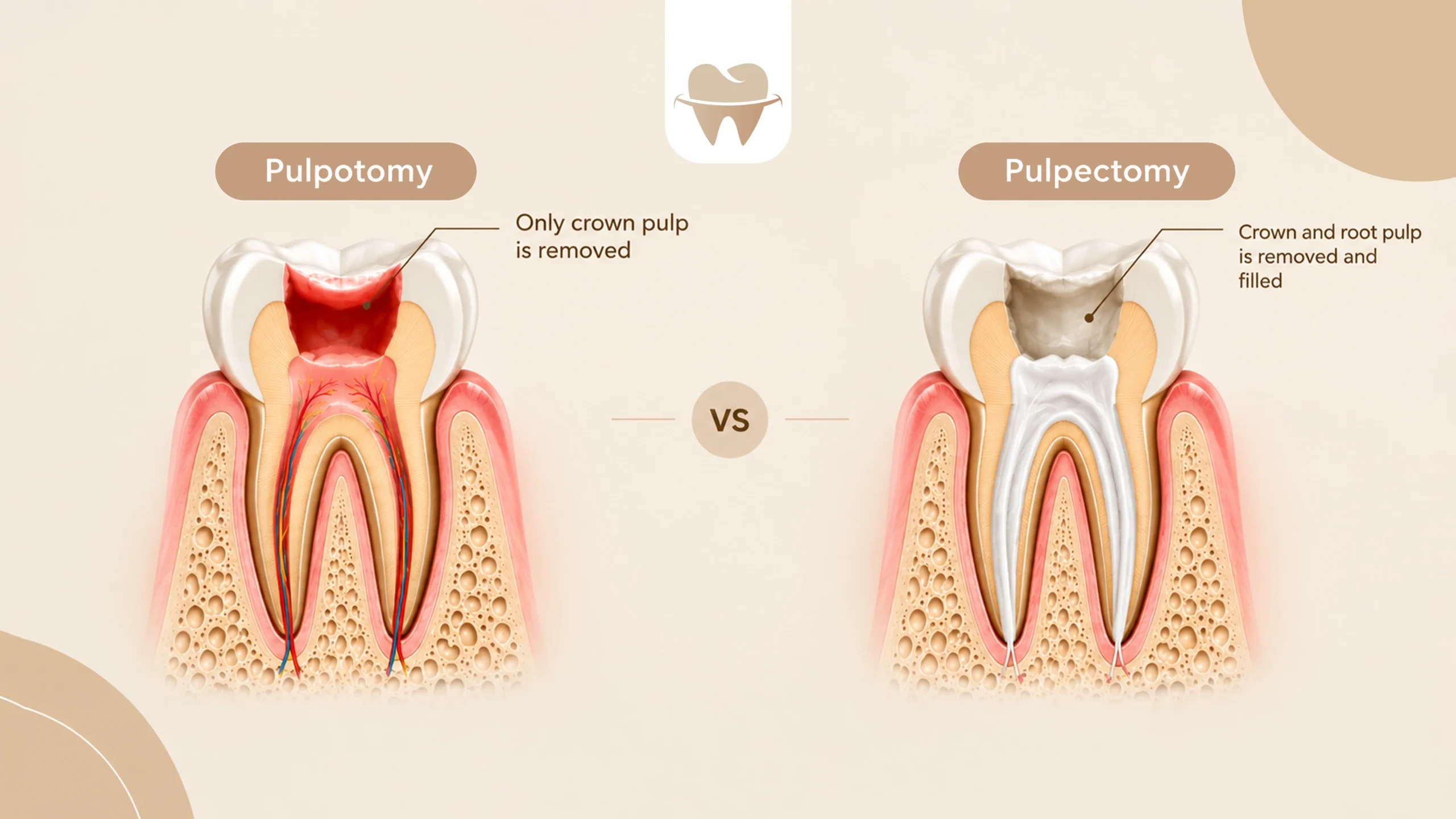
- The main difference between pulpotomy and pulpectomy is how much pulp is removed. Pulpotomy removes only the crown pulp; pulpectomy removes all of it including the root canals.
- Pulpotomy is the preferred first-line treatment when the infection is limited to the crown portion of the pulp.
- Pulpectomy is required when infection has spread into the root canals or the pulp is completely non-vital.
- Recent clinical research published in BMC Oral Health (2024) found pulpotomy to be a viable, minimally invasive alternative to pulpectomy even in cases of symptomatic irreversible pulpitis.
- Baby teeth are worth saving. They hold space for permanent teeth and affect speech, chewing, and facial development.
- Both procedures are performed under local anaesthetic and are not painful during treatment.
Your child’s baby teeth matter more than most parents realise.
They are not just placeholders. Baby teeth guide the eruption of permanent teeth, maintain the spacing of the dental arch, support normal speech development, and allow a child to chew properly. Losing them too early has real consequences, and the most common reason baby teeth are lost prematurely is untreated tooth decay reaching the pulp.
When a deep cavity or trauma in a baby tooth reaches the pulp, the soft tissue at the centre containing nerves and blood vessels, two treatments can save the tooth: pulpotomy or pulpectomy. Understanding the difference between pulpotomy and pulpectomy helps parents know what their child’s dentist is recommending, why, and what to expect.
What Is the Dental Pulp?
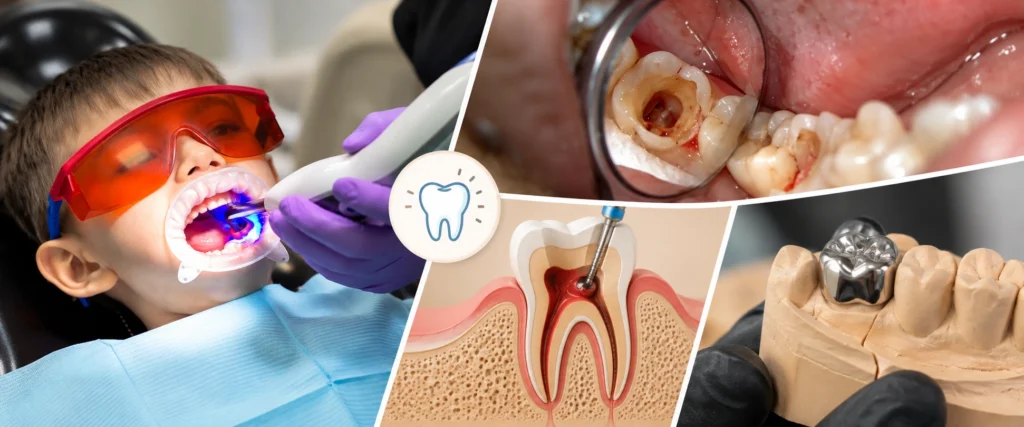
The dental pulp is the soft tissue at the centre of every tooth. It runs from the crown, the visible portion of the tooth, down through the root canals to the tip of the root.
It contains blood vessels, nerve fibres, and connective tissue. In a healthy tooth, the pulp is responsible for sensation. It is why teeth feel hot, cold, and pressure. In a baby tooth, the pulp also plays a role in root development.
When bacteria from deep tooth decay penetrate to the pulp, they cause infection and inflammation. The pulp cannot heal itself once bacteria reach it. Without treatment, the infection spreads, into the root, into the surrounding bone, and potentially to the emerging permanent tooth beneath.
This is why treating infected tooth pulp promptly matters. The window for a conservative procedure is not indefinite.
What Is a Pulpotomy?
A pulpotomy is a partial pulp removal procedure. It removes the infected or inflamed coronal pulp. The pulp tissue in the crown of the tooth while leaving the healthy pulp in the root canals intact.
A bioactive medicament is placed over the remaining root pulp after haemostasis is achieved. The most used materials are Mineral Trioxide Aggregate (MTA), Biodentine (calcium silicate cement), and formocresol, depending on the clinic and the specific case. The tooth is then restored, usually with a stainless-steel crown.
Pulpotomy is the treatment of choice when:
- The infection or inflammation is limited to the coronal pulp
- The root pulp is still vital and free from infection
- Bleeding from the pulp stops within a few minutes of amputation
- There is no sign of bone involvement on the X-ray
Pulpotomy in children is the most performed pulp treatment in paediatric dentistry. It is faster, technically simpler, and better tolerated by young patients than pulpectomy.
What Is a Pulpectomy?
A pulpectomy is a complete pulp removal procedure. It removes all pulp tissue, both the coronal portion and the entire root canal system, cleans and shapes the root canals and fills them with a resorbable material.
The resorbable filling material, typically Metapex (calcium hydroxide with iodoform) or Vitapex is critical. Baby teeth eventually fall out, and their roots resorb as permanent teeth erupt beneath them. The filling material must resorb alongside the root. So, it does not interfere with permanent tooth eruption.
After pulpectomy, the tooth is restored again. Typically, with a stainless-steel crown to protect the weakened structure.
Pulpectomy treatment is required when:
- The infection has spread beyond the crown pulp into the root canals
- The pulp is partially or completely necrotic (non-vital)
- Bleeding does not stop after pulp amputation, indicating radicular infection
- X-ray shows signs of bone involvement, internal resorption, or periapical pathology
- The child has spontaneous pain, swelling, or a sinus tract (pimple on the gum)
Pulpotomy vs Pulpectomy: The Core Difference
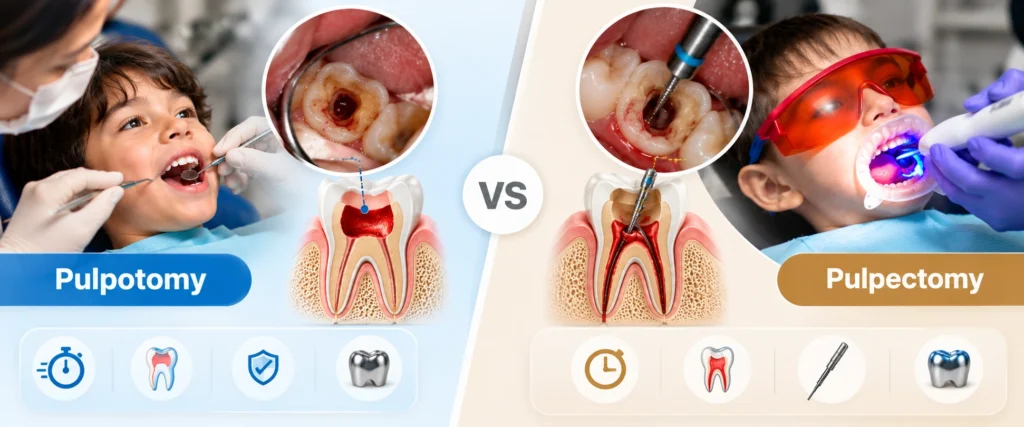
The fundamental difference between pulpotomy and pulpectomy is the extent of pulp tissue removed.
| Factor | Pulpotomy | Pulpectomy |
|---|---|---|
| Pulp removed | Coronal pulp only | All pulp (coronal + radicular) |
| Root canals treated | No | Yes, cleaned and filled |
| Clinical indication | Vital pulp, limited infection | Non-vital or extensively infected pulp |
| Procedure time | Shorter (30–45 minutes) | Longer (45–75 minutes) |
| Technical complexity | Moderate | Higher |
| Child tolerance | Better | More demanding |
| Filling material | MTA, Biodentine, formocresol | Metapex, Vitapex (resorbable) |
| Restoration after | Stainless steel crown | Stainless steel crown |
| Recovery | Minimal | Slightly more discomfort post-op |
| Success rate | 77–90% at 4 years | 53–82% depending on material |
Pulpotomy Procedure: What Happens Step by Step
Understanding the pulpotomy procedure reduces anxiety for both parents and children.
Step 1: Local Anaesthetic
The area around the tooth is numbed with local anaesthetic. The child feels pressure and movement but not pain. Topical anaesthetic gel is applied to the gum before the injection to minimise discomfort. Most children tolerate this well.
Step 2: Rubber Dam Placement
A small rubber sheet isolates the tooth and keeps the area clean and dry. It also prevents the child from swallowing anything during the procedure.
Step 3: Removing Decay
All decay is removed from the tooth using a dental drill. The access cavity is opened to reach the pulp chamber.
Step 4: Pulp Amputation
The coronal pulp, the portion in the crown of the tooth, is removed using a spoon excavator or bur. The radicular pulp in the root canals remains in place.
Step 5: Haemostasis
Bleeding from the remaining root pulp is controlled using a moist cotton pellet. If bleeding stops within a few minutes, the root pulp is considered vital and healthy, confirming that pulpotomy is the appropriate procedure. If bleeding does not stop, a pulpectomy is indicated instead.
Step 6: Medicament Placement
A bioactive medicament (MTA, Biodentine, or formocresol) is placed over the root pulp stumps. This seals and protects the remaining pulp.
Step 7: Restoration
The access cavity is sealed and the tooth is restored. In most cases, a stainless-steel crown is placed over the tooth at the same appointment. The crown protects the weakened tooth structure and significantly improves the longevity of the pulpotomy.
Pulpectomy Treatment: What Happens Step by Step
Here is the step-by-step procedure of pulpectomy:
Step 1: Local Anaesthetic and Rubber Dam
Same as pulpotomy. Local anaesthetic, topical gel, and rubber dam placement.
Step 2: Access and Decay Removal
All decay is removed and the pulp chamber is accessed.
Step 3: Complete Pulp Removal
All pulp tissue, coronal and radicular, is removed using barbed broaches and endodontic files. In baby teeth, the root canal system is complex, ribbon-like, and tortuous. This makes pulpectomy technically more demanding in primary teeth than in permanent teeth.
Step 4: Canal Irrigation and Shaping
The root canals are irrigated with antiseptic solution and shaped with small endodontic files to remove infected tissue.
Step 5: Canal Obturation
The cleaned root canals are filled with a resorbable paste, Metapex or Vitapex. It is essential that this material resorbs alongside the baby tooth root so that the permanent tooth can erupt normally beneath it.
Step 6: Restoration
The tooth is sealed and restored with a stainless-steel crown.
Signs That a Child’s Tooth Pulp Is Infected
Parents are often the first to notice something is wrong. These are the signs that a child may have infected tooth pulp and needs prompt dental assessment:
| Sign | What It Suggests |
|---|---|
| Spontaneous toothache, unprovoked | Pulp inflammation or infection |
| Pain waking the child at night | Pulpitis, inflamed or infected pulp |
| Pain lasting more than 30 seconds after cold | Irreversible pulpitis |
| Swelling of the gum near the tooth | Abscess forming, infection spreading |
| Pimple-like bump on the gum | Sinus tract, sign of existing abscess |
| Tooth that looks dark or grey | Pulp necrosis, pulp has died |
| Child refusing to eat on one side | Pain with biting or chewing |
| Bad taste coming from a specific tooth area | Possible discharge from infection |
A deep cavity in a baby tooth does not always cause symptoms. Some pulp infections develop silently, which is why regular dental check-ups with X-rays are the most reliable way to catch these before they require more extensive treatment.
Pulpectomy vs Pulpotomy Recovery Time
One of the most common parent questions is what to expect after each procedure.
Pulpotomy Recovery
Recovery after pulpotomy in baby teeth is typically straightforward.
- Mild soreness or sensitivity for 24 to 48 hours is normal
- The local anaesthetic wears off within 2 to 4 hours, keep the child away from hot foods during this time to avoid accidental burning
- Most children return to normal eating within 24 to 48 hours
- Significant or worsening pain beyond 48 hours is not expected and should be reviewed
Pulpectomy Recovery
Recovery after pulpectomy treatment is slightly longer.
- Soreness and mild swelling for 2 to 4 days is typical
- Standard children’s pain relief (paracetamol or ibuprofen at age-appropriate doses) manages discomfort effectively
- The tooth and jaw may feel tender for 3 to 5 days
- Full recovery in most cases within one week
- Any swelling, fever, or worsening pain after 48 hours should be reviewed promptly
| Recovery Factor | Pulpotomy | Pulpectomy |
|---|---|---|
| Typical discomfort duration | 24–48 hours | 3–5 days |
| Swelling expected | Minimal | Mild, possible |
| Return to normal eating | 1–2 days | 3–5 days |
| Follow-up X-ray needed | Yes, 6–12 months | Yes, 6–12 months |
| Signs needing review | Pain after 48 hours | Pain or swelling after 48 hours |
Pulpectomy vs Pulpotomy Aftercare
Both procedures require similar aftercare at home. These guidelines apply to both:
- Pain management. Children’s ibuprofen or paracetamol at age-appropriate doses as needed. Do not give aspirin to children. Follow the dosage on the packaging or as directed by your dentist.
- Soft foods for 24–48 hours. Avoid hard, crunchy, or chewy foods on the treated side for at least two days. Soft options, rice, yoghurt, mashed vegetables, soup, soft bread are ideal.
- Avoid hot foods and drinks while the anaesthetic is still wearing off. A numbed mouth cannot register heat accurately. Burns inside the mouth are a real risk in the first 2 to 4 hours.
- Oral hygiene. Continue brushing twice daily with a child-appropriate fluoride toothpaste. Brush gently around the treated tooth. Do not avoid the area entirely. Keeping it clean supports healing.
- Stainless steel crown care. If a crown was placed, it is fully functional immediately. Avoid sticky sweets and chewing gum. These can dislodge the crown. If the crown comes off, bring the child in promptly.
- Follow-up appointment. A review appointment at 6 to 12 months is standard for both procedures. An X-ray confirms the treatment is successful and the tooth is healthy.
How a Dentist Decides Between Pulpotomy and Pulpectomy
The decision is clinical, based on the examination, the symptoms, and the X-ray findings. A dentist cannot always determine which procedure is needed before beginning treatment. The haemostasis test during pulp amputation is often the deciding factor.
Pulpotomy is chosen when:
- The cavity is deep, but the child has had no spontaneous pain
- The tooth has mild sensitivity to cold that resolves quickly
- The X-ray shows no bone changes, no resorption, no widening of the periodontal ligament space
- Bleeding stops within minutes after pulp amputation
Pulpectomy is chosen when:
- The child has spontaneous pain or pain that wakes them at night
- There is visible swelling, a sinus tract, or tooth mobility
- The X-ray shows bone changes, furcal involvement, or periapical pathology
- Bleeding does not stop after pulp amputation, indicating the root pulp is also infected
Sometimes, a dentist for kids begins a pulpotomy and converts to a pulpectomy mid-procedure when the clinical picture reveals more extensive infection than was apparent before treatment. This is not a clinical error. It is appropriate clinical decision-making in real time.
Does a Baby Tooth Need a Crown After Pulpotomy or Pulpectomy?
Yes, in almost all cases. Both procedures weaken the tooth structure. The access cavity through the crown removes a significant amount of tooth substance. Without a crown, the tooth is at high risk of fracturing under normal biting forces. If the tooth is lost regardless, a space maintainer may be needed to hold room for the permanent tooth.
A stainless-steel crown is the restoration of choice for both pulpotomy in baby teeth and pulpectomy treatment. It is:
- Durable enough to last until the tooth naturally exfoliates
- Easy to place in a single appointment
- Cost-effective
- Proven to significantly improve the long-term success rate of both procedures
Final Word
Pulpotomy and pulpectomy are both effective ways to save a baby tooth when decay or trauma has reached the pulp. They are not competing treatments. They are different responses to different stages of the same problem.
The right procedure depends on how far the infection has progressed. The right time to assess that is before the tooth becomes an emergency.
If your child has tooth pain, a visible dark spot on a tooth, or a swollen gum, do not wait. Early treatment means a simpler procedure, a shorter appointment, and better odds for the tooth. Our paediatric dental team can assess your child promptly.
Book a Paediatric Dental Assessment at Teeth & Gums, DHA Phase 6, Lahore
Frequently Asked Questions
What is the main difference between pulpotomy and pulpectomy?
The main difference is how much pulp is removed. A pulpotomy removes only the coronal pulp (the portion in the crown of the tooth) while leaving the healthy root pulp intact. A pulpectomy removes all pulp tissue, including the entire root canal system, and fills the canals with a resorbable material.
Is pulpotomy better than pulpectomy for kids?
Pulpotomy is preferred when clinically appropriate. It is less invasive, technically simpler, faster, and better tolerated by young children. A 2024 cohort study in BMC Oral Health found pulpotomy showed significantly better survival rates than pulpectomy at 48 months. When infection has spread to the root canals, however, pulpectomy is necessary regardless of preference.
When is a pulpectomy necessary for a baby tooth?
Pulpectomy is necessary when the infection has spread beyond the coronal pulp into the root canals, when the tooth pulp is partially or completely non-vital, when bleeding does not stop during pulp amputation, or when the X-ray shows bone changes, furcal involvement, or abscess formation. Spontaneous pain and swelling are strong indicators.
What is the main difference between pulpotomy, pulpectomy, and root canal?
A pulpotomy removes coronal pulp only and is specific to baby teeth or young permanent teeth. A pulpectomy removes all pulp in a baby tooth and fills the canals with resorbable material. A root canal, in permanent teeth, removes all pulp and fills the canals with a non-resorbable material (gutta-percha). Root canal treatment is not performed on baby teeth.
Are pulpotomy and pulpectomy painful?
Both procedures are performed under local anaesthetic. The child should not feel pain during the procedure, only pressure and movement. Some children are anxious about the injection, which is why topical anaesthetic gel is applied first. Post-procedure soreness for 24 to 48 hours after pulpotomy and 3 to 5 days after pulpectomy is normal and managed with children’s pain relief.
Can a baby tooth need a crown after pulpotomy?
Yes, almost always. A stainless-steel crown is placed after both pulpotomy and pulpectomy to protect the weakened tooth structure from fracture. Research consistently shows that crowning the treated tooth significantly improves its long-term survival. At Teeth & Gums, the crown is placed at the same appointment wherever clinically possible.
Does a pulpectomy save a baby tooth?
Yes, pulpectomy is a tooth-saving procedure. It removes all infected pulp tissue, cleans and fills the root canals with resorbable material, and restores the tooth with a crown. The goal is to keep the baby tooth functional until it naturally falls out and the permanent tooth erupts beneath it. Success rates vary by material and case severity.
What are the signs that a child’s tooth pulp is infected?
Key signs include spontaneous toothache, pain waking the child at night, pain lasting more than 30 seconds after cold, a pimple-like swelling on the gum, tooth darkening or discolouration, facial swelling near the tooth, or a child refusing to eat on one side. Some infections develop silently and are found only on routine X-ray.
Can a pulpotomy fail?
Pulpotomy can fail if the infection was more extensive than the pre-treatment assessment indicated, if the remaining root pulp was not truly vital, or if the crown restoration is lost or damaged. Signs of failure include return of pain, swelling, X-ray changes at the root, or gum sinus tract. A failed pulpotomy is usually managed with pulpectomy or extraction.
What should a child eat after pulpotomy or pulpectomy?
Soft foods for 24 to 48 hours. Rice, yoghurt, soup, mashed vegetables, soft bread, bananas. Avoid hard, crunchy, or chewy food on the treated side. Avoid hot food and drinks while the anaesthetic is still active. Resume a normal diet once the child is comfortable, typically within 2 to 3 days for pulpotomy and 4 to 5 days for pulpectomy.
How does a dentist decide between pulpotomy and pulpectomy?
The decision is based on symptoms, clinical examination, and X-ray findings. A child with spontaneous pain, swelling, or X-ray bone changes is more likely to need pulpectomy. A child with a deep cavity but no spontaneous pain may be suitable for pulpotomy. The haemostasis test during the procedure is often the final deciding factor, if bleeding stops, pulpotomy proceeds. If it does not, pulpectomy is performed instead.