TL;DR
- Dental space maintainers hold open the gap left by a prematurely lost baby tooth, preventing adjacent teeth from shifting and blocking the permanent tooth’s path.
- Types of dental space maintainers include band and loop, crown and loop, distal shoe, lingual arch, and removable appliances.
- Do space maintainers hurt teeth? Placement is painless; mild discomfort like a “foreign body” sensation may occur for a few days.
- Cost ranges from $150–$500 in the US, far less than the $5,000–$7,500+ cost of braces and corrective orthodontics later.
- How long does a child wear a space maintainer? Typically, 1–3 years, until the permanent tooth erupts.
- Not every child who loses a baby tooth early needs a space maintainer; front teeth (incisors) generally do not require one, while back teeth (molars) almost always do.
A child loses a baby tooth years before the permanent one is ready to come in. You might assume it is just a normal part of growing up, one less tooth to brush. But when a baby tooth falls out too early, whether due to decay or trauma, the neighbouring teeth can drift into the empty space. The permanent tooth, when it finally attempts to erupt, finds its path blocked.
This is where a dental space maintainer steps in. It acts as a placeholder, preserving the gap until the adult tooth is ready to emerge. Space maintainers are one of the most effective and cost-saving interventions in pediatric dentistry. Investing in a simple appliance now can prevent years of braces and complex orthodontic treatment later.
Quick answer: A dental space maintainer is a small appliance that holds open the space left by a baby tooth lost too early, so it does not close up and block the permanent tooth underneath. Fixed types like the band and loop are most common for younger children, stay in place for about 1 to 3 years, and cost far less than the braces or surgery often needed if the gap is left unmanaged.
What Are Dental Space Maintainers?
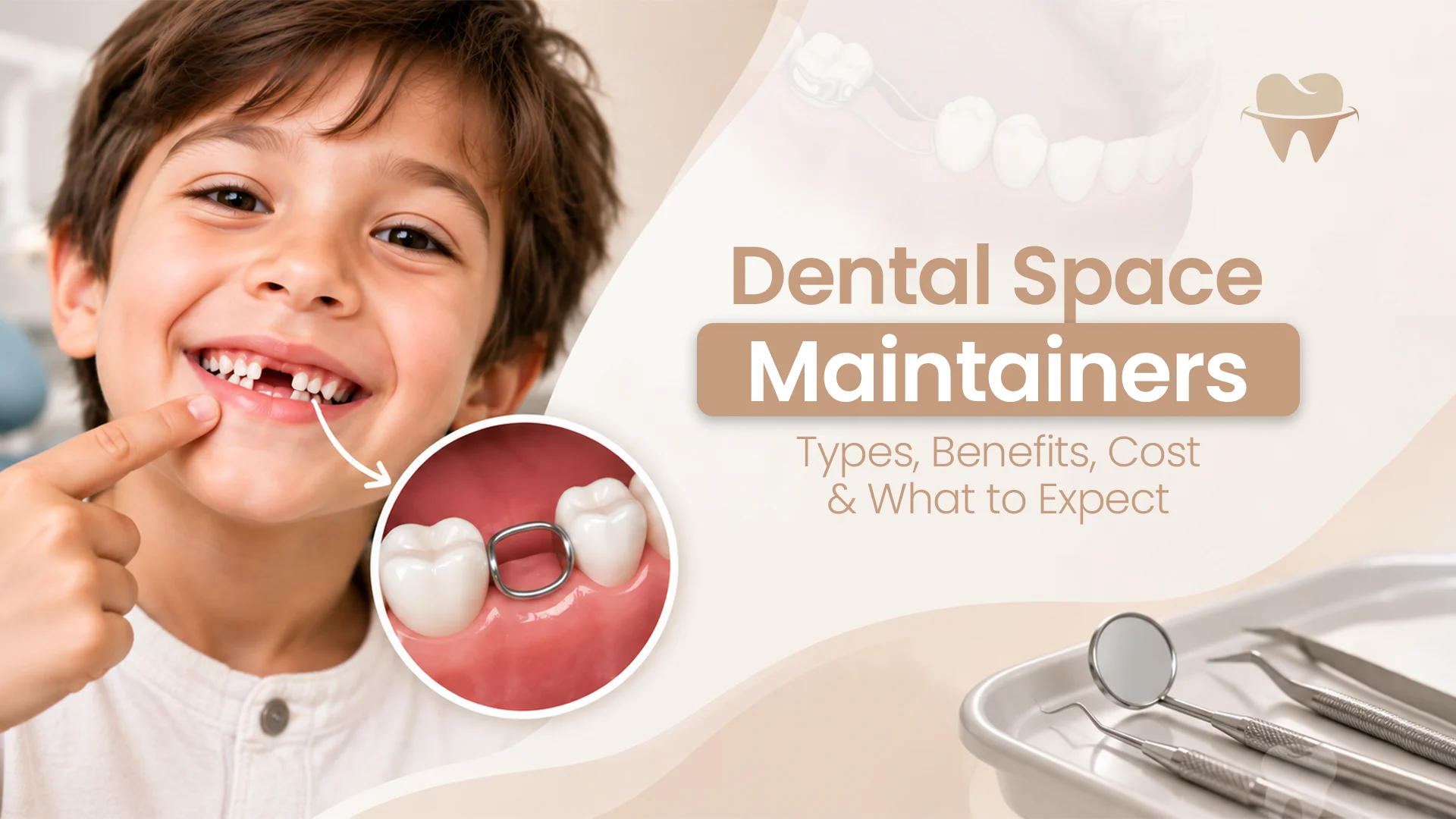
A dental space maintainer is a custom-made orthodontic appliance designed to hold open the space left by a prematurely lost baby tooth. It prevents the adjacent teeth from shifting into the gap and blocking the permanent tooth’s path.
Why Does a Child Need a Space Maintainer?
When a primary tooth is lost too early, the surrounding teeth can drift into the empty space. This narrows the arch and blocks the permanent successor from erupting properly. The consequences can include:
- Impacted permanent teeth: the adult tooth becomes trapped beneath the gum or bone.
- Crowding and misalignment: crooked teeth and bite problems develop.
- The need for braces later: orthodontic correction typically costs far more than placing a space maintainer early.
What Happens If a Baby Tooth Is Lost Too Early?
If a baby tooth is lost prematurely and no space maintainer is placed, the adjacent teeth gradually tilt or drift into the gap. This can partially or completely block the permanent tooth from erupting in the correct position.
In some cases, the permanent tooth becomes impacted, requiring surgical exposure and orthodontic treatment to guide it into place. The cost and treatment time for these corrective procedures are significantly higher than early space maintenance.
Types of Dental Space Maintainers
Types of dental space maintainers fall into two main categories: fixed and removable. The choice depends on the child’s age, maturity, which tooth was lost, and how long the space needs to be held.
Fixed Space Maintainers
Fixed appliances are semi-permanently cemented onto adjacent teeth and remain in place until the dentist removes them. They are the most common choice for younger children because they do not depend on the child remembering to wear them.
1. Band and Loop Space Maintainer. A metal band wraps around a neighbouring tooth, and a wire loop extends across the gap. This is the most frequently used pediatric space maintainer when a single back tooth (molar or premolar) is lost. Studies report a success rate of 86.6% for conventional band and loop at 12 months follow-up.
2. Crown and Loop Space Maintainer. Similar to a band and loop, but the anchor tooth receives a stainless-steel crown instead of a band. This is often chosen when the anchor tooth also has decay that requires a crown.
3. Distal Shoe Space Maintainer. A specialised device used when a child loses a primary second molar before the permanent first molar (six-year molar) has erupted. A small metal guide is inserted just beneath the gum to direct the erupting permanent molar into the correct spot.
4. Lingual Holding Arch. A wire connects bands on both lower molars, running along the tongue side of the teeth. It holds space on both sides of the lower jaw at once, a bilateral space maintainer for children who lose multiple baby teeth.
5. Transpalatal Arch / Nance Palatal Arch. Similar to a lingual arch but used in the upper jaw. A wire connects bands on both upper molars. The Nance appliance includes a small acrylic button resting against the roof of the mouth for added stability.
Removable Space Maintainers
Removable space maintainers look similar to an orthodontic retainer and can be taken out for eating and cleaning. They are typically recommended for older, more responsible children, or when a front tooth is missing and an artificial tooth is added for appearance. However, removable devices carry a higher risk of loss or damage, with studies showing failure rates as high as 59.7% due to misuse.
Dental Space Maintainer Procedure: What to Expect
The process of getting a space maintainer is straightforward and child-friendly. Understanding each step helps parents prepare their child for a smooth, stress-free experience.
Step 1: Consultation and Diagnosis
The journey begins with a comprehensive evaluation by a pediatric dentist or orthodontist. Your child’s dentist will examine the mouth, review the dental history, and assess the space left by the prematurely lost baby tooth.
An X-ray is taken to check the position and development stage of the permanent tooth beneath the gum, revealing how much space is available and whether it is developing normally.
What parents should know: this first visit is about information gathering. The dentist will explain why a space maintainer is recommended, what type would work best for your child, and what the timeline looks like.
Step 2: Impression or Digital Scan
Once the decision is made to proceed, the dentist needs an accurate model of your child’s teeth to design a custom appliance. Two methods are available.
Traditional impressions: a tray filled with soft, putty-like material is placed over the teeth to create a mould. This method can be uncomfortable for some children, causing a gag reflex due to the texture and the need to hold still for a minute or two.
Digital scans (intraoral scanners): Many modern clinics now use advanced intraoral scanners, a small handheld device that captures thousands of images of the teeth in seconds. The process is fast, comfortable, and completely eliminates the gag-inducing putty and cold material. For children who are anxious or sensitive, digital scanning is a significantly better experience.
What parents should know: if your child is prone to gagging or has dental anxiety, ask the clinic if they offer digital scanning. It makes the process much smoother for young patients.
Step 3: Fabrication
After the impression or scan is taken, the appliance is custom-created in a dental laboratory using precise measurements to fit your child’s mouth. This step typically takes 1 to 2 weeks, depending on the lab’s schedule and the type of appliance being made. During this time, the space in your child’s mouth remains open and can be monitored by the dentist.
What parents should know: the fabrication phase is entirely behind the scenes. Your child does not need to visit the clinic during this time.
Step 4: Placement
Once the custom appliance is ready, your child returns to the clinic for placement. The dentist ensures the appliance fits securely and comfortably. For fixed space maintainers, the band is cemented onto the anchor tooth, and the wire loop is adjusted to sit just in contact with the adjacent tooth.
The entire appointment is quick, typically 15 to 30 minutes, and no shots are required in most cases. The dentist will check your child’s bite and make any necessary adjustments.
What parents should know: some children may feel a foreign-body sensation for the first day or two, like a piece of food stuck between their teeth. This is normal and usually resolves as the child adjusts. The dentist will provide care instructions, including how to clean around the appliance and which foods to avoid.
Step 5: Follow-Up Visits
Regular check-ups are essential to ensure the space maintainer is functioning properly and to monitor your child’s dental development. During these visits, the dentist will check that the appliance remains securely in place, examine the surrounding teeth and gums for hygiene issues, take periodic X-rays to monitor the eruption progress of the permanent tooth, and determine when the appliance can be removed.
The appliance typically stays in place until the permanent tooth begins to erupt, usually 1 to 3 years depending on the child’s age and which tooth was lost. Your dentist will schedule follow-ups every 4 to 6 months to track progress.
What parents should know: regular check-ups are not just about the appliance, they are about catching any issues early. Do not skip these appointments; they are key to ensuring your child’s permanent teeth come in correctly.
What Parents Should Expect Overall
| Step | What happens | Child’s experience | Parent’s role |
|---|---|---|---|
| Consultation | Exam and X-ray | Quick, non-invasive | Provide dental history; ask questions |
| Impression / scan | Mould or digital images | May gag with traditional; comfortable with digital | Request digital scan if available |
| Fabrication | Lab creation | No visit required | Wait 1 to 2 weeks |
| Placement | Appliance cemented or fitted | No shots; mild pressure; quick appointment | Care instructions; food restrictions |
| Follow-ups | Check-ups every 4 to 6 months | Quick exam and X-rays | Ensure good oral hygiene; report any issues |
Do Space Maintainers Hurt Teeth?
It is a common question from parents. The placement procedure itself is painless, and no shots are typically required for a band and loop. Some children may experience a foreign-body sensation, like a piece of food stuck between teeth, for the first few days.
Their tongue may play with the wire, or their speech might be slightly altered temporarily as the mouth adapts. This discomfort is mild and resolves as the child becomes accustomed to the appliance.
How Long Does a Child Wear a Space Maintainer?
The appliance typically stays in until the adult tooth starts to poke through, usually 1 to 3 years. For back molars, the maintainer may remain in place for 2 to 3 years. Follow-up X-rays are taken periodically to track the progress of the developing permanent tooth.
Dental Space Maintainer Cost
Dental space maintainer cost varies based on the type of appliance, clinic location, and materials used. As a general reference point, costs in the US typically range from 150 to 500 US dollars per device, with a band and loop at the lower end of the range and distal shoe appliances costing more.
Space maintainers remain one of the best investments in pediatric dentistry, since even a few hundred dollars for a maintainer is a fraction of what braces, surgical exposure, and corrective orthodontics can cost later. For an accurate, local figure, ask your dentist for a written quote at your child’s consultation.
Benefits of Dental Space Maintainers
Space maintainers offer multiple long-term advantages:
- Maintain space for permanent teeth
- Prevent crowding and misalignment
- Support proper jaw development
- Reduce the need for braces later
- Improve chewing efficiency and speech
Conclusion
A dental space maintainer may be small, but its impact is significant. When a baby tooth is lost early, adjacent teeth can shift within weeks, closing the space and blocking the permanent tooth’s path. Placing a space maintainer is one of the most cost-effective preventive measures in pediatric dentistry, typically far less than the cost of braces or corrective surgery later.
If your child has lost a baby tooth early, do not wait. Prompt evaluation and timely placement of a space maintainer can save years of orthodontic treatment and help ensure a healthy, confident smile for life. This article is for general education and is not a substitute for a pediatric dental examination.
Concerned about your child’s early tooth loss?
At Teeth and Gums, our pediatric dentistry team provides expert evaluation and space maintainer treatment to protect your child’s developing smile.
Frequently Asked Questions
What are space maintainers?
Space maintainers are custom-made dental appliances that hold open the space left by a prematurely lost baby tooth, preventing adjacent teeth from shifting and blocking the permanent tooth’s path.
Why does a child need a space maintainer?
If a baby tooth falls out too early, surrounding teeth can drift into the gap and block the permanent tooth from erupting properly, leading to crowding, impaction, and the need for braces later.
What happens if a baby tooth is lost too early?
The adjacent teeth can tilt or drift into the gap, narrowing the space and potentially blocking the permanent tooth. This can cause impaction, crowding, and orthodontic issues.
What are the different types of dental space maintainers?
Types include band and loop, crown and loop, distal shoe, lingual holding arch, transpalatal arch, and removable appliances.
What is a band and loop space maintainer?
A band and loop is a fixed appliance with a metal band around a neighbouring tooth and a wire loop extending across the gap. It is the most common type for single missing molars.
What is a distal shoe space maintainer?
A distal shoe is a specialised appliance used when a child loses a primary second molar before the permanent first molar has erupted. It guides the erupting permanent molar into the correct position.
Are space maintainers fixed or removable?
Both. Fixed appliances are cemented to adjacent teeth and are most common for younger children. Removable devices are reserved for older, more responsible children.
How long does a child need to wear a space maintainer?
Typically 1 to 3 years, until the permanent tooth begins to erupt. Regular X-rays are taken to monitor progress.
Is getting a dental space maintainer painful?
No. The placement is painless and usually no shots are needed. Some children may feel a mild foreign-body sensation for a few days as they adjust.
How much does a dental space maintainer cost?
Costs vary by clinic and country. As a general reference, US pricing typically ranges from 150 to 500 US dollars per device, with band and loop at the lower end and distal shoe at the higher end. Ask your dentist for a local, written quote.
Can a child eat normally with a space maintainer?
Yes, but avoid hard, sticky, or chewy foods that can bend or dislodge the appliance. Good oral hygiene is essential.
How do you clean a space maintainer?
Brush around the appliance carefully, floss between the band and the tooth, and use a water flosser to remove trapped food particles. Regular dental check-ups are essential.
What happens if a space maintainer becomes loose or breaks?
Contact your dentist immediately. Do not attempt to fix or remove it yourself.
Does every child who loses a baby tooth need a space maintainer?
No. Front teeth (incisors) generally do not require a maintainer. Back teeth (molars) almost always do because of the forces of chewing.
How do dentists decide which type of space maintainer a child needs?
The decision is based on the location of the missing tooth, the child’s age, whether multiple teeth are missing, and the child’s maturity level.
What should parents do after a child loses a baby tooth early?
Schedule a dental appointment promptly so your dentist can evaluate the space and determine if a space maintainer is needed. Early action prevents complications.