SUMMARY
- Dentures are custom appliances replacing missing teeth and gum tissue. Modern false teeth use acrylic or porcelain that mimics natural tooth appearance, color, and translucency.
- Four main denture types exist: partial dentures, complete dentures, immediate dentures, and implant-supported dentures that snap onto titanium posts for maximum stability.
- The fitting process includes consultation, impressions, wax try-in, delivery, and adjustments. Treatment takes 4-8 weeks, with proper care extending denture lifespan to 5-10 years.
Losing teeth can feel like losing a part of yourself. The hesitation before laughing, the careful selection of soft foods at restaurants, the quiet embarrassment of a denture that clicks or slips. For millions of people worldwide, these experiences are painfully familiar. But modern dentistry has transformed the landscape of tooth replacement.
Today’s false teeth, more commonly known as artificial teeth, are more comfortable, natural-looking, and functional than ever before.
Whether you’ve lost teeth to decay, gum disease, injury, or age, understanding your options is the first step toward reclaiming your smile. This comprehensive guide answers the fundamental question what dentures are, explores the various denture types, explains how they fit, and helps you make an informed decision about your oral health.
What Are Dentures?
| Term | Definition |
| Dentures | Removable or fixed dental appliances that replace missing teeth and surrounding tissues |
| False Teeth | Colloquial term for any artificial tooth replacement |
| Artificial Teeth | Prosthetic teeth made from materials like acrylic, porcelain, or resin |
| Denture Teeth | The individual prosthetic teeth are attached to the denture base |
Dentures: A Complete Overview
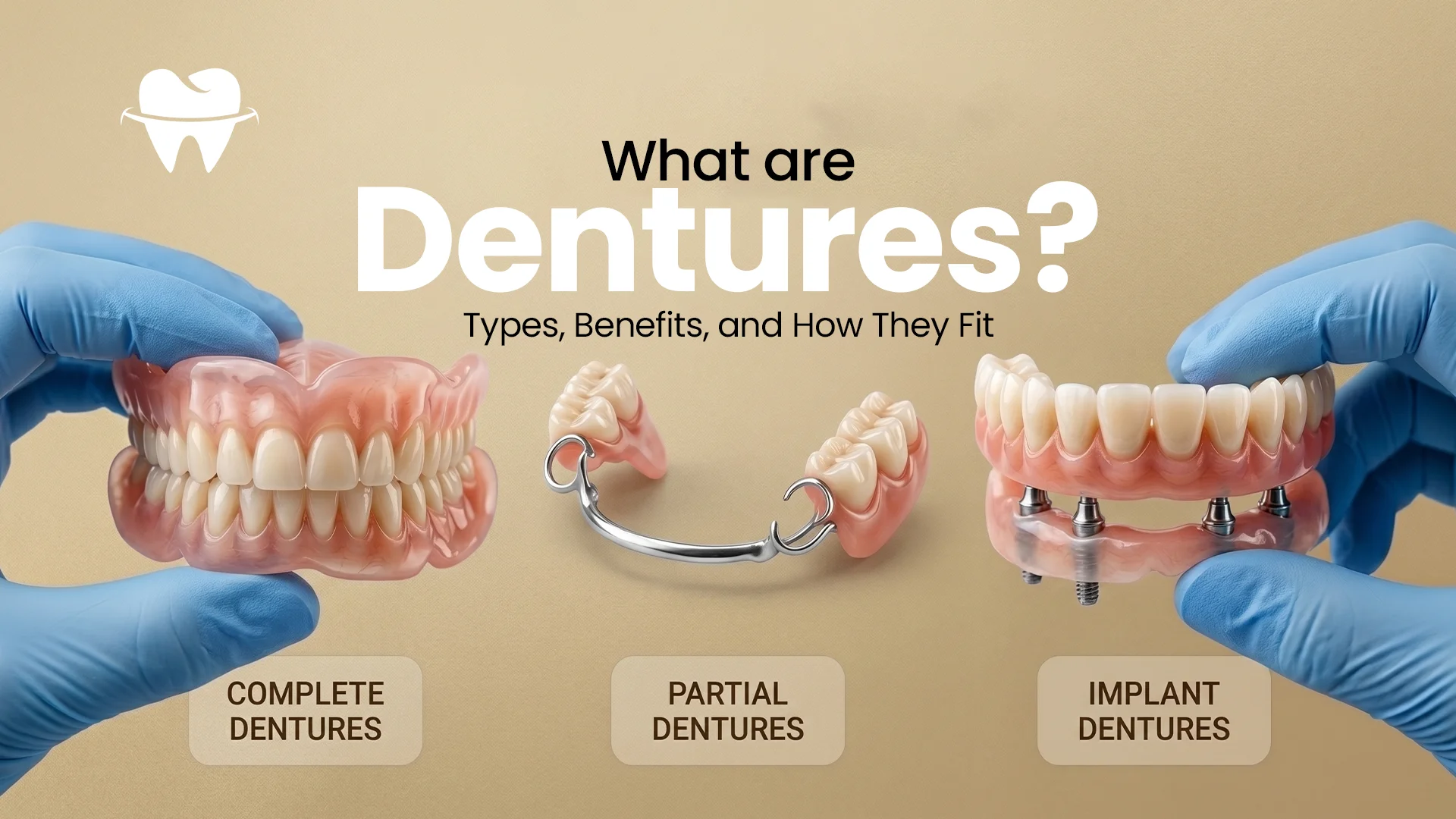
Dentures are custom-crafted dental appliances designed to replace missing teeth and restore your ability to eat, speak, and smile with confidence. Unlike dental bridges that anchor to adjacent natural teeth, dentures replace entire sections of teeth, or all of them, along with the supporting gum tissue.
Modern denture teeth are made from high-quality materials that mimic the appearance, translucency, and even the slight variations in color found in natural teeth. The base, which rests on your gums, is typically crafted from a flesh-colored acrylic resin that blends seamlessly with your oral tissues.
Whether you need to replace a few missing teeth or an entire arch, false teeth today are barely distinguishable from natural teeth, even up close.
Denture Types: Finding the Right Solution for You
Understanding the different denture types is essential for choosing the option that best suits your needs, budget, and lifestyle. Each type serves a specific purpose and comes with its own set of advantages.
Partial Dentures
Partial dentures are designed for individuals who still have some healthy natural teeth remaining. These removable appliances fill the gaps created by missing teeth while preventing the remaining natural teeth from shifting position.
Key features of partial dentures:
- Consists of replacement denture teeth attached to a gum-colored acrylic base
- Connected by a metal framework (usually cobalt chromium) or flexible material
- Secured to natural teeth using precision attachments or metal clasps
- Prevent adjacent teeth from drifting into empty spaces
- Less expensive than other tooth replacement options
Best for: People missing several teeth but still having healthy, natural teeth to support the appliance.
Complete Dentures (Full Dentures)
When all teeth in an arch are missing, complete dentures provide a full set of replacement teeth. These are traditional false teeth that many people visualize when hearing the word “dentures.”
Key features of complete dentures:
- Replace an entire upper or lower arch of teeth (or both)
- Rest entirely on the gum ridge
- Held in place by suction, muscle control, and denture adhesive
- Can be made for immediate placement after tooth extraction (immediate dentures)
Immediate Dentures
Immediate dentures are placed on the same day your remaining natural teeth are extracted. While they provide the advantage of never being without teeth, they require more adjustments as your gums heal and reshape over time.
Pros: No toothless period; immediate restoration of smile and function.
Cons: Require frequent relining or replacement after healing (typically 6-12 months).
Implant-Supported Dentures
This modern solution addresses the most common complaint about traditional dentures: instability. Implant-supported dentures snap onto small titanium posts surgically placed in your jawbone.
Key features of implant-supported dentures:
- Extremely stable—no slipping or clicking
- Preserve jawbone density by providing stimulation
- Improved chewing ability (up to 70% of natural bite force)
- No need for denture adhesives
Best for: Patients with sufficient bone density seeking maximum stability and comfort.
Denture Types Comparison Table
| Denture Type | Replaces | Stability | Removable? | Cost | Best For |
| Partial Dentures | Several missing teeth (some remain) | Good with clasps | Yes | Moderate | Patients with healthy remaining teeth |
| Complete Dentures | Entire arch (all teeth missing) | Fair (suction) | Yes | Lower | Patients with no remaining teeth |
| Immediate Dentures | Entire arch (placed same day as extraction) | Fair initially, decreases with healing | Yes | Moderate | Patients who cannot go without teeth |
| Implant-Supported Dentures | Entire arch (with implants) | Excellent | Varies (snap-on) | Higher | Patients seeking maximum stability |
Benefits of Modern Dentures
Today’s artificial teeth offer advantages that go far beyond aesthetics. Modern materials and techniques have transformed dentures into sophisticated restorations that look, feel, and function remarkably like natural teeth.
1. Restored Chewing Function
Well-fitted dentures restore your ability to enjoy a variety of foods, improving nutrition and overall health. Traditional dentures restore 20-30% of natural biting force, partial dentures offer 50-60%, and implant-supported options restore up to 70-80%.
Many patients with implant-supported false teeth report eating apples, steak, and corn on the cob with complete confidence. No more scanning menus for “soft options only” or declining dinner invitations.
2. Enhanced Speech
Missing teeth disrupt the delicate coordination of tongue, lips, and breath needed for clear speech. Sounds like “s,” “z,” “f,” “v,” and “th” are particularly affected, often resulting in lisps or distortions.
False teeth that fit properly provide essential support for your lips and tongue, restoring clear, confident articulation. Most patients adapt to new denture teeth within 1-3 weeks of regular speaking practice.
3. Facial Support and Youthful Appearance
Your teeth provide essential structural support to your entire lower face. When teeth are missing, lips collapse inward, nasolabial folds deepen, and the chin appears more prominent, adding 5-10 years to your appearance.
Artificial teeth restore this support, filling out lips and cheeks naturally. The improvement is often dramatic, with patients frequently hearing comments about looking “rested” or “healthier” without others realizing the change is dental.
4. Improved Confidence
Perhaps the most significant benefit is psychological. Missing teeth often lead to social withdrawal, suppressed laughter, photograph avoidance, and constant self-consciousness.
Modern denture types address these concerns with materials virtually indistinguishable from natural teeth. Patients report smiling freely, accepting dinner invitations, volunteering for photos, and experiencing reduced social anxiety. Many describe the transformation as “life-changing.”
5. Protecting Remaining Teeth (Partial Dentures)
When teeth are missing, remaining natural teeth gradually tilt, drift, and shift into empty spaces. This leads to bite problems, decay in hard-to-clean areas, and eventual additional tooth loss.
Partial dentures fill gaps, prevent shifting, distribute chewing forces evenly, and maintain proper spacing for easy cleaning. This proactive approach saves patients from more extensive, and expensive, future dental work while preserving the natural teeth they still have.
How Dentures Fit: The Complete Process
Understanding the fitting process answers the common question of what patients actually experience from start to finish.
Step 1: Initial Consultation and Examination
Your dentist evaluates your oral health, takes X-rays, and discusses your goals. Existing teeth that cannot be saved are identified for extraction. This visit also determines which denture types best suit your needs and budget.
Step 2: Impressions and Jaw Records
Precise impressions of your mouth are taken to create accurate models of your gums and any remaining teeth. Jaw relation records capture how your upper and lower jaws align when biting, critical for proper chewing function.
Step 3: Try-In Appointment
A wax model with denture teeth is created for you to try in your mouth. This critical appointment allows you to evaluate tooth color, shape, size, and overall appearance before the final denture is fabricated. Adjustments are easy at this stage.
Step 4: Delivery and Insertion
The finished false teeth are placed, and your dentist checks the fit, bite, and comfort. Minor adjustments are made as needed. You receive instructions for cleaning, wearing, and adapting to your new artificial teeth.
Step 5: Follow-Up Adjustments
Your gums and bone change shape after extractions or during healing. Follow-up appointments ensure your partial dentures or complete dentures continue to fit comfortably. Relining or rebasing is performed as needed, typically at 6 months and then annually.
How Long Does Fitting Take?
| Denture Type | Appointments | Total Time (approx.) |
| Partial Dentures | 3-4 visits | 3-5 weeks |
| Complete Dentures | 4-5 visits | 4-8 weeks |
| Immediate Dentures | 5+ visits (initial + post-healing) | Same-day placement; relining at 6-12 months |
| Implant-Supported Dentures | 6+ visits | 3-9 months (includes healing after implant surgery) |
Denture Steps: A Detailed Breakdown
Understanding the complete denture process helps patients know what to expect when replacing an entire arch of teeth.
| Step | What Happens | Time |
| 1. Initial Assessment | Full oral exam, X-rays, treatment planning | 1 hour |
| 2. Extractions (if needed) | Remaining unhealthy teeth are removed | 1-2 hours per arch |
| 3. Healing Period | Gums heal and reshape (if extractions were needed) | 4-8 weeks |
| 4. Primary Impressions | Preliminary molds of the mouth | 30 minutes |
| 5. Custom Tray Fabrication | Lab creates specialized impression trays | 1-2 weeks |
| 6. Final Impressions | Detailed impressions for precise fit | 45 minutes |
| 7. Jaw Relation Records | Bite registration and tooth position | 1 hour |
| 8. Wax Try-In | Test fit of tooth arrangement in wax | 30-45 minutes |
| 9. Final Processing | Lab creates finished acrylic denture | 1-2 weeks |
| 10. Delivery & Insertion | Denture placed, adjustments made | 1 hour |
| 11. Follow-Up Adjustments | Fine-tuning fit as you adapt | Ongoing |
Adjusting to Your New Denture Teeth
The first few weeks with new denture teeth require patience and practice.
Week 1: Expect increased saliva flow, minor sore spots, and difficulty with certain foods. Your tongue and cheek muscles are learning new movements.
Weeks 2-4: Most patients adapt to speaking clearly. Start with soft foods cut into small pieces. Chew evenly on both sides.
Week 6 onward: Normal eating gradually returns. Many patients report forgetting they are wearing false teeth at all.
Caring for Your Dentures
Proper care extends the life of your artificial teeth and maintains oral health.
Daily care routine:
- Remove and rinse after eating
- Brush with a soft denture brush and non-abrasive cleaner (not regular toothpaste)
- Soak overnight in water or denture cleaning solution
- Brush your gums, tongue, and any remaining natural teeth
What to avoid:
- Hot water (can warp the denture base)
- Abrasive cleaners or hard-bristled brushes
- Sleeping with dentures (increases bone loss and infection risk)
- DIY adjustments or repairs
What Are Denture Implants?
It is a common question among those seeking greater stability than traditional removable appliances. Denture implants, more accurately called implant-supported dentures, use small titanium posts surgically placed in your jawbone to anchor your artificial teeth securely.
Unlike traditional false teeth that rest entirely on your gums, implant-supported versions snap onto these posts. The implants fuse with your bone through a process called osseointegration, creating a foundation as stable as a natural tooth root.
What are denture implants offering that traditional options cannot? Elimination of slipping, clicking, and the need for denture adhesives. Many patients report feeling so secure that they forget they are wearing artificial teeth entirely.
Cost Considerations
| Denture Type | Average Cost Range (PKR) | Lifespan (with care) |
| Partial Dentures | 25,000 – 60,000 | 5-8 years |
| Complete Dentures | 35,000 – 80,000 | 5-10 years |
| Immediate Dentures | 40,000 – 90,000 | 5 years (plus post-healing replacement) |
| Implant-Supported (per arch) | 250,000 – 600,000 | 10-20 years (implant’s lifetime) |
Final Thoughts
Understanding dentures and the available denture types helps you to make informed decisions about your oral health. Modern false teeth have advanced dramatically. They look natural, fit comfortably, and restore not just function but confidence.
Whether you need partial dentures to fill a few gaps or a complete set of artificial teeth for full arch replacement, today’s solutions offer something for every need and budget. The journey requires patience, from the complete denture steps to the adjustment period, but the destination is a smile you can be proud of.
Ready to explore your tooth replacement options? At Teeth and Gums, our experienced dental team creates custom-crafted dentures that fit perfectly, look natural, and restore your confidence.
Frequently Asked Questions
What are dentures made of?
Denture teeth are typically made from high-quality acrylic resin or porcelain for natural appearance. The gum-colored base is crafted from acrylic material. Porcelain is more durable but can wear down natural opposing teeth, so acrylic is more commonly used.
How long do dentures last?
With proper care, partial dentures and complete dentures typically last 5-10 years before requiring replacement or relining. Your jawbone and gums naturally change shape over time, affecting fit even if the denture itself remains intact.
What are denture implants and how do they work?
They are titanium posts surgically placed in your jawbone that anchor your artificial teeth securely. Unlike traditional dentures that rest on gums, implant-supported versions snap onto these posts, eliminating slipping and the need for adhesives.
Can I sleep with my false teeth in?
No. Removing your false teeth at night allows your gum tissues to rest and recover. Sleeping with denture teeth increases the risk of fungal infections, bone loss, and gum irritation. Most dentists recommend nightly removal for at least 6-8 hours.
Will partial dentures affect my remaining natural teeth?
Properly designed partial dentures actually protect remaining teeth by preventing them from shifting into empty spaces. However, poor fit or inadequate cleaning can lead to decay or gum disease around the anchor teeth. Regular dental check-ups and meticulous hygiene are essential.