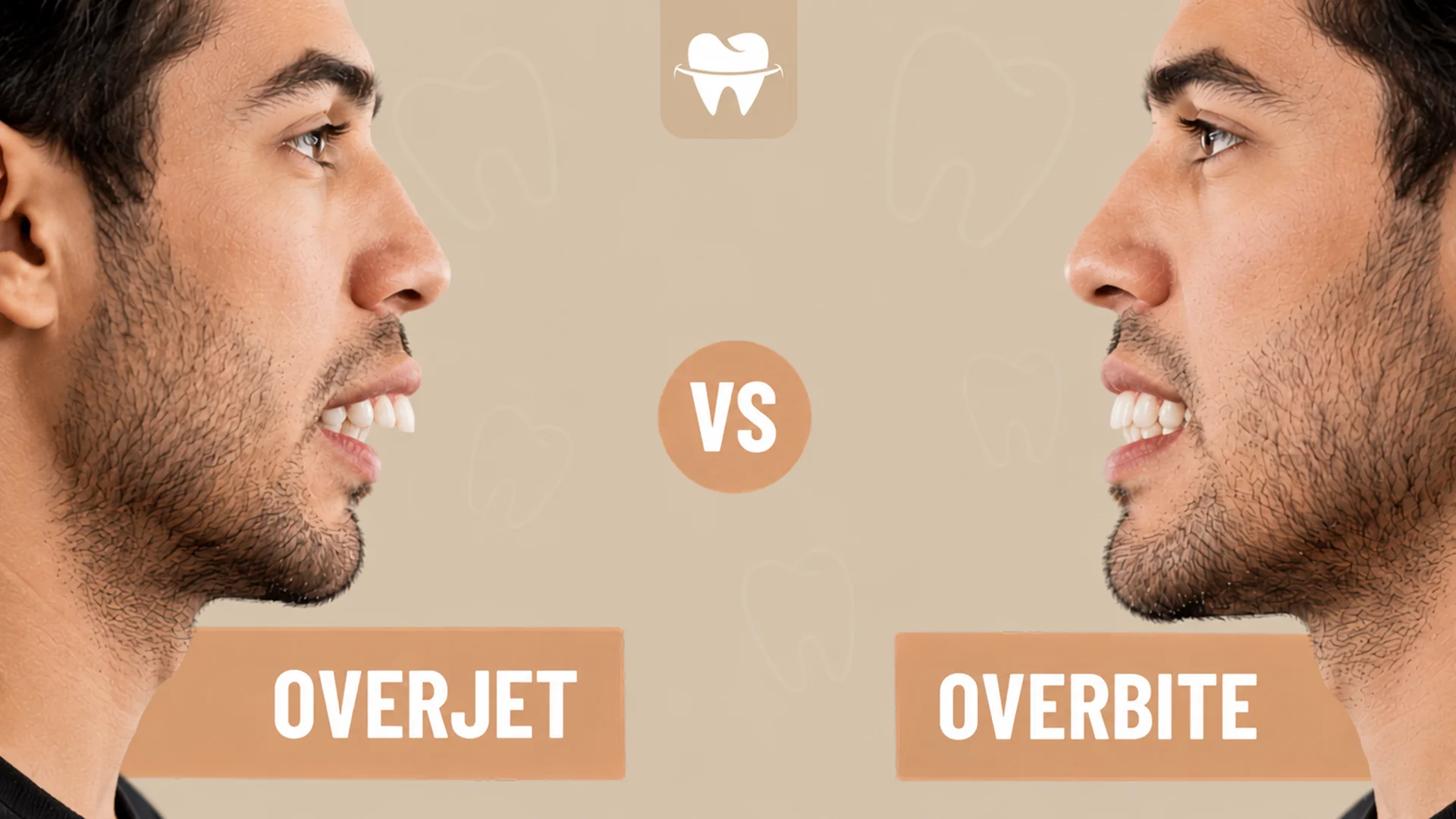
SUMMARY
- Overjet is horizontal protrusion (“buck teeth”); overbite is vertical overlap (“deep bite”).
- Overjet teeth are upper front teeth that stick out too far forward. An overbite is when upper front teeth cover too much of the lower teeth.
- Normal overjet is 1.5–2.5 mm; normal overbite is 2–4 mm. Measurements beyond these may need treatment.
- Treatment includes braces, clear aligners, orthodontic appliances, and sometimes surgery for severe cases.
- Both can affect speech, chewing, and jaw health — early intervention gives the best outcomes.
“Your child has an overbite.” If you have heard these words from a dentist or orthodontist, you are not alone.
But here is where things get interesting. Many people say “overbite” when they actually mean “overjet.” The two terms sound similar, and both involve the upper teeth overlapping the lower teeth, yet they describe completely different misalignments.
One refers to teeth that stick out too far horizontally — the classic “buck teeth” look. The other describes teeth that overlap too deeply vertically, sometimes called a “deep bite.” Understanding the overjet vs overbite distinction is essential for recognising the problem, seeking the right treatment, and achieving a healthy, functional smile.
Did you know that a healthy overjet measures only about 1.5 to 2.5 millimetres, while a normal overbite is around 2 to 4 millimetres? Many people live with measurements well outside these ranges, unaware of the potential consequences for their oral health. Let’s explore what sets these conditions apart, what causes them, and how modern orthodontics can correct both.
Quick Definitions
| Term | Definition |
|---|---|
| Overjet | Horizontal protrusion of the upper front teeth beyond the lower front teeth; commonly called “buck teeth” |
| Overbite | Vertical overlap where the upper front teeth cover too much of the lower front teeth; also called “deep bite” |
| Malocclusion | The general term for a “bad bite” or misalignment of the teeth and jaws |
| Normal overjet | 1.5 to 2.5 millimetres in most clinical definitions |
| Normal overbite | 2 to 4 millimetres of vertical overlap, or covering less than one-third of the lower teeth |
What Is an Overbite? The Vertical Overlap
An overbite is a vertical misalignment where the upper front teeth overlap the lower front teeth more than they should. A small overbite is perfectly normal — in fact, it is essential for a healthy bite. In a typical bite, the upper front teeth should slightly overlap the lower front teeth by about 2 to 4 millimetres, which helps guide the lower jaw into a proper closed position.
An overbite becomes a problem when the upper teeth cover more than 30% of the lower teeth, or roughly 4 to 6 millimetres of overlap. In severe cases, the lower front teeth may even touch the gum tissue behind the upper front teeth, causing gum damage. This is one form of malocclusion that an orthodontist can assess and correct.
Overbite Symptoms and Signs
The most obvious sign of an overbite is visible vertical overlap when you close your mouth — your upper front teeth cover most of your lower front teeth. Other signs include:
- Difficulty chewing or biting
- Increased wear on the front teeth
- Jaw pain or headaches
- Gum recession from the lower teeth contacting the palate
What Causes an Overbite?
- Genetics and jaw shape: an overbite can be inherited when the upper jaw is larger or positioned forward relative to the lower jaw.
- Teeth grinding (bruxism): clenching or grinding, especially at night, can worsen an overbite.
- Missing lower teeth: when lower teeth are absent, the remaining teeth may drift, deepening the overbite.
- Poor oral habits: prolonged thumb sucking, nail biting, or tongue thrusting beyond age three can push teeth out of alignment.
What Is an Overjet? The Horizontal Protrusion
An overjet is a horizontal misalignment where the upper front teeth protrude forward beyond the lower front teeth — the condition commonly known as “buck teeth.” A normal overjet is about 1.5 to 2.5 millimetres of horizontal distance between the upper and lower front teeth. When the upper teeth stick out more than 3.5 millimetres, it is considered excessive and may require treatment.
Overjet Symptoms and Signs
The most visible sign is the protrusion of the upper front teeth beyond the lower teeth, creating a prominent appearance. Additional signs include:
- Difficulty closing the lips comfortably
- Speech difficulties (such as a lisp)
- Higher risk of chipping or fracturing the front teeth, especially during sports or accidents
- Difficulty biting into foods
What Causes an Overjet?
- Genetics: an overjet can be passed down from parents, often due to jaw size or shape.
- Underdeveloped lower jawbone: a smaller lower jaw results in the upper teeth protruding forward.
- Childhood habits: thumb sucking, tongue thrusting, and prolonged pacifier use can push the upper teeth forward.
Overjet vs Overbite: The Key Differences
The distinction between overjet and overbite comes down to direction.
| Feature | Overjet | Overbite |
|---|---|---|
| Direction | Horizontal (teeth protrude forward) | Vertical (teeth overlap too deeply) |
| Common name | “Buck teeth” | “Deep bite” or “closed bite” |
| Normal range | 1.5–2.5 mm | 2–4 mm vertical overlap |
| What you see | Upper teeth extend diagonally beyond the lower teeth | Upper teeth cover the lower teeth vertically |
| Main risk | Chipped or fractured front teeth; speech issues | Gum damage; worn teeth; jaw pain |
Overjet vs Overbite: Can You Have Both?
Yes. It is possible to have both an overjet and an overbite at the same time. Many patients have upper teeth that both protrude forward horizontally and overlap too deeply vertically. Treatment plans for combined conditions are more complex, but still highly effective.
Overjet and Overbite Measurement: Normal Values
| Measurement | Normal range | Treatment threshold |
|---|---|---|
| Overjet | 1.5–2.5 mm | > 3.5 mm with incompetent lips |
| Overbite | 2–4 mm vertical overlap | > 3.5 mm with gingival contact |
| Overbite percentage | < 30% of lower teeth covered | > 30% or full coverage |
An overjet greater than 9 millimetres is considered “very great” and requires prompt treatment. Similarly, an overbite where the lower teeth contact the palate or cause gum trauma is graded as severe and needs intervention.
Overjet and Overbite Treatment Options
Treatment depends on the severity of the condition, the patient’s age, and whether both problems exist together. A tailored orthodontic treatment plan will match the right approach to your bite. Here are the most common options.
1. Braces
Traditional braces are the most common treatment for both overjet and overbite. By applying continuous, gentle pressure, they gradually guide the teeth into proper alignment. For severe overjets (8 to 10 millimetres or more), braces may be combined with additional appliances.
2. Clear Aligners (Invisalign)
Clear aligners are effective for mild to moderate overjets and overbites. Treatment is planned with advanced 3D software, and the aligners are changed every one to two weeks to gradually shift the teeth. For more complex cases, aligners may be used with elastics to correct bite issues. Not sure which route suits you?
3. Orthodontic Appliances
- Herbst appliance: used for an overjet caused by an underdeveloped lower jaw. This fixed appliance gradually encourages the lower jaw to grow forward.
- Carriere Distalizer: moves the upper molars backward, creating space to correct overbite and overjet without extractions.
4. Surgical Options
For severe skeletal discrepancies, jaw surgery (orthognathic surgery) may be recommended. This is typically considered when the overjet exceeds 8 to 10 millimetres, or when the lower jaw is significantly underdeveloped.
5. Tooth Extractions (In Severe Crowding)
Where severe crowding contributes to an overjet or overbite, an orthodontist may recommend extracting one or more teeth (typically premolars) to create space for proper alignment. This lets the remaining teeth shift into correct positions, reducing protrusion and improving bite function. Extractions are often combined with braces or aligners for comprehensive correction.
What If They Are Left Untreated?
Both conditions can lead to significant oral health complications if not addressed.
| Complication | Overjet | Overbite |
|---|---|---|
| Chipped or fractured teeth | High risk from protrusion | Moderate risk |
| Speech difficulties | Lisp or pronunciation issues | Less common |
| Jaw pain and headaches | Possible | Common from a misaligned bite |
| Gum damage | Less common | High risk; lower teeth may hit the palate |
| Tooth wear | Possible | Common from excessive contact |
| Sleep apnoea | Higher risk with a small lower jaw | Not directly linked |
If a misaligned bite is already causing jaw pain or headaches, it is worth having it assessed sooner rather than later.
Conclusion
Understanding the overjet vs overbite distinction is essential for recognising bite problems and seeking the right treatment. Both conditions involve the upper teeth overlapping the lower teeth, but they differ in direction: overjet is horizontal protrusion, while overbite is vertical overlap. Left untreated, both can affect your appearance, speech, chewing ability, and long-term oral health.
The good news is that modern orthodontics offers effective solutions for both — from traditional braces to clear aligners and surgical options, there is a plan for every severity level. Early intervention gives the best outcomes, but it is never too late to correct a bite issue. This article is for general education and is not a substitute for a professional examination; if you suspect you or your child has an overjet or overbite, a qualified orthodontist can determine the extent of the problem and recommend the most appropriate treatment.
Is your bite causing you concern?
At Teeth & Gums, our experienced orthodontic team specialises in diagnosing and treating overjet, overbite, and other bite misalignments. Rediscover the comfort of proper alignment.
Frequently Asked Questions
What is the difference between overjet and overbite?
Overjet is a horizontal misalignment where the upper front teeth protrude forward beyond the lower teeth. Overbite is a vertical misalignment where the upper front teeth overlap the lower teeth too deeply.
Is overjet the same as buck teeth?
Yes. Overjet is the clinical term for what is commonly called “buck teeth” — upper front teeth that stick out forward beyond the lower teeth.
What is a normal overbite measurement?
A normal overbite is roughly 2 to 4 millimetres of vertical overlap, with the upper teeth covering less than 30% of the lower front teeth.
What is a normal overjet measurement?
A normal overjet is 1.5 to 2.5 millimetres of horizontal distance between the upper and lower front teeth. Measurements above 3.5 millimetres may indicate a problem.
Can overjet and overbite occur together?
Yes. Many patients have both conditions at once, and a treatment plan can address both alignments to achieve a healthy bite.
Does overjet require treatment?
Overjet should be treated if it exceeds 3.5 millimetres, especially if it causes functional problems such as speech issues, chewing difficulty, or an increased risk of trauma to the front teeth.
Can Invisalign fix overjet and overbite?
Yes. Invisalign can effectively treat mild to moderate overjet and overbite. For more complex alignments, additional elastics or orthodontic appliances may be needed.
How is overjet measured?
Overjet is measured horizontally with a ruler or periodontal probe held parallel to the bite plane, recording the distance in millimetres from the front surface of the lower front teeth to the front surface of the upper front teeth.
How can overjet be fixed?
Overjet can be corrected with braces, clear aligners (Invisalign), orthodontic appliances such as Herbst or Carriere devices, and, in severe cases, jaw surgery. The best option depends on the severity and whether growth is still possible.