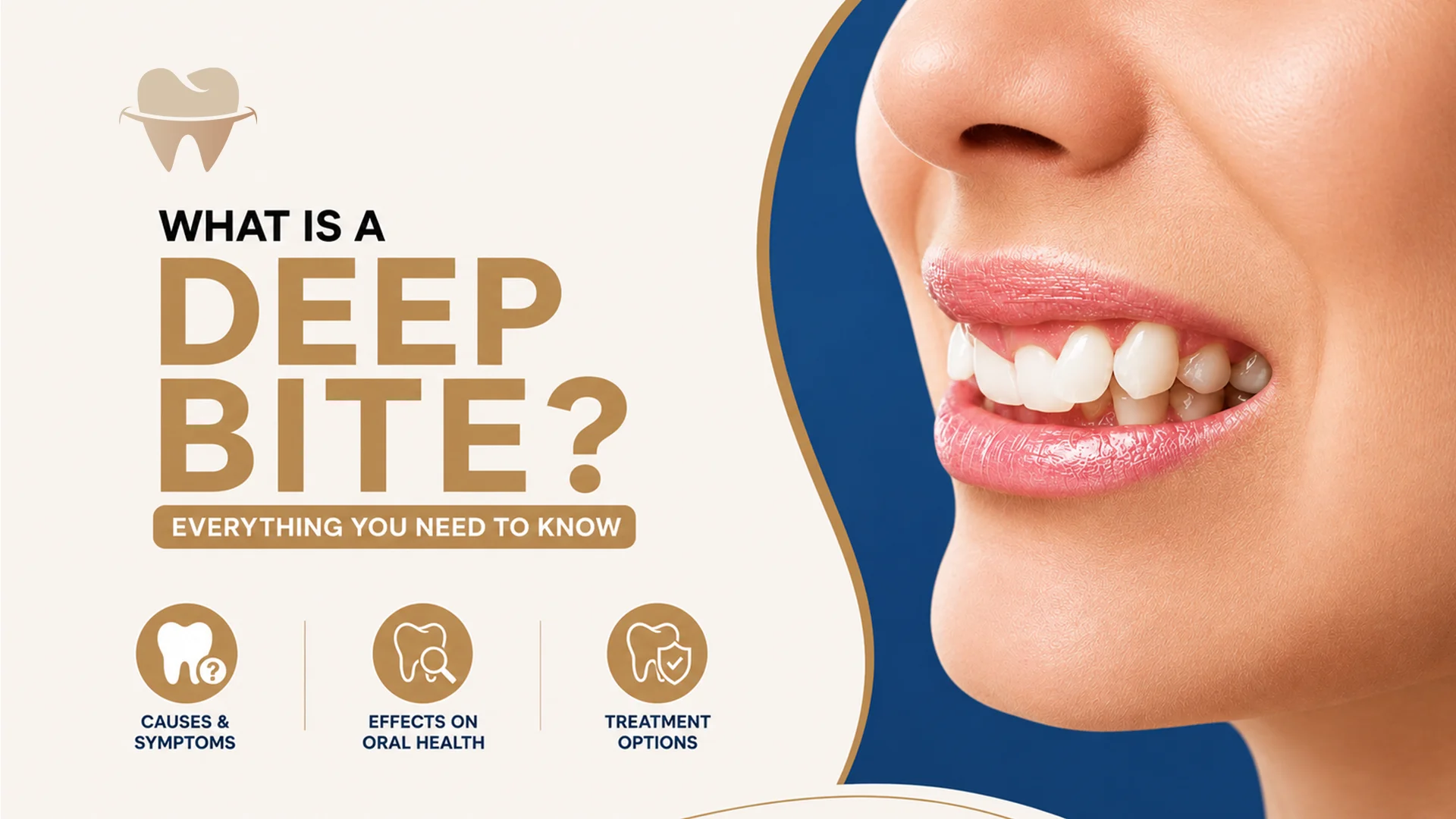
TL;DR
- A deep bite occurs when your upper front teeth overlap your lower teeth by 5 mm or more, affecting about 10-30% of orthodontic patients.
- Deep bite vs overbite teeth: Both terms describe vertical misalignment. Orthodontists prefer “deep bite” as the clinical term; patients often use “overbite.”
- Causes of deep bite include genetics (skeletal), dental positioning, childhood habits (thumb-sucking), teeth grinding, and missing back teeth.
- Deep bite braces are the gold standard, achieving successful corrections in 85-90% of cases through front tooth intrusion and back tooth control.
- Deep bite Invisalign can correct deep bites through posterior extrusion and anterior intrusion, with studies showing significant overbite reduction averaging 4.1 mm.
- Severe deep bite cases may require jaw surgery in addition to orthodontic treatment, especially when the condition is skeletal.
- Deep bite treatment cost in Pakistan ranges from PKR 80,000 to 350,000, depending on the type of treatment and complexity.
When you close your mouth, your upper front teeth should overlap your lower front teeth just slightly. But when that overlap becomes excessive, so much that the upper teeth cover most or all of the lower ones, it is called a deep bite. It is one of the most common bite problems, and while it may seem harmless at first, an untreated deep bite can lead to worn teeth, gum damage, and jaw pain over time.
This guide explains what a deep bite is, what causes it, the problems it can create, and the treatment options available in Pakistan, from braces and Invisalign to typical costs.
Quick answer: A deep bite (deep overbite) is when the upper front teeth overlap the lower front teeth excessively, often covering more than 40% of them. It is usually caused by genetics, missing back teeth, teeth grinding, or jaw development. Left untreated, it can wear down teeth and strain the jaw. It is most reliably corrected with braces or clear aligners such as Invisalign, and treatment in Pakistan typically costs between PKR 80,000 and 600,000 depending on the method.
What Is a Deep Bite?
A deep bite, also called a deep overbite, is a type of malocclusion (a misaligned bite) in which the upper front teeth vertically overlap the lower front teeth too much. In a healthy bite, the upper incisors cover about 20 to 30% of the lower incisors. In a deep bite, that overlap is significantly greater, and in severe cases the lower front teeth may bite into the gum tissue behind the upper teeth or the roof of the mouth.
A deep bite is different from an overbite or overjet. Overbite is the general term for vertical overlap, while a deep bite specifically means that overlap is excessive. It is a vertical problem, whereas an overjet (upper teeth protruding forward) is a horizontal one.
Signs and Symptoms of a Deep Bite
A deep bite teeth condition often goes unnoticed until symptoms appear. Here are the most common signs to watch for:
Visible Signs
- Lower teeth hidden when smiling: Your upper teeth cover most or all of your lower teeth
- Uneven gum line: Your gums may appear uneven or inflamed
- Worn front teeth: Your lower front teeth may show signs of wear from contacting the upper teeth or gum tissue
Physical Symptoms
- Jaw pain or stiffness: The jaw joint (TMJ) can become strained from abnormal bite forces
- Pain while chewing: Difficulty biting into certain foods
- Earaches or headaches: TMJ issues can cause radiating pain
- Tooth sensitivity: Worn enamel can expose sensitive dentin
- Gum disease: Lower teeth biting into upper gum tissue can cause inflammation and recession
- Speech challenges: Some patients notice difficulty pronouncing certain sounds
Normal Overlap vs Deep Bite
| Feature | Normal Bite | Deep Bite |
| Vertical Overlap | 2-4 mm | 5 mm or more |
| Percentage of Lower Teeth Covered | Less than 30% | More than 30% |
| Lower Teeth Visibility When Smiling | Visible | Partially or fully hidden |
| Contact Points | Upper teeth contact lower teeth normally | Lower teeth may contact gum tissue behind upper teeth |
The term “deep bite” is often used interchangeably with “overbite.” However, there is a subtle but important difference between deep bite vs overbite teeth, as explained below.
Deep Bite vs Overbite Teeth: What’s the Difference?
The terms overbite and deep bite are frequently confused, even by some dental professionals. While they are related, they are not exactly the same.
According to the Cleveland Clinic, overbite refers to vertical misalignment where your upper teeth overlap your lower teeth more than typical. In dental terminology, the professional term for this condition is a deep bite.
What is overbite teeth in simple terms?
The terms are often used interchangeably because an overbite is the visible result of a deep bite.
Deep Bite vs Overbite: Quick Comparison
| Feature | Overbite | Deep Bite |
| Definition | Any vertical overlap beyond normal range | The specific dental condition causing the overlap |
| Measurement | Usually 2-4 mm normal; beyond is overbite | Typically, 5 mm or more of vertical overlap |
| Usage | More commonly used by patients | More commonly used by orthodontists |
The bottom line: When you visit your orthodontist, they may use the term deep bite to describe your overbite teeth because the condition is technically a deep bite malocclusion.
What Causes a Deep Bite?
Understanding causes of deep bite helps you recognize whether you or your child might develop this condition. The causes fall into two main categories: skeletal and dental.
1. Genetics (Skeletal Causes)
Your jaw shape and size are largely determined by your genes. If one or both of your parents had a deep bite, you are more likely to develop one .
Skeletal deep bites occur when:
- Your upper and lower jaws have a vertical imbalance
- Your face height is shorter than average
- Your lower jaw is positioned too close to your upper jaw
2. Dental Causes
Dental deep bites result from tooth positioning rather than jaw size:
- Upper front teeth tilted too far down
- Lower front teeth too short
- Back teeth (molars) over-erupted
3. Childhood Habits
Certain habits can contribute to a deep bite, especially when they continue past age 3:
- Prolonged thumb-sucking
- Pacifier use beyond age 3
- Tongue-thrusting
- Excessive nail-biting
4. Teeth Grinding (Bruxism)
Clenching or grinding your teeth can wear down back teeth, allowing your front teeth to overlap more deeply over time.
5. Missing or Congenitally Missing Teeth
When back teeth are missing, the bite can collapse, deepening the overlap of front teeth.
Causes of Deep Bite Summary Table
| Cause Type | Specific Causes | Preventable? |
| Genetic | Inherited jaw shape, short face height | No |
| Dental | Front teeth tipped down, molars over-erupted | Sometimes |
| Habits | Thumb-sucking, pacifier use past age 3 | Yes |
| Bruxism | Teeth grinding, clenching | Partially |
| Missing Teeth | Back teeth loss leading to bite collapse | Yes |
Why a Deep Bite Should Not Be Ignored
A deep bite is not just an aesthetic concern. Left untreated, it can lead to several serious oral health problems:
1. Tooth Erosion and Wear
When your upper front teeth continuously rub against your lower front teeth or gum tissue, enamel wears away. This can lead to:
- Flattened incisal edges
- Exposed dentin
- Increased sensitivity
2. Gum Disease
If your lower front teeth bite into your upper gum tissue, you may develop:
- Gum recession
- Gum inflammation
- Periodontal pockets
3. Jaw Pain and TMJ Disorders
The temporomandibular joint (TMJ) can become strained from abnormal bite forces, leading to:
- Pain while chewing
- Jaw stiffness
- Headaches and earaches
4. Difficulty Chewing
Deep bites can impair your ability to bite into certain foods, limiting your diet and enjoyment of meals.
5. Speech Issues
Severe deep bites can affect your ability to pronounce certain sounds clearly.
6. Aesthetic Concerns
Many patients feel self-conscious about their smile when their lower teeth are hidden. A deep bite can also make the chin appear more prominent than it actually is.
Complications Summary
| Complication | Description | Long-Term Impact |
| Tooth Erosion | Upper teeth wear down lower teeth or gum tissue | Tooth loss if severe |
| Gum Disease | Lower teeth contact upper gum tissue | Gum recession, tooth loss |
| TMJ Disorders | Strain on jaw joint | Chronic pain, headaches |
| Chewing Difficulty | Impaired bite function | Limited diet |
| Speech Issues | Pronunciation problems | Social impact |
| Aesthetic Concerns | Lower teeth hidden | Confidence issues |
How Is a Deep Bite Diagnosed?
Diagnosing a deep bite goes beyond a visual examination. Orthodontists use specific measurements and imaging to determine the severity of your condition:
1. Visual Examination
Your orthodontist will visually inspect your bite, looking for excessive overlap of your front teeth.
2. Cephalometric X-Rays
These X-rays provide a detailed view of your teeth and jaw structure, allowing your orthodontist to:
- Measure the degree of overlap
- Differentiate between skeletal and dental deep bite
- Plan treatment accordingly
3. Bite Registration
Using a bite registration material, your orthodontist captures an exact replica of your bite to analyze how your teeth fit together.
4. Digital Scans
Many modern orthodontists use intraoral scanners to create 3D models of your teeth, which help plan treatments like Invisalign with precision.
Deep Bite Treatment Options
The right treatment depends on your age and whether the deep bite is dental or skeletal.
| Treatment | Best for | How it works |
|---|---|---|
| Braces (metal or ceramic) | Most deep bite cases | Move and intrude the front teeth and level the bite, often with small bite turbos |
| Clear aligners (Invisalign) | Mild to moderate cases | Use attachments and precision cuts to intrude front teeth discreetly |
| Bite ramps/turbos | Adjunct to braces or aligners | Prevent the deep overlap and let the back teeth settle into place |
| Functional appliances | Growing children and teens | Guide jaw growth while the jaw is still developing |
| Orthognathic surgery | Severe skeletal cases in adults | Surgically repositions the jaw, combined with orthodontics |
1. Deep Bite Braces
Traditional braces are the most reliable option for correcting a deep bite. The brackets and wires gradually intrude and reposition the front teeth while allowing the back teeth to come into better contact, levelling the bite. Metal and ceramic braces both work well, and bite turbos are often added to speed up correction.
2. Deep Bite and Invisalign
Invisalign and other clear aligners can correct mild to moderate deep bites using tooth-coloured attachments and precision cuts to intrude the front teeth. They are removable and nearly invisible, which many adults prefer. For severe or skeletal deep bites, braces or surgery may still be necessary. If you are weighing your options, our comparison of aligners vs braces can help.
3. Orthodontic Appliances
For growing children and teens, additional appliances may be used:
- Palate expanders to widen the roof of the mouth
- Headgear to correct jaw position
- Bite turbos attached to upper teeth to open the bite
- Temporary Anchorage Devices (TADs), tiny titanium implants placed in the jaw bone to provide stable anchorage for more controlled tooth movement
4. Surgery for Severe Cases
Severe deep bite cases with significant skeletal jaw imbalances may require corrective jaw surgery (orthognathic surgery).
Surgery is typically recommended when:
- The deep bite is caused by a significantly short lower face height
- Braces alone cannot achieve optimal correction
- The patient is no longer growing (adults)
- The overlap exceeds 8-10 mm
Deep Bite Treatment Cost in Pakistan
Costs vary with the method, case complexity, and clinic. The ranges below are approximate market estimates for 2026 in Pakistan.
| Treatment | Approximate cost (PKR) |
|---|---|
| Consultation and X-rays | 1,000 to 5,000 |
| Metal braces | 80,000 to 180,000 |
| Ceramic braces | 120,000 to 250,000 |
| Clear aligners / Invisalign | 250,000 to 600,000 |
For a fuller breakdown, see our guide to braces prices and types in Pakistan. Always confirm the exact fee at your consultation.
Factors Affecting Cost
| Factor | Impact on Cost |
| Severity of deep bite | More severe cases require longer treatment and more complex mechanics |
| Type of treatment | Clear aligners cost more than traditional braces |
| Duration of treatment | Longer treatment plans increase overall cost |
| Orthodontist’s expertise | More experienced orthodontists may charge higher fees |
| Clinic location | Premium clinics in major cities charge higher rates |
Many orthodontic clinics offer flexible payment plans to make deep bite treatment more affordable.
How Long Does Deep Bite Treatment Take?
Most deep bite cases take about 12 to 24 months to correct, though mild cases can finish sooner and severe or skeletal cases can take longer. After active treatment, a retainer is essential to hold the corrected bite in place and prevent the deep bite from returning.
Can a Deep Bite Be Fixed Without Braces?
Mild deep bites can sometimes be corrected with clear aligners alone, and in growing children functional appliances may guide the jaw without traditional braces. However, moderate to severe deep bites usually respond best to braces, and skeletal cases may need surgery. Only an orthodontic assessment can tell you which approach suits your case.
Can Adults Fix a Deep Bite?
Yes. A deep bite can be corrected at any age. While treatment may take a little longer in adults because the jawbone is denser, braces and clear aligners produce excellent results for adult patients. Correcting a deep bite as an adult also helps prevent further tooth wear and jaw strain.
Conclusion
A deep bite is a common but treatable condition. Ignoring it can lead to worn teeth, gum damage, and jaw problems, but with braces, clear aligners, or, in severe cases, surgery, it can be fully corrected at any age.
If you think you have a deep bite, an orthodontic evaluation is the best first step. This article is for general education and is not a substitute for a professional orthodontic assessment.
Think you have a deep bite?
At Teeth & Gums, our orthodontic team can assess your bite and create a personalised treatment plan using braces or clear aligners.
Frequently Asked Questions
What is a deep bite?
A deep bite is when the upper front teeth overlap the lower front teeth excessively, often covering more than 40% of them. It is a common type of malocclusion.
Is a deep bite serious?
It can be if left untreated. Over time a deep bite can cause excessive tooth wear, gum damage, fractured teeth, and jaw problems such as TMJ pain and headaches.
What is the difference between a deep bite and an overbite?
Overbite is the general term for the vertical overlap of the front teeth. A deep bite is specifically an excessive overbite, where the overlap is much greater than normal.
Can a deep bite be fixed with Invisalign?
Yes, mild to moderate deep bites can often be corrected with Invisalign using attachments and precision cuts. Severe or skeletal cases may need braces or surgery.
How long does it take to fix a deep bite?
Most cases take about 12 to 24 months, depending on severity and the treatment method. A retainer is needed afterwards to maintain the result.
How much does deep bite treatment cost in Pakistan?
Metal braces typically cost PKR 80,000 to 180,000, ceramic braces PKR 120,000 to 250,000, and clear aligners or Invisalign PKR 250,000 to 600,000.
Can adults fix a deep bite?
Yes. A deep bite can be corrected at any age with braces or clear aligners, though treatment may take slightly longer in adults.