KEY TAKEAWAYS
- Natural teeth shapes fall into five main groups: square, rectangular, oval, triangular and round.
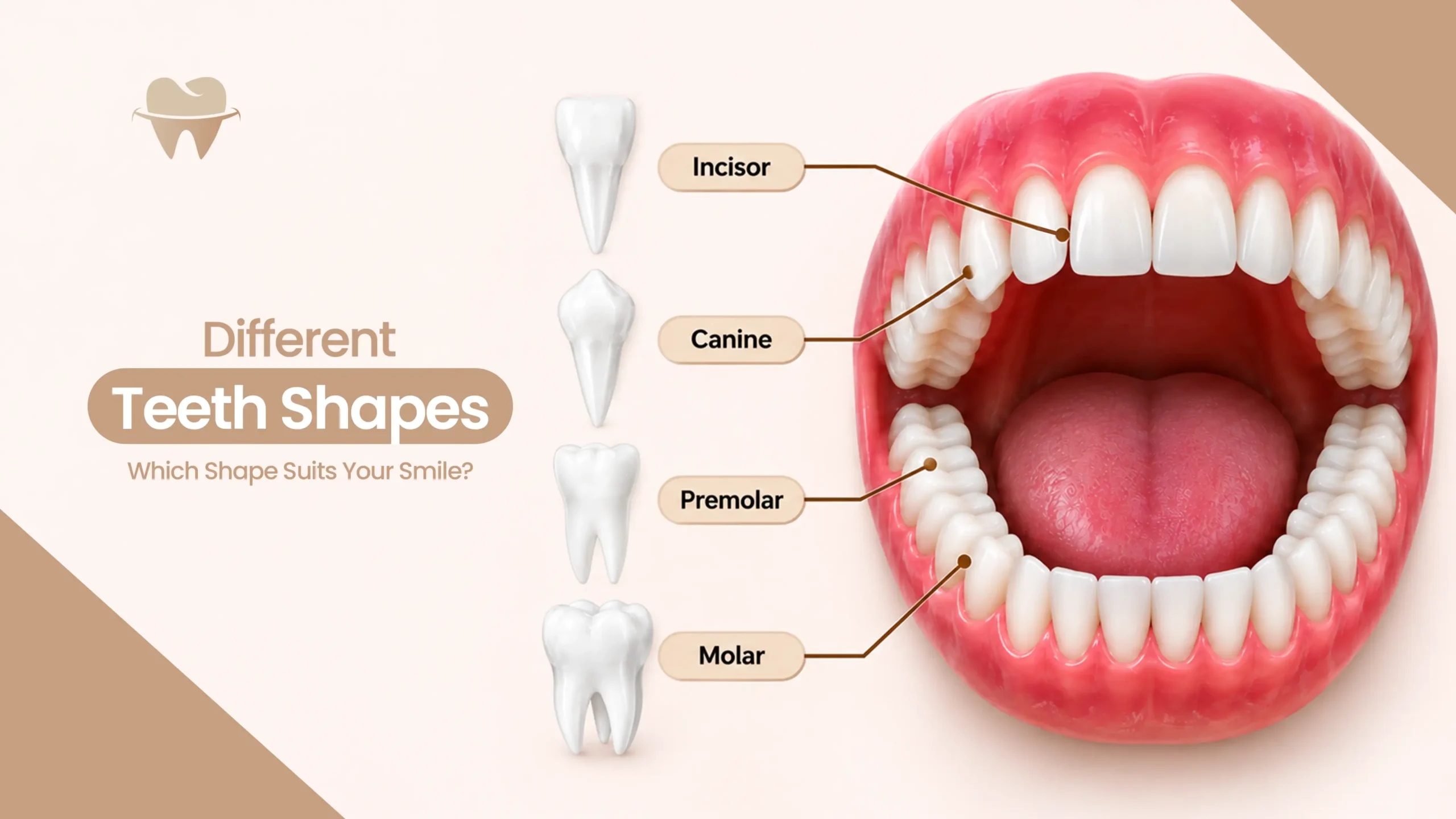
- Adults have four types of teeth, each with its own job: incisors, canines, premolars and molars.
- A 2025 study of 126 adults found the average upper central incisor measures 8.83 mm wide and 9.83 mm long.
- There is no single best shape. The right shape depends on your face, lips, bite and personal taste.
- Dentists use digital smile design to preview a new tooth shape before any treatment starts.
- Shapes can be changed with contouring, bonding, veneers, crowns or orthodontics. Never file your own teeth.
Your smile has a shape. Most people never notice it until something changes.
Look at your front teeth in the mirror. Are they broad and boxy? Long and narrow? Soft and rounded at the edges? That outline is your tooth shape. It shapes how your smile reads to everyone else.
Tooth shape also decides what treatment you may need. A chipped corner, a pointed canine or a small side tooth all call for different fixes.
This guide explains the main teeth shapes and their names, how big teeth normally are, what each type of tooth does, and how dentists choose a shape in smile design. It also covers when a change in tooth shape needs a dentist.
What Are Teeth Shapes?
Tooth shape describes the outline of a tooth when you look at it from the front. Dentists look at three things.
- The outline. Are the sides straight, curved or tapered?
- The proportion. How wide is the tooth compared with its height?
- The edges and corners. Are they sharp, softened or rounded?
Every person has natural teeth shapes that come from genetics. They can also change with age, wear, grinding, injury or dental work.
Shape matters for three reasons. It affects how your smile looks. It affects how teeth meet when you bite. And it guides any cosmetic treatment you choose later.
Different Types of Teeth and Their Functions
Before we look at shape names, it helps to know the different types of teeth in the mouth. Each type is built for a job.
| Type of Tooth | Number in Adults | Main Function | Typical Shape |
|---|---|---|---|
| Incisors | 8 | Cutting and biting into food | Flat, thin, straight edge |
| Canines | 4 | Tearing and gripping food | Pointed, single cusp |
| Premolars | 8 | Crushing and tearing | Two cusps, broader surface |
| Molars | 12 (including 4 wisdom teeth) | Grinding and chewing | Wide, multiple cusps |
Children have 20 baby teeth. These include incisors, canines and molars, but no premolars. Adults have up to 32 permanent teeth.
Teeth do more than chew. They support the lips and cheeks. They help you pronounce sounds like “s”, “f” and “th”. And they guide the jaw into position when you close your mouth.
Incisors and canines are the front teeth. They are the teeth people see when you smile. So most cosmetic shape work happens here.
Teeth Shape Names: Tooth Shapes & Names Explained
Dentists describe natural tooth shapes using a few common names. Most people have a mix of shapes rather than one pure type.
| Shape Name | What It Looks Like | Typical Impression |
|---|---|---|
| Square | Straight sides, flat edge, similar width and height | Strong, balanced |
| Rectangular | Straight sides, flat edge, longer than wide | Elegant, youthful |
| Oval | Rounded edges, curved sides | Soft, gentle |
| Triangular | Narrow near the gum, wide at the biting edge | Dramatic, distinctive |
| Round | Short and softly curved, almost circular | Friendly, compact |
Square Teeth
Square teeth have straight sides and a flat biting edge. Their width and length are close to equal. They look sturdy and balanced. Square shapes are common in people with a strong jawline, but the link is not strict.
Rectangular Teeth
Rectangular teeth are longer than they are wide. They have flat edges and straight sides. They tend to look youthful. Long teeth show more when the lip lifts, so they suit people with a lower lip line.
Oval Teeth
Oval teeth have soft, rounded corners. They look gentle and natural. Many veneer patients choose a slightly oval shape because it blends well with most faces.
Triangular Teeth
Triangular teeth are narrow near the gum line and widen toward the edge. They create small gaps near the gum, called black triangles, when the teeth are closely spaced. Treatment can soften this outline.
Round Teeth
Round teeth are short and curved. They look compact. Wear over time often makes teeth look rounder and shorter.
Front Teeth Shapes: Central Incisors, Laterals and Canines
Six upper front teeth frame your smile. Each has its own character.
- Central incisors. These are the two largest and most visible teeth. They set the tone for the whole smile. Their size and shape matter most in smile design.
- Lateral incisors. These sit beside the centrals. They are smaller and often a little shorter. Some people have peg-shaped laterals, which are narrow and pointed. Some are missing altogether. Both are common reasons for cosmetic treatment.
- Canines. These are the pointed corner teeth. They are strong and anchor the arch. A very sharp or prominent canine can catch the lip. Reshaping can soften it.
Together these front teeth shapes create the visual rhythm of your smile. Central teeth lead. Laterals support. Canines finish the line.
Teeth Sizes: What Is Normal?
Teeth sizes vary from person to person. Researchers measure width and crown length to define a normal range.
A 2025 study in Clinical, Cosmetic and Investigational Dentistry measured the upper front teeth of 126 healthy adults in Kuwait. Here are the averages.
| Upper Tooth | Average Width | Average Length | Width-to-Length Ratio |
|---|---|---|---|
| Central incisor | 8.83 mm | 9.83 mm | 91% |
| Lateral incisor | 6.83 mm | 8.00 mm | 86% |
| Canine | 7.76 mm | 9.14 mm | 86% |
Normal ranges were wider than the averages suggest. Central incisors ranged from 7.5 to 9.8 mm in width and from 8.2 to 11.2 mm in length.
What the Research Found About Men and Women
The same study found clear differences between the genders.
- Men had longer front teeth. The average central incisor was 10.36 mm long in men and 9.57 mm in women.
- Women had higher width-to-length ratios. Their central incisors measured 92% against 87% in men.
- Canines showed the biggest difference. Male canines were wider than female canines.
Why Ethnicity and Population Matter
The researchers also noted that tooth proportions differ between populations. Earlier studies reported a central incisor ratio of about 89% in Turkish groups and about 72% in Asian groups. The Kuwaiti group was closer to the Turkish figure, which suggests slightly squarer teeth.
This study measured Kuwaiti adults. We did not find large, published reference data for Pakistani adults. So, treat these numbers as a guide, not a target. Your dentist will measure your own teeth and your own face.
The Golden Proportion Is Not a Rule
You may have heard that ideal teeth follow the “golden proportion”. The theory says each tooth should look about 62% as wide as the one in front of it.
A 2023 systematic review and meta-analysis found that the golden proportion is rarely seen in natural smiles. The 2025 study also notes that following it does not guarantee a more attractive smile. Beautiful smiles vary. A fixed formula cannot define them.
What dentists do watch is the width-to-length ratio. Traditional guidance favoured about 75% to 80%. Research on patient preference has found people often like ratios closer to 82%. In short, the acceptable range is wider than older textbooks claimed.
Best Teeth Shape for Your Smile
There is no single best teeth shape. The best shape is the one that suits you. Dentists weigh several things.
Your Face Shape
A long-standing guideline says tooth shape should echo face shape. Square faces suit square teeth. Oval faces suit oval teeth. Tapered faces suit tapered teeth.
This idea is popular. The evidence is weak. The 2025 paper notes that studies often failed to find consistent links between facial measurements and tooth size. Use face shape as a starting point for a conversation, not a rule.
Your Lip Line and Smile Arc
How much of your teeth show when you smile matters more than most people think. A high lip line shows more tooth and gum. A low lip line shows less. The edges of the upper teeth should follow the curve of the lower lip.
Your Age
Young teeth have soft, rounded edges and longer central incisors. Older teeth are shorter and flatter because of wear. A shape that matches your age usually looks the most natural. A shape that is too youthful can look out of place.
Your Bite
Teeth must work as well as they look. A dentist checks how your upper and lower teeth meet before changing any shape. A beautiful tooth that breaks under pressure is a poor result.
Your Personal Taste
Some people want a soft, subtle smile. Others want a bold, bright one. This is a real choice. A good dentist explains the options and respects yours.
Which teeth shape looks most natural? For most patients, slightly softened rectangular or oval shapes with small natural variations look the most natural. Perfect symmetry can look artificial. Small differences between left and right make a smile look real.
Teeth Shape for Smile Design: How Dentists Plan It
Teeth shape for smile design is a planned process. It is not guesswork.
- Photos and measurements. The dentist photographs your face and smile. They measure your teeth, your lip line and your gum levels.
- Digital smile design. Software overlays proposed shapes on your photo. You see how different shapes would look on your face. Studies now show these tools work best when they use data that fits the patient’s population.
- A mock-up. A temporary resin version of the proposed shape is placed over your teeth. It does not remove any enamel. You can try it for a few days.
- Your feedback. You say what feels right and what does not. Changes are made before treatment starts.
- Treatment. Only then is the final shape created with contouring, bonding, veneers or crowns.
The mock-up step protects you. It is far easier to change a temporary shape than a finished veneer.
How to Identify Your Natural Teeth Shape
You can get a rough idea at home.
- Stand in good light. Smile wide and look at your two upper central incisors.
- Compare width and height. If they look about equal, your teeth lean square. If height is clearly greater, they lean rectangular.
- Look at the corners and edges. Rounded corners suggest oval. A tapered look toward the gum suggests triangular.
Remember that you may have a mix. Canines are almost always pointier than centrals. Wear can also change your shape over time.
A dentist can measure your teeth exactly and tell you where you fall.
Why Are My Front Teeth Different Shapes or Sizes?
Small differences are normal. Faces are not perfectly symmetrical, and teeth are not either. But larger differences have causes.
- Genetics. Tooth size and shape run in families.
- Peg or small lateral incisors. One or both side teeth are narrow or pointed.
- Chips and fractures. An old injury changed the edge.
- Wear. Grinding or acidic foods shorten teeth unevenly.
- Eruption differences. A tooth that came in late may sit at a different height.
- Gum differences. Gum levels change how long a tooth looks.
- Old fillings or bonding. Past dental work altered the shape.
Most of these can be corrected if you want to.
Dental Treatments That Improve Tooth Shape
Dentists have several ways to change tooth shape. The right one depends on how much needs to change.
| Treatment | What It Does | Best For | Estimated Cost in Lahore (PKR) |
|---|---|---|---|
| Enameloplasty (tooth contouring) | Removes a tiny amount of enamel to smooth or reshape | Small chips, sharp edges, pointed canines | 3,000 to 10,000 per tooth |
| Dental bonding | Adds tooth-coloured resin and sculpts it | Chips, gaps, short or small teeth | 8,000 to 15,000 per tooth |
| Porcelain veneers | Bonds thin ceramic shells to the front of teeth | Shape, size, colour and minor alignment | 25,000 to 55,000 per tooth |
| Dental crowns | Covers the whole tooth | Heavily damaged or weak teeth | 25,000 to 50,000 per tooth |
| Gum contouring | Reshapes the gum line | Gummy smile, uneven gum levels | 15,000 to 30,000 |
| Orthodontics | Moves teeth into better positions | Crowding, rotation, uneven edges | 80,000 to 250,000 |
Prices are market estimates for established clinics in Lahore and may change. Your costs depend on your case.
Choosing Between Treatments
If the change is tiny, contouring may be enough. It is quick, painless and low cost. If you need to add length or fill a gap, bonding or veneers work better. If the tooth is weak, a crown gives strength.
Orthodontics comes first when teeth are crowded or rotated. Veneers cannot fix a poor bite.
Do Not Shape Your Teeth at Home
Social media shows nail files and sandpaper used on teeth. Please do not try it.
Enamel does not grow back. Filing removes it for good. It can expose the softer layer beneath, cause sensitivity, increase decay risk and leave rough surfaces that trap plaque. Uneven filing can also change how you bite.
A dentist uses fine instruments, checks enamel thickness on X-ray and polishes the surface afterward. The difference is large.
When to See a Dentist About a Change in Tooth Shape
Teeth should keep their shape for years. A change usually has a reason. See a dentist if you notice:
- A tooth that looks shorter or flatter than before
- New chips, cracks or rough edges
- Teeth that look thin or see-through at the edges
- Sensitivity to cold or sweet foods
- Teeth that look longer because gums are pulling back
- A tooth that is moving or looks tilted
- Jaw pain or morning headaches that suggest grinding
Early checks protect your teeth. Wear and cracks are easier to treat when small.
Teeth Shape and Smile Design at Teeth & Gums
At Teeth & Gums in DHA Phase 6, Lahore, every cosmetic case starts with an assessment. We check gum health, bite and enamel before any shape change is planned.
We use digital smile design to preview results. We often recommend the most conservative option first. If a small contour solves your concern, there is no reason to place veneers.
Our team also sees patients who travel from abroad for smile work, so we plan around your schedule.
Final Word
Teeth shapes are personal. Square, oval, rectangular, triangular or round, each has its own character. There is no perfect formula. Research shows that natural smiles vary by person, sex and population, and that rigid ratios do not define beauty.
What matters is that your teeth are healthy, they suit your face and you like how they look. If one tooth bothers you, there is likely a simple fix. If you want a full change, planning and previews make it safe.
Start with a consultation. Bring photos of smiles you like. Ask what is possible and what is wise.
Book a consultation at Teeth & Gums, DHA Phase 6, Lahore
Our team will assess your smile and show you how different tooth shapes would look on your face.
Frequently Asked Questions
What are the different types of teeth shapes?
The five main natural teeth shapes are square, rectangular, oval, triangular and round. Most people have a mix. Front teeth are usually flatter and wider, while canines are more pointed. Shape is described by outline, proportion and edge form.
What is the difference between square, oval, and triangular teeth?
Square teeth have straight sides and a flat edge with similar width and height. Oval teeth have rounded corners and curved sides. Triangular teeth are narrow at the gum and wide at the biting edge. Each gives a different overall impression.
How can I identify my natural teeth shape?
Look at your upper central incisors in good light. Compare their width to their height. Then check whether the corners are sharp or rounded and whether the sides taper toward the gum. A dentist can measure your teeth precisely.
Which teeth shape looks most natural?
Slightly softened rectangular or oval shapes with small natural variations usually look most natural. Perfect symmetry can look artificial. The best choice matches your age, face and lip line, which a smile design review helps confirm.
Does teeth shape affect the appearance of your smile?
Yes. Shape changes how broad, soft, youthful or bold a smile looks. Length affects how much tooth shows, and edge form affects softness. Research shows beautiful smiles vary widely, so the right shape depends on the person.
Why are my front teeth different shapes or sizes?
Genetics is the most common reason. Small or peg-shaped lateral incisors, past chips, uneven wear, late eruption and old fillings also change shape. Mild differences are normal, but larger ones can be corrected.
Can dentists change the shape of your teeth?
Yes. Dentists reshape teeth with enameloplasty, bonding, veneers or crowns. Gum contouring changes how long a tooth looks. Orthodontics moves teeth into new positions. The right method depends on how much change is needed.
What dental treatments can improve irregular tooth shapes?
Contouring smooths small irregularities. Bonding adds material to fix chips and gaps. Veneers change shape, size and colour together. Crowns rebuild weak teeth. Orthodontics fixes crowding. Your dentist picks the most conservative option that meets your goal.
How to shape teeth?
Only a dentist should shape teeth. They remove tiny amounts of enamel with fine instruments, add resin, or place veneers after checking X-rays. Filing teeth at home removes enamel permanently and can cause sensitivity, decay and bite problems.
Does removing wisdom teeth change face shape?
No. Wisdom tooth removal does not meaningfully change face shape. Swelling after surgery can make the cheeks look fuller for several days, but it settles. Any later facial changes come from ageing and weight, not from the extraction.
What are the four types of teeth, and what does each do?
Incisors cut food. Canines tear it. Premolars crush and tear. Molars grind it. Together they support chewing, speech and the shape of the lips and face. Adults have up to 32 teeth.
When should I see a dentist about a change in tooth shape?
See a dentist if a tooth looks shorter, chipped, thin at the edge or newly sensitive, or if gums are pulling back. Shape changes often signal wear, grinding or decay. Early treatment is simpler and protects the tooth.