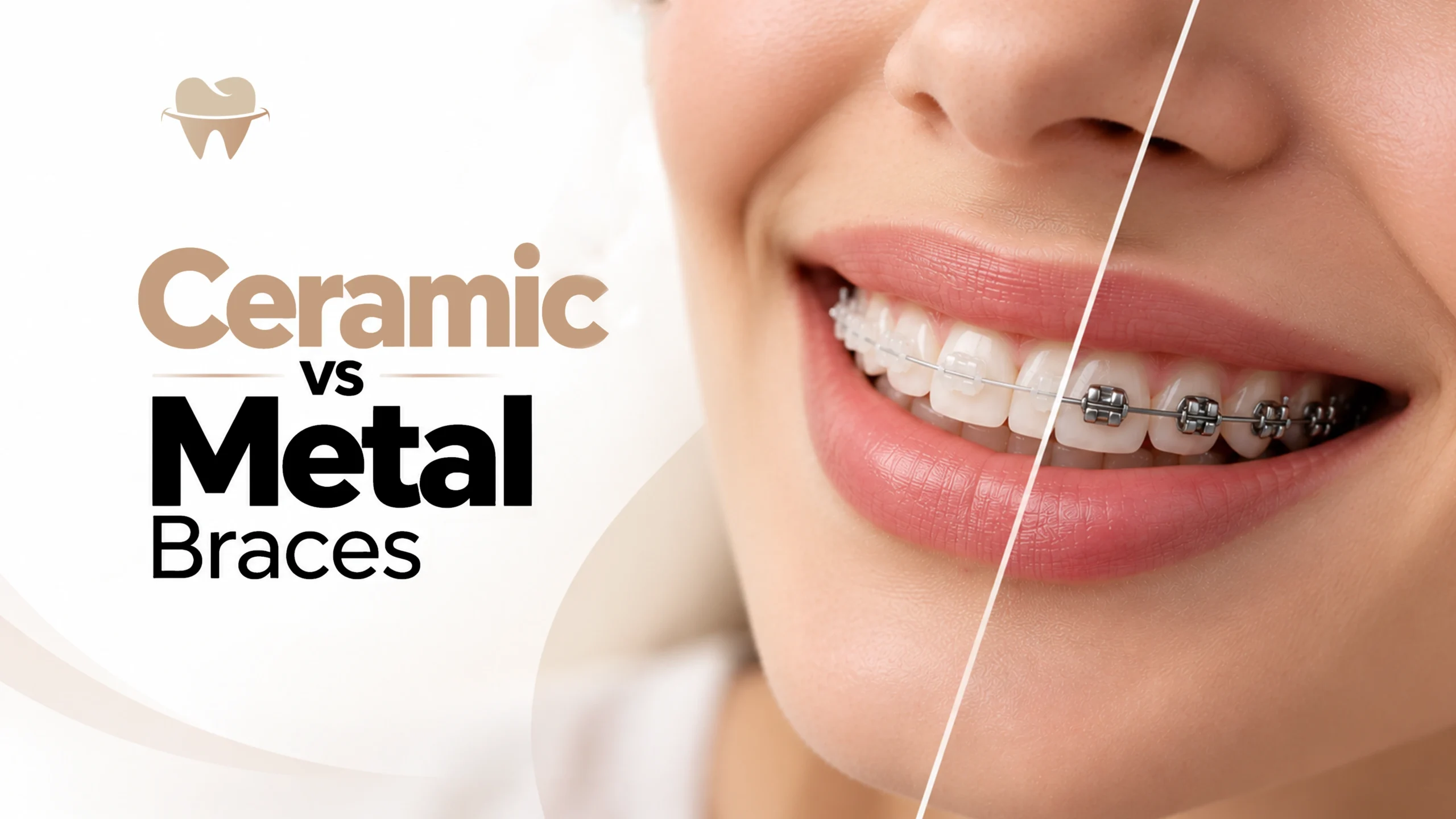
KEY TAKEAWAYS
- Both ceramic and metal braces straighten teeth effectively. The difference is in aesthetics, cost, strength, and comfort.
- Metal braces are stronger, more affordable, and better suited for complex cases.
- Ceramic braces are far less visible and preferred by adults, professionals, and image-conscious patients.
- Ceramic braces cost more than metal braces, typically PKR 15,000 to PKR 30,000 more per arch in Lahore.
- Neither type hurts more than the other during active treatment; initial soreness affects both equally.
- The right choice depends on your specific case, your lifestyle, and what matters most to you.
The question most patients ask at their first orthodontic consultation is not “do I need braces?” It is “which braces?” And for the majority of adults and teenagers sitting in that chair today, the choice comes down to two: ceramic or metal.
Both straighten teeth. Both use the same underlying mechanics. But they look different, feel slightly different, cost different amounts, and perform differently under real-world conditions.
This guide covers every meaningful comparison so you can make an informed choice: not just pick the one a friend recommended.
How Braces Work
Before comparing ceramic braces vs metal braces, it helps to understand what both have in common.
All fixed braces use the same basic system. Brackets are bonded to the front surface of each tooth. An archwire runs through the slots in each bracket. The wire applies steady, controlled force to move teeth gradually into their correct positions.
Both ceramic and metal braces use this system. Both are adjusted at regular intervals; typically every four to six weeks. Both require a retainer after treatment to hold the result.
The difference is entirely in the material the brackets are made from, and the consequences that follow from that material choice.
What Are Metal Braces?
Metal braces use brackets made from high-grade stainless steel. They are the original fixed orthodontic appliance and have been used in essentially the same form for decades.
The brackets are small, durable, and strong. The archwire is stainless steel or sometimes nickel-titanium. Small elastic ties, called ligatures, hold the wire in the bracket slot. These ties are typically grey, silver, or coloured. Patients can choose from a range of colours at adjustment appointments.
Metal braces are visible. There is no way around it. The brackets are silver and the wire runs visibly across the front of the teeth. For most patients, this is the primary reason they consider ceramic as an alternative.
What metal lacks in aesthetics, it makes up for in performance, durability, and cost.
What Are Ceramic Braces?
Ceramic braces use brackets made from tooth-coloured or clear ceramic material. The brackets blend with the natural shade of the teeth. From a normal conversational distance, they are significantly less visible than metal.
Ceramic brackets are available in two main types:
- Monocrystalline ceramic: Completely clear, highly translucent, and the most aesthetic option. The bracket itself does not stain, but the elastic ligatures holding the wire in place can pick up colour from tea, coffee, or turmeric.
- Polycrystalline ceramic: Slightly more opaque than monocrystalline, closer to tooth-white rather than clear. Slightly stronger than monocrystalline. Less visible than metal but not as discreet as clear ceramic.
In Lahore, ceramic braces are commonly referred to as aesthetic braces, clear braces, or tooth-coloured braces. All of these terms refer to the same appliance category.
Ceramic vs Metal Braces: The Full Comparison
| Feature | Metal Braces | Ceramic Braces |
|---|---|---|
| Appearance | Clearly visible; metallic brackets and wires | Blend with tooth surface; significantly less noticeable |
| Visibility | Highly conspicuous | More discreet, though not entirely invisible (archwire remains metallic) |
| Ligature Ties | Elastics can discolour but are replaced at each appointment | Elastics can stain from coffee, tea, turmeric, or tobacco; changed every 4-6 weeks |
| Strength | Stainless steel brackets; significantly stronger; resist fracture under biting force | More brittle; can fracture under hard foods or heavy biting forces |
| Durability | Essentially indestructible under normal conditions; bend before breaking | More fragile; bracket fractures more common; replacement adds time and cost |
| Effectiveness (Mild-Moderate Cases) | Excellent; no meaningful difference in treatment time | Excellent; equivalent to metal for standard cases |
| Effectiveness (Complex Cases) | Can apply more precise and heavier forces; faster movement in complex cases | Slightly more brittle; may require lighter forces; can extend treatment time modestly |
| Comfort (Tooth Movement) | Same soreness after adjustments; 2-4 days per adjustment | Same soreness after adjustments; 2-4 days per adjustment |
| Comfort (Soft Tissue) | Modern brackets have smaller profiles; minimal irritation | Slightly larger profile; may feel more prominent initially; settles quickly |
| Staining (Brackets) | Do not stain | Quality ceramic does not stain |
| Staining (Ligatures) | Elastics may discolour; replaced at every adjustment | Elastics stain more visibly; replaced every 4-6 weeks |
| Hygiene | Requires diligent cleaning; food traps around brackets | Similar cleaning requirements; slightly larger profile may trap marginally more food |
| Best For | Complex cases, strong bites, contact sports, bruxism | Patients prioritizing discretion and aesthetics |
| Cost | Generally more affordable | Typically more expensive |
Ceramic vs Metal Braces Cost in Lahore (2026)
Cost is one of the most practically important factors in the ceramic or metal braces decision for patients in Lahore.
Braces Cost in Lahore by Type
| Braces Type | Approximate Cost (PKR) |
|---|---|
| Metal Braces (full treatment) | PKR 80,000 – 150,000 |
| Ceramic Braces (full treatment) | PKR 110,000 – 200,000 |
| Self-Ligating Metal Braces | PKR 120,000 – 180,000 |
| Self-Ligating Ceramic Braces | PKR 150,000 – 230,000 |
| Clear Aligners (Invisalign) | PKR 200,000 – 400,000 |
Market estimates for established orthodontic clinics in Lahore, 2026. Actual costs depend on case complexity, treatment duration, and clinic.
Why Ceramic Costs More
Ceramic brackets cost significantly more to manufacture than metal brackets. The ceramic material requires more precise fabrication. Replacement brackets needed when ceramic fractures add to the overall treatment cost.
The ceramic braces price premium over metal braces is typically PKR 15,000 to PKR 50,000 for a full treatment, depending on the clinic and case complexity.
International Comparison
| Location | Ceramic Braces (full treatment) | Metal Braces (full treatment) |
|---|---|---|
| Lahore, Pakistan | PKR 110,000–200,000 | PKR 80,000–150,000 |
| United Kingdom | £2,500–£5,000 | £1,800–£3,500 |
| Dubai, UAE | AED 8,000–18,000 | AED 6,000–14,000 |
| United States | USD 3,000–8,000 | USD 2,500–6,000 |
Head-to-Head Comparison Table
| Factor | Metal Braces | Ceramic Braces |
|---|---|---|
| Visibility | High — clearly visible | Low — blends with teeth |
| Strength | Excellent | Good — more prone to fracture |
| Treatment speed | Slightly faster for complex cases | Equivalent for standard cases |
| Comfort | Good | Good — marginally larger profile initially |
| Staining | Elastics can discolour | Elastics can discolour; brackets do not |
| Maintenance | Standard | Requires dietary awareness |
| Cost (Lahore) | PKR 80,000–150,000 | PKR 110,000–200,000 |
| Best for | Complex cases, children, budget | Adults, professionals, image-conscious patients |
| Durability | Excellent | Good — fragile under extreme force |
| Available at Teeth & Gums | Yes | Yes |
Who Should Choose Metal Braces?
Metal braces are the stronger clinical recommendation for:
- Children and younger teenagers. The higher fracture risk of ceramic brackets, combined with dietary habits that are harder to control in younger patients, makes metal the more practical choice. Coloured elastics are also popular with younger patients, a feature metal handles well.
- Complex orthodontic cases. Significant crowding, major bite corrections, large tooth movements, and surgical orthodontic cases all benefit from the precision force application that metal brackets allow.
- Budget-conscious patients. The metal braces price is lower. For patients who want excellent orthodontic results without the premium of ceramic, metal delivers the same clinical outcome at a lower cost.
- Patients who grind their teeth. Bruxism places lateral force on brackets. Metal handles this far better than ceramic.
- Patients who cannot commit to dietary restrictions. Metal brackets are simply more robust. Patients who know they will eat hard food, play contact sports, or have difficulty maintaining the ceramic-specific habits will have fewer complications with metal.
Who Should Choose Ceramic Braces?
Ceramic braces are the better fit for:
- Adults in professional environments. A visible metal brace in a patient-facing or client-facing professional role creates a self-consciousness that ceramic largely removes. For adults who want orthodontic treatment without the adolescent connotations of visible metal, aesthetic braces vs metal braces is a straightforward preference.
- Older teenagers concerned about appearance. Social confidence matters. For teenagers who would avoid necessary treatment because of how visible metal looks, ceramic provides a meaningful bridge.
- Patients with mild to moderate cases. Ceramic is clinically equivalent to metal for standard alignment and spacing corrections. The aesthetic advantage is gained with no clinical sacrifice when the case complexity is manageable.
- Patients motivated to follow care instructions. The dietary and cleaning discipline required by ceramic is not difficult, it is just more specific. Patients who follow instructions reliably get excellent results without the staining or breakage risks materialising.
- Image-conscious patients preparing for an important period. Patients starting a new job, getting married, or about to attend a significant social event sometimes choose ceramic for the final phase of treatment even if they started with metal.
Switching from Metal to Ceramic During Treatment
Patients sometimes start with metal for a complex alignment phase and switch to ceramic for the final, more visible stage of treatment. This is a clinical decision made with the treating orthodontist and depends on how the case is progressing.
It is not always possible or advisable; switching bracket types mid-treatment adds cost and can occasionally add time. But it is a conversation worth having if your preferences change during treatment.
Clear Aligners: An Alternate?
For patients comparing clear braces vs metal braces, clear aligners (such as Invisalign) represent a third option worth knowing about.
Clear aligners are nearly invisible, removable, and carry no dietary restrictions. They are the most aesthetic option. They are also the most expensive, require the most patient compliance (they must be worn 20 to 22 hours per day), and are not appropriate for all types of orthodontic cases.
The comparison between aligners and fixed braces deserves its own guide. For patients whose primary concern is appearance, however, it is worth asking your orthodontist whether aligner treatment is suitable for your case before committing to either ceramic or metal braces.
Final Words
Neither ceramic nor metal braces is universally better. They are different tools for different priorities.
Metal braces are stronger, more affordable, and better for complex cases. They have a visible presence that most patients become comfortable with quickly.
Ceramic braces are less visible, more expensive, and slightly more fragile. For adults and image-conscious patients who understand the maintenance requirements, they deliver the same orthodontic result with considerably less impact on daily appearance.
The right choice is the one that fits your case, your lifestyle, and what matters most to you during treatment. That conversation is what an orthodontic consultation is for.
Why Teeth & Gums
Teeth & Gums offers both metal and ceramic braces as part of our orthodontic services in DHA Phase 6, Lahore. Every case begins with a full clinical assessment and OPG X-ray to determine which treatment approach is most appropriate.
We provide honest, case-specific recommendations. For straightforward cases where ceramic is clinically equivalent to metal, we discuss both options with full cost and maintenance transparency. For complex cases where metal is clinically superior, we say so clearly.
Our orthodontic patients receive a written treatment plan with timeline, cost, and appliance type confirmed before treatment begins.
Book an Orthodontic Consultation at Teeth & Gums
Frequently Asked Questions
Are ceramic braces as effective as metal braces?
Yes. For most cases, ceramic and metal braces produce the same result in the same timeframe. Both use identical orthodontic mechanics. For complex or severe cases requiring heavy forces or significant bite correction, metal braces may be marginally more efficient. For standard alignment cases, the clinical effectiveness is equivalent.
Do ceramic braces cost more than metal braces?
Yes. Ceramic braces price in Lahore is typically PKR 15,000 to PKR 50,000 higher than metal braces for a full treatment course. The premium reflects the cost of ceramic bracket fabrication and replacement. The investment is in aesthetics, the clinical result is the same.
Do ceramic braces hurt more than metal braces?
No. The tooth movement pain is identical for both. Both types cause soreness for two to four days after each adjustment. Ceramic brackets have a slightly larger profile than modern metal brackets, which some patients notice in the first few weeks before the lips and cheeks adapt. Most patients report no meaningful difference in comfort between the two.
Which braces are stronger, ceramic or metal?
Metal braces are significantly stronger. Stainless steel brackets resist fracture under everyday biting forces. Ceramic brackets can chip or fracture if hard foods are bitten into directly. For patients with strong bites, grinding habits, or who find dietary restrictions difficult, metal is the more durable choice.
Which braces work faster, ceramic or metal?
For standard cases, there is no meaningful difference in treatment time. For complex cases (severe crowding, significant bite correction) metal braces can apply slightly heavier forces and may be marginally faster. In typical cases, the difference in treatment duration between ceramic and metal is weeks at most, not months.
Can ceramic braces stain?
The ceramic brackets themselves do not stain if made from quality monocrystalline or polycrystalline ceramic. The elastic ligatures holding the wire in place can stain from coffee, tea, turmeric, and tobacco. These ties are replaced at each adjustment appointment, so any staining resets regularly. Between appointments, avoiding staining foods and drinks minimises visible discolouration.
Are ceramic braces suitable for children?
Metal braces are generally recommended for children. Ceramic brackets are more fragile and more expensive. Children’s dietary habits are harder to control and they are more likely to fracture ceramic brackets by eating hard foods. The visible metal is rarely a concern for children in the way it is for adults.
What is the difference between aesthetic braces and ceramic braces?
They are the same thing. Aesthetic braces, clear braces, ceramic braces, and tooth-coloured braces all refer to ceramic bracket fixed appliances. The different names reflect how different clinics and countries market the same appliance.