TL;DR
- A root canal treats the inside of a tooth. A dental crown covers and protects the outside. They solve different problems.
- A crown cannot fix an infected tooth. If the nerve is infected, the infection must be treated first.
- Many teeth need both. A root canal removes the infection. A crown then protects the weakened tooth.
- A 2020 study of root-treated teeth found that timely placement of the final restoration was the most critical factor for long-term survival.
- Root canal treatment in Lahore costs about PKR 12,000 to 55,000. A crown adds about PKR 25,000 to 50,000 at established clinics.
- Only a dentist can tell you which you need. The decision rests on an exam, an X-ray and your symptoms.
A crown protects a tooth. A root canal saves one. Many teeth need both.
Your dentist says you need a crown. Or a root canal. Or maybe both. You nod, but you leave the clinic confused.
You are not alone. Patients often mix up these two treatments. They sound similar. They are often done on the same tooth. But they do very different jobs.
This guide explains the difference between a crown and a root canal in plain language. It covers when you need each, how the treatment process compares, how long each lasts, what they cost in Lahore and what the research says.
What Is the Difference Between a Crown and a Root Canal?
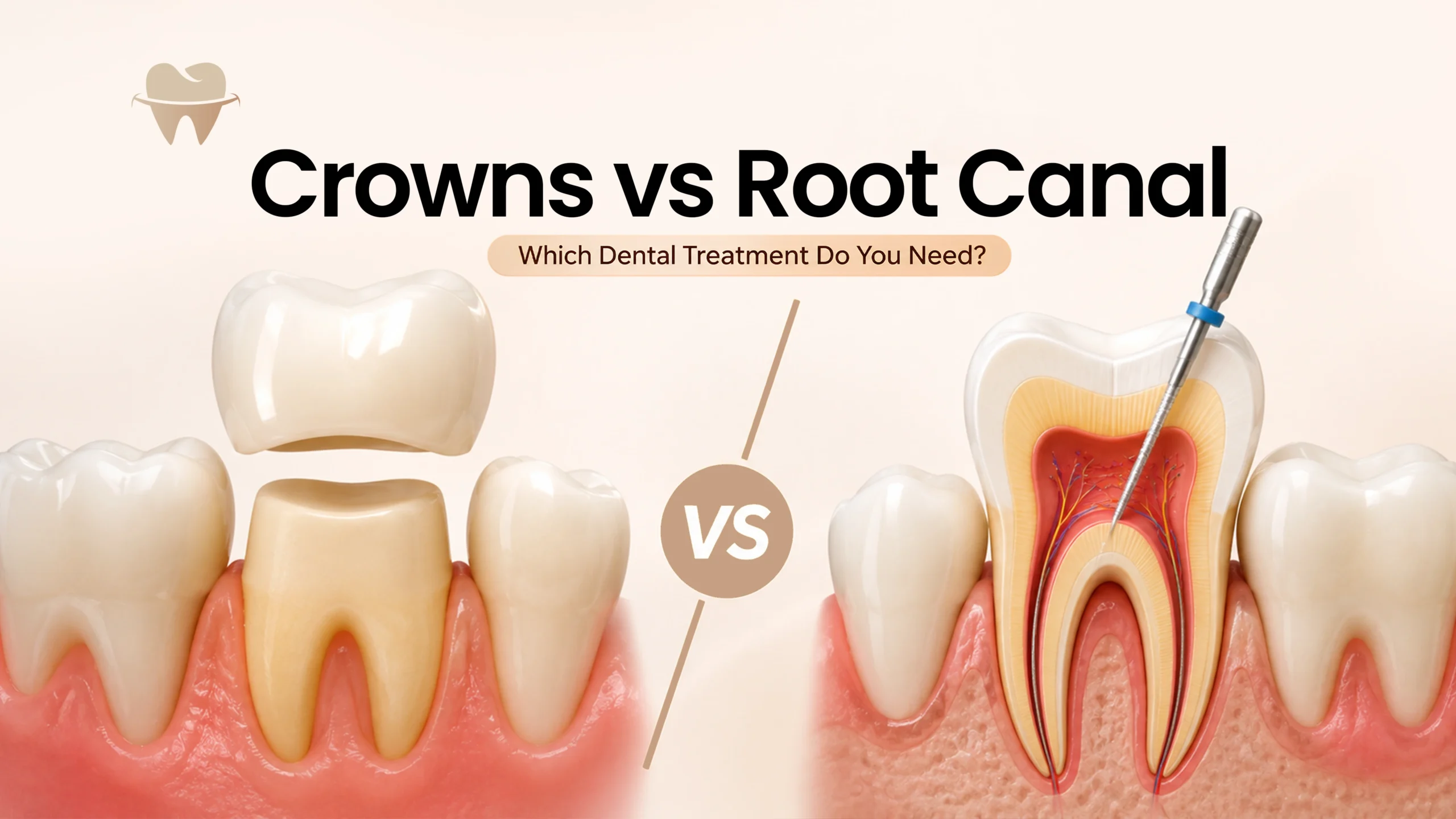
A root canal treats infection or damage inside the tooth. The dentist removes the damaged nerve tissue, cleans the canals and seals them.
A dental crown is a cap that covers the visible part of the tooth. It restores shape, strength and appearance.
One treats the inside. The other protects the outside.
| Feature | Root Canal Treatment | Dental Crown |
|---|---|---|
| What it is | Removal of infected or damaged pulp | A cap placed over the tooth |
| Main purpose | Remove infection and relieve pain | Restore strength, shape and look |
| Where it works | Inside the tooth | Outside the tooth |
| Fixes infection | Yes | No |
| Fixes weak or broken tooth structure | No | Yes |
| Usually needs anaesthetic | Yes | Yes, for tooth preparation |
| Typical time | 60 to 90 minutes for one visit | Two visits, or one with same-day systems |
| Typical lifespan | Tooth can last decades | Often 10 to 15 years or more |
| Lahore cost (estimate) | PKR 12,000 to 55,000 | PKR 25,000 to 50,000 |
First, a Quick Look Inside Your Tooth
A tooth has three main layers.
- Enamel is the hard outer shell.
- Dentine is the softer layer under the enamel.
- Pulp is the soft centre. It holds nerves and blood vessels.
The pulp runs from the crown down through narrow root canals to the tip of each root.
When decay or a crack reaches the pulp, bacteria get in. The pulp becomes inflamed or infected. It cannot heal on its own.
That is where a root canal comes in. When the outer tooth is weak, cracked or heavily filled, that is where a crown comes in.
What Is a Dental Crown?
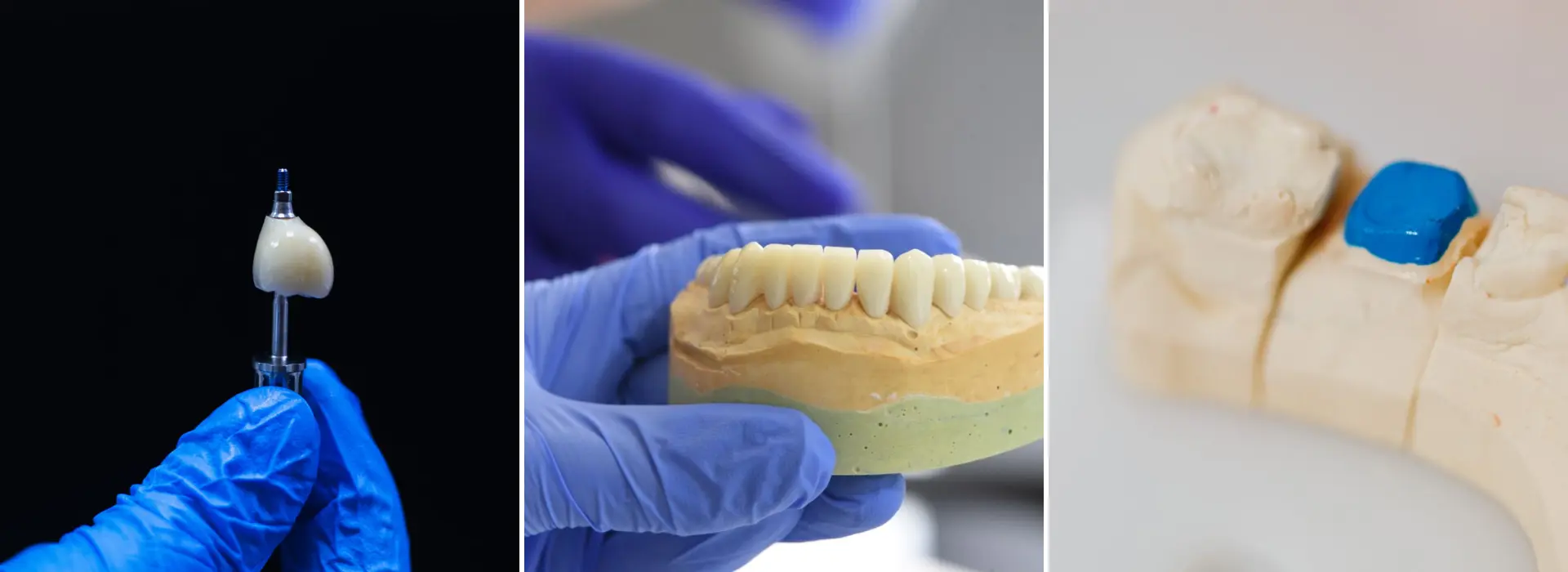
A dental crown is a tooth-shaped cap made in a dental laboratory. It fits over a prepared tooth like a helmet. It is cemented in place and covers everything above the gum line.
This is a common tooth crown treatment. It is also a major tooth restoration treatment because it rebuilds a tooth that is too damaged for a filling.
Crown Materials
| Material | Look | Strength | Best For |
|---|---|---|---|
| Zirconia | Natural, opaque to translucent | Very strong | Back teeth, and front teeth with modern types |
| E.max (lithium disilicate) | Most natural | Good | Front teeth and visible areas |
| Porcelain fused to metal | Good | Strong | Back teeth, where metal edges are less visible |
| Gold or metal alloy | Metallic | Very strong, gentle on opposing teeth | Rear teeth, for patients who prefer it |
When Does a Tooth Need a Crown?
You may need a dental crown if you have:
- A large cavity that a filling cannot hold
- A cracked tooth or a broken cusp
- A very large old filling that is failing
- A tooth worn down by grinding or acid
- A tooth that has had a root canal, especially a back tooth
- A misshapen or badly discoloured tooth
- A dental implant that needs a visible tooth on top
- A bridge that needs support from neighbouring teeth
What Is Root Canal Treatment?
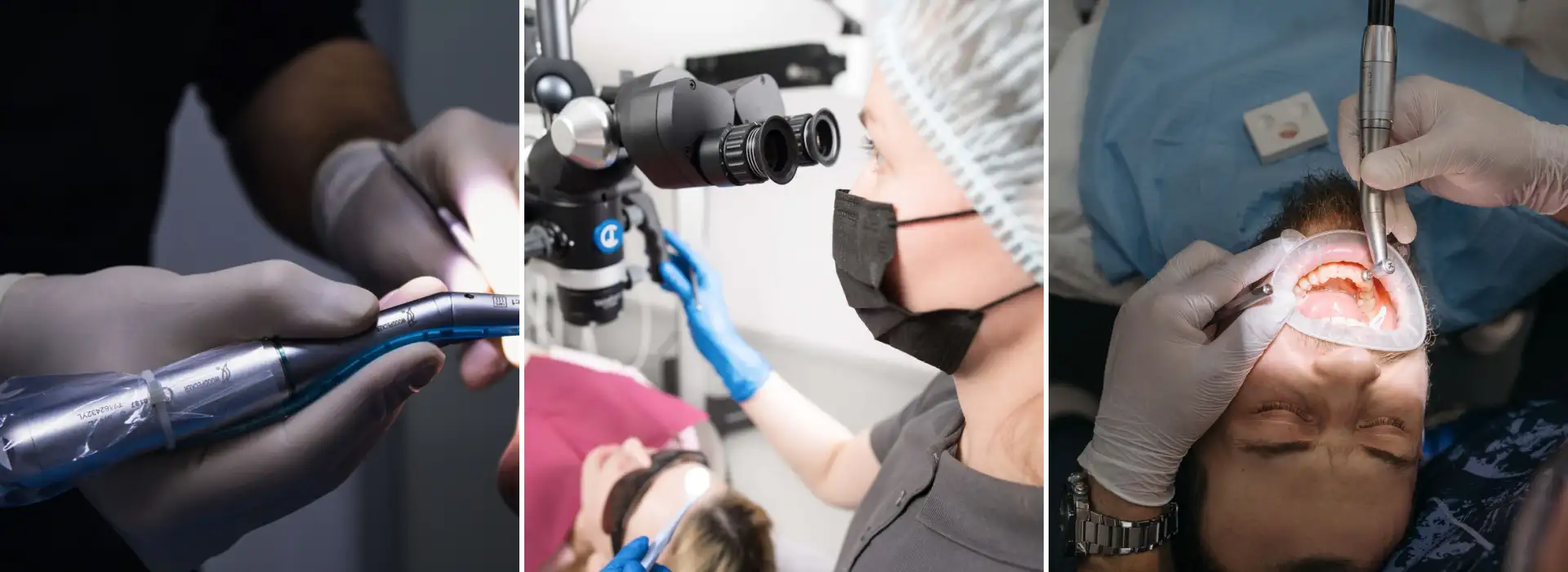
Root canal treatment removes the infected or inflamed pulp from inside a tooth. The dentist cleans and shapes the canals, disinfects them and fills them with a sealing material. The tooth stays in your mouth.
The aim is simple. Remove the infection. Stop the pain. Keep the tooth.
When Is Root Canal Treatment Necessary?
You may need root canal treatment if you have:
- Deep decay that has reached the pulp
- Pain that lingers after hot or cold, or wakes you at night
- A tooth that hurts when you bite or press
- Swelling or a pimple on the gum near the tooth
- A tooth that has darkened after an injury
- A crack that has reached the pulp
- An abscess shown on an X-ray, even without pain
Read our full guide to root canal dentists and treatment in Lahore.
Crowns vs Root Canal: Which One Do You Need?
The choice depends on what is wrong with the tooth.
| What Your Dentist Finds | Usual Treatment |
|---|---|
| Large cavity, nerve healthy | Crown (or large filling) |
| Deep decay, lingering pain or abscess | Root canal, then a crown |
| Cracked cusp, nerve healthy | Crown |
| Crack reaching the nerve | Root canal, then a crown |
| Worn or weak tooth, no infection | Crown |
| Root-treated back tooth | Crown, strongly advised |
| Root-treated front tooth with plenty of tooth left | Filling or crown, depending on remaining structure |
| Infection with severe fracture or bone loss | Extraction may be needed |
Do I Need a Root Canal Before a Crown?
Not always. You need a root canal before a crown only if the pulp is infected, dying or dead.
If the nerve is healthy, a crown can go on without a root canal. Sometimes, shaping a tooth for a crown irritates the nerve and a root canal becomes necessary later. This is uncommon, but your dentist should mention it.
Can a Tooth Need Both?
Yes. This is very common. A root canal removes the infection. The crown then covers the weakened tooth. Many back teeth need both.
Can a Crown Fix an Infected Tooth?
No. A crown covers the tooth. It does not clean the inside.
If a crown is placed over an infected tooth, the bacteria stay sealed inside. The infection can grow and spread into the bone. Infected teeth need root canal treatment first. Only then should the dentist place a crown.
Why a Crown Is Usually Recommended After a Root Canal?
A root-treated tooth is not dead wood. But it is weaker.
Two things make it weaker.
- Lost tooth structure. Decay and the access hole remove tooth material.
- Lost nerve supply. The pulp no longer feeds the tooth, so it can become more brittle.
A crown ties the tooth together. It holds the walls in place and seals the top against bacteria.
What the Evidence Says
A 2020 study in a university hospital followed root-treated teeth over eight years. It found that timely placement of the final coronal restoration was the most critical factor for long-term survival.
A long-term study of 312 patients and 598 teeth found cumulative survival of 97% at 10 years, 81% at 20 years, 76% at 30 years and 68% at 37 years. It identified lack of a crown restoration, being a molar, and acting as an abutment for a prosthesis among factors affecting survival.
A 2025 systematic review in Cureus found that preserving remaining tooth structure is the most consistent factor for outcomes. It also noted that molars left unrestored after root canal therapy show more fracture and bacterial leakage.
The Honest Caveat
Not every root-treated tooth needs a crown. A trial in a systematic review found no clear difference in three-year survival between direct composite restorations and full crowns in certain teeth. Front teeth with strong remaining walls may do well with a filling.
The decision depends on how much healthy tooth is left, where the tooth sits, and how hard you bite. Your dentist will assess this.
What Happens If You Skip the Crown After a Root Canal?
- The tooth is more likely to crack or split, especially a molar.
- Bacteria can seep through the temporary filling and reinfect the canals.
- A split tooth may need extraction.
- You may lose the money and effort already spent on the root canal.
If you have had a root canal and have not had a crown, do not wait for pain. Book your crown visit.
Root Canal vs Crowns Treatment Process

Here is how each treatment works, step by step.
Root Canal Treatment: Steps
| Step | What Happens |
|---|---|
| 1. Exam and X-ray | The dentist confirms infection and maps the canals |
| 2. Local anaesthetic | The tooth is numbed |
| 3. Isolation | A rubber dam keeps the tooth clean and dry |
| 4. Access | A small hole is made in the top of the tooth |
| 5. Cleaning | Infected pulp is removed. The canals are cleaned and shaped |
| 6. Disinfection | The canals are rinsed with antiseptic |
| 7. Filling | The canals are filled and sealed |
| 8. Temporary or permanent filling | The access hole is closed |
| 9. Crown planning | A crown appointment is booked |
Dental Crown Treatment: Steps
| Step | What Happens |
|---|---|
| 1. Exam and X-ray | The dentist checks the tooth and the roots |
| 2. Local anaesthetic | The tooth is numbed |
| 3. Preparation | The tooth is shaped to make room for the crown |
| 4. Impression or scan | A mould or digital scan records the tooth |
| 5. Temporary crown | A temporary cap protects the tooth |
| 6. Laboratory work | The crown is made, often in one to two weeks |
| 7. Fitting | The crown is tried in, adjusted and cemented |
| 8. Bite check | The bite is checked and polished |
Side-by-Side Timeline
| Treatment | Appointments | Time in Chair | Healing or Waiting |
|---|---|---|---|
| Root canal | 1 to 2 | 60 to 120 minutes | Days of soreness |
| Crown | 2 (or 1 with same-day systems) | 60 to 90 minutes each | 1 to 2 weeks for lab work |
| Root canal plus crown | 3 to 4 | Combined | Crown after the tooth settles, often within weeks |
If your tooth needs both, the dentist will usually place the crown soon after the root canal. A long wait raises the risk of fracture and leakage.
What About a Cracked Tooth?
Which treatment is better for a cracked tooth? It depends on the crack.
| Type of Crack | Description | Usual Treatment |
|---|---|---|
| Craze lines | Tiny surface lines in enamel | Usually none |
| Fractured cusp | A piece of the biting edge breaks off | Crown or onlay |
| Cracked tooth | Crack runs from the biting surface toward the root | Crown. Root canal if the nerve is affected |
| Split tooth | Crack separates the tooth into segments | Often extraction |
| Vertical root fracture | Crack starts in the root | Often extraction |
A crown holds a cracked tooth together and stops it spreading. A root canal is added only if the pulp is infected or irreversibly damaged.
See a dentist soon if you have pain when you bite and release, sensitivity to cold, or a sharp pain that comes and goes. Early treatment gives you the most options.
Crown vs Root Canal Lifespan
Crown vs root canal lifespan is not a direct comparison. A root canal treats the inside of the tooth. A crown is a restoration on the outside. They age in different ways.
| Treatment | What Lasts | Typical Lifespan |
|---|---|---|
| Root canal treatment | The treated tooth in your mouth | Many last decades. One long-term study found 97% survival at 10 years and 81% at 20 years |
| Dental crown | The crown itself | Often 10 to 15 years, and sometimes longer |
| Root canal with crown | The tooth plus the crown | Tooth can last decades. The crown may need replacing once or more |
A systematic review of randomised trials reported tooth survival after root canal treatment of about 93% at 4 to 5 years and 87% at 8 to 10 years. Figures vary between studies, and each tooth is different.
What Shortens the Life of Each
For a root canal:
- Bacterial leakage from a missing or poor restoration
- Missed canals
- A crack or fracture
- Reinfection
For a crown:
- Decay at the crown edge
- Grinding or clenching
- A poor fit
- Chipping of porcelain
- Gum disease or bone loss
How to Make Them Last
- Brush twice a day and clean between teeth daily
- Visit your dentist every six months
- Wear a night guard if you grind
- Avoid biting hard objects such as ice, pens and bottle caps
- Treat gum disease early
Is It Painful? What About Recovery?
Root canal. The tooth is numbed, so you should feel pressure but not pain. Soreness for two to four days afterwards is normal. Standard painkillers usually control it. The pain you had before treatment is usually worse than the treatment itself.
Crown. Preparation is done under local anaesthetic. The tooth may feel sensitive to hot and cold for a few days. Your bite may feel slightly different until the crown settles. The dentist adjusts it if needed.
Call your dentist if swelling develops, pain worsens after 48 hours, or the temporary crown comes off. Read what to do if your temporary crown falls off.
Crown vs Root Canal Cost in Lahore
Prices depend on the tooth, the clinic, the material and how complex the case is.
| Treatment | Estimated Cost in Lahore (PKR) |
|---|---|
| Root canal, front tooth | 12,000 to 20,000 |
| Root canal, premolar | 15,000 to 25,000 |
| Root canal, molar | 20,000 to 40,000 |
| Complex or calcified canals | 30,000 to 55,000 |
| Root canal retreatment | 25,000 to 50,000 |
| Dental crown, per tooth | 25,000 to 50,000 |
| Root canal plus porcelain crown | 50,000 to 90,000 |
These are market estimates for established clinics, based on public listings from WhatClinic and InstaCare (2026). Some budget clinics list crowns from about PKR 3,000 to 20,000. Prices differ by material and clinic. Ask for a written quote.
If an earlier root canal has failed, our root canal retreatment guide covers cost and the retreatment-versus-extraction decision in detail.
What Changes the Price?
- Number of canals in the tooth
- Crown material, such as zirconia, E.max or metal
- Whether a specialist or a general dentist treats the tooth
- Use of a microscope or advanced equipment
- Whether a post or build-up is needed
- The clinic location and laboratory quality
Is It Worth Saving the Tooth?
Usually, yes. An extracted tooth leaves a gap. Replacing it with an implant costs more, and in Lahore a single implant with crown typically runs from about PKR 90,000 to 250,000. Read our dental implant cost guide.
If a tooth is too broken or too infected to save, your dentist will tell you honestly.
Other Options Your Dentist May Discuss
| Option | When It May Suit |
|---|---|
| Large filling | Moderate decay with enough tooth left |
| Onlay or inlay | Partial coverage when part of the tooth is sound |
| Pulp capping or partial pulpotomy | Early pulp involvement in some cases, where the pulp is still healthy |
| Extraction and implant | Tooth cannot be saved |
| Extraction and bridge | Alternative to an implant |
| Watchful monitoring | Tiny cracks or minor wear |
Ask your dentist why they recommend one option over the others. A good dentist will explain this without pressure.
How to Choose a Dentist for a Crown or Root Canal
- Ask for an exam and X-ray first. Treatment should not be decided over the phone.
- Ask for the diagnosis in plain words. Is the nerve infected? How much tooth is left?
- Ask about options. You should hear more than one.
- Check their training. Endodontic training matters for complex root canals. Prosthodontic skills matter for crowns.
- Ask about materials and laboratories. Crown quality depends on both.
- Get a written plan with costs. It should list the root canal, any build-up and the crown.
- Ask what happens if something fails. Clear policies show a responsible clinic.
When to See a Dentist Urgently
Get help the same day if you have:
- Severe or throbbing tooth pain
- Facial swelling
- Fever with tooth pain
- A bad taste or pus near a tooth
- Difficulty swallowing or opening your mouth
A spreading dental infection can become serious. Do not wait.
Final Word
Crowns and root canals are not rivals. They are partners. One cleans the inside. The other protects the outside.
If you have an infected tooth, the root canal comes first. If your tooth is weak, cracked or heavily filled, a crown may be all you need. If both apply, plan the two together.
Do not decide from a price list. Get an exam, an X-ray and a clear explanation. Then choose the treatment that gives your tooth the best chance of lasting.
Crown and Root Canal Care at Teeth & Gums, DHA Phase 6
At Teeth & Gums in DHA Phase 6, Lahore, we start with an exam and X-ray. We tell you what is happening inside and outside your tooth. Then we explain your options, the steps and the costs.
If your tooth needs both a root canal and a crown, we plan them together. That way the tooth is protected soon after the root is cleaned. We also help patients who travel from abroad to plan their visits around their dates.
Book a consultation at Teeth & Gums
What is the difference between a dental crown and a root canal?
A root canal removes infected or damaged pulp from inside the tooth and seals the canals. A crown is a cap that covers and protects the outside of the tooth. One treats infection. The other restores strength and shape. Many teeth need both.
Do I need a root canal before getting a crown?
Only if the nerve is infected, inflamed beyond repair or dead. If the nerve is healthy, a crown can be placed without a root canal. Occasionally, tooth preparation irritates the nerve and a root canal is needed later. Your dentist will assess this.
Can a tooth need both a root canal and a crown?
Yes, and this is common. The root canal removes infection from inside. The crown then protects the weakened tooth from fracture and leakage. Back teeth especially benefit from this combination because they take heavy biting forces.
Can a dental crown fix an infected tooth?
No. A crown covers the tooth but does not treat infection inside it. Sealing an infected tooth under a crown can let the infection spread. Root canal treatment must come first, followed by a crown once the tooth has been cleaned and sealed.
When does a tooth need a dental crown?
A tooth needs a crown when it is too damaged for a filling. Common reasons are large decay, a cracked or broken tooth, a failing big filling, severe wear, or a root canal on a back tooth. Crowns also cap implants and anchor bridges.
When is root canal treatment necessary?
Root canal treatment is needed when the pulp is infected or irreversibly damaged. Signs include lingering pain, night pain, pain on biting, swelling, a gum pimple or a darkened tooth. Sometimes an X-ray shows infection before any pain begins.
Which treatment is better for a cracked tooth?
It depends on the crack. A crown holds a cracked tooth together if the nerve is healthy. If the crack reaches the nerve, a root canal is added before the crown. Split teeth and cracks that run into the root may need extraction.
How long does a dental crown last?
Crowns often last 10 to 15 years, and some last longer. Lifespan depends on the material, fit, bite, grinding and oral hygiene. Decay at the crown edge is a common reason for replacement. Regular check-ups and a night guard help.
How long does root canal treatment take?
A straightforward root canal takes about 60 to 90 minutes. A molar with several canals may take up to two hours. Some cases need two visits, especially with infection or complex canals. The crown is a separate step afterwards.
What happens if you don’t get a crown after a root canal?
The tooth is more likely to crack or split, and bacteria can leak through the filling and reinfect the canals. Back teeth are most at risk. A fractured tooth may need extraction, so the root canal investment can be lost. Get the crown soon.