TL;DR
- Root canal retreatment is a second root canal performed when a previous treatment has failed or developed new problems.
- Common causes of failure include missed canals, coronal leakage, persistent infection, root fractures, or new decay.
- Success rates are 85-90%, making retreatment a reliable alternative to extraction.
- Costs in Pakistan range from PKR 15,000 to 50,000 depending on tooth complexity and clinic.
- Preserving your natural tooth through retreatment is always preferable when possible.
- Most teeth can be retreated once or twice, depending on the tooth’s condition.
Last updated: Sep 2026 · Written and reviewed by the Teeth & Gums clinical team
You thought it was over. The pain was gone, the crown was placed, and you moved on with your life. Months or years later, the familiar ache returns. Your dentist takes an X-ray and delivers unexpected news: the tooth needs treatment again.
A failed root canal is not uncommon. Studies suggest root canal failure occurs in roughly 5 to 15% of cases, sometimes due to undetected canals, persistent infection, or delayed crown placement. When this happens, root canal retreatment offers a second chance to save the tooth, preventing extraction and preserving your natural smile.
This guide covers everything about repeat root canal treatment: why it fails, how the procedure works, costs in Pakistan, and what to expect during recovery.
Quick answer: Root canal retreatment cleans out and reseals a tooth whose original root canal has failed, usually due to a missed canal, a leaking crown, or persistent infection. It has an 85 to 90% success rate and typically costs PKR 15,000 to 50,000 in Pakistan, far less than extraction and an implant. Most cases take 60 to 120 minutes and are completed in one or two visits.
What Is Root Canal Retreatment?
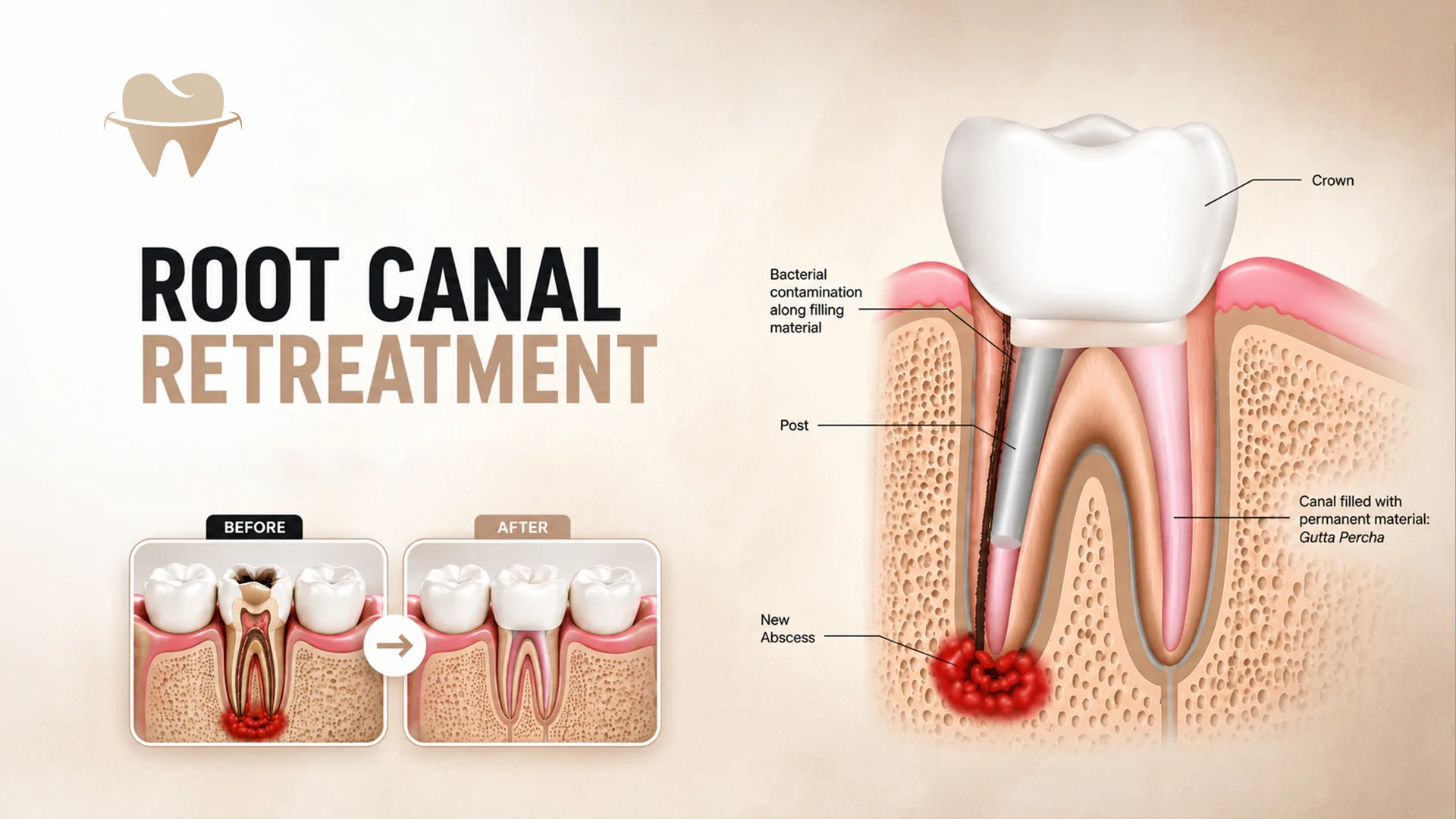
Root canal retreatment is a procedure performed when a tooth that has previously undergone root canal therapy develops new problems or fails to heal properly. The process involves removing the original filling material, thoroughly cleaning and disinfecting the root canals, and refilling them with new material.
Think of it as a second chance for your tooth. Instead of extracting the tooth and replacing it with an implant or bridge, retreatment lets you preserve your natural tooth structure.
Common Reasons for Root Canal Failure
Several factors can contribute to root canal failure.
| Cause | Description |
|---|---|
| Missed canals | Teeth have complex anatomy, and some canals may be missed during initial treatment, particularly in molars |
| Coronal leakage | Delayed crown placement or a poorly sealed restoration allows bacteria to re-enter |
| Persistent infection | Resistant bacteria remain within the canal system or surrounding bone |
| Root fracture | Vertical cracks can develop over time, allowing bacteria access |
| Canal calcification | Narrowed or blocked canals that were not fully cleaned initially |
| New tooth decay | New decay develops, compromising the seal |
These factors explain why a tooth might need repeat root canal treatment, even when the original procedure was performed correctly.
Recognising the Signs of a Failing Root Canal
Recognising the symptoms of a failed root canal helps you seek timely care. Watch for persistent or recurring pain in the treated tooth, swelling or tenderness in the surrounding gums, a pimple-like bump on the gum known as a fistula that indicates infection, discoloration of the tooth, pain when biting or chewing, sensitivity to hot or cold, and a visible crack in the tooth.
Even without symptoms, your dentist may detect signs of failure on routine X-rays, such as bone loss around the root tip or an incomplete seal, which is why regular dental check-ups matter for early detection.
Consequences of Untreated Root Canal Failure
An untreated failed root canal can lead to serious consequences. Bacteria can spread to adjacent teeth or surrounding bone as a persistent infection, pus-filled pockets called abscesses can develop at the root tip, the infection can cause bone loss that undermines the tooth’s support, and eventually extraction may become the only option. Chronic infection has also been linked to broader health risks, including cardiovascular concerns.
A failed root canal does not improve on its own and needs prompt professional attention.
The Root Canal Retreatment Procedure Step by Step
The retreatment procedure involves several carefully planned steps.
| Step | Description |
|---|---|
| 1. Diagnosis | X-rays are taken to confirm failure and assess the extent of infection |
| 2. Anaesthesia | Local anaesthesia is administered to ensure comfort |
| 3. Access restoration | The crown or filling is removed to access the canals |
| 4. Removal of old filling | The original filling material is carefully removed |
| 5. Cleaning and disinfecting | Canals are thoroughly cleaned to eliminate bacteria |
| 6. Refilling | Canals are filled with new biocompatible material |
| 7. Temporary seal | The opening is sealed temporarily |
| 8. Final restoration | A new crown or filling is placed to protect the tooth |
The procedure typically takes 60 to 120 minutes, depending on the complexity of the case.
How Long Does Root Canal Retreatment Take?
| Case type | Approximate time |
|---|---|
| Simple (single canal) | 60 to 90 minutes |
| Moderate (multiple canals) | 90 to 120 minutes |
| Complex (with calcification) | Split over 2 visits |
Your dentist will give you a more specific timeline based on your individual case.
Pain Management and Comfort During Retreatment
The procedure itself is performed under local anaesthesia, so you should not feel pain during treatment. Any discomfort experienced is typically mild and can be managed with over-the-counter pain relievers.
Some tenderness or mild pain may occur for a few days as the tissue heals. This is normal and usually settles within 48 to 72 hours.
Success Rates of Root Canal Retreatment
Success rates for retreatment are generally high, at 85 to 90% when performed by an experienced endodontist. This is slightly lower than the roughly 95% success rate of initial root canal therapy, since the outcome depends on the tooth’s anatomy, the cause of the original failure, and the quality of the final seal. Even so, retreatment remains a reliable alternative to extraction for most cases.
Retreatment vs Extraction and Implant
In most cases, preserving your natural tooth through retreatment is preferable to extraction.
| Comparison | Retreatment | Extraction and implant |
|---|---|---|
| Preserves natural tooth | Yes | No |
| Maintains jawbone | Yes | Requires bone grafting |
| Less invasive | Yes | Surgical procedure required |
| Timeline | 1 to 2 visits | Months-long process |
| Cost | Lower | Significantly higher |
| Success rate | 85 to 90% | 95%+ for implants |
Extraction and implant placement is a longer, more expensive, and more invasive process, so retreatment should generally be considered first.
Limitations on Retreatment Frequency
Most teeth can be retreated once or twice. Each retreatment removes additional tooth structure, though, which increases the risk of root fracture. Where the tooth is already compromised, extraction may be the better option. The decision depends on the remaining tooth structure, the cause of failure, and the condition of the surrounding bone, and your dentist will weigh these factors before recommending a course of action.
Root Canal Retreatment Cost in Pakistan
Root canal retreatment cost in Pakistan varies based on the tooth, its complexity, and the clinic. The ranges below are approximate.
| Treatment | Cost range (PKR) |
|---|---|
| Retreatment (one canal) | 15,000 to 25,000 |
| Retreatment (two canals) | 20,000 to 35,000 |
| Retreatment (three canals) | 30,000 to 50,000 |
| Crown replacement (additional) | 15,000 to 40,000 |
Retreatment cost is generally 20 to 40% higher than initial root canal therapy, reflecting the added complexity of removing old filling material and addressing complications. For the cost of a first-time procedure, see our root canal treatment price guide.
Cost Comparison: Retreatment vs Extraction and Implant
| Option | Approximate cost (PKR) |
|---|---|
| Retreatment | 15,000 to 50,000 |
| Extraction plus implant | 150,000 to 250,000 |
Retreatment is a fraction of the cost of extracting and replacing a tooth.
Preventing the Need for Retreatment
While not all failures can be prevented, these steps reduce your risk.
| Prevention measure | How it helps |
|---|---|
| Restore promptly | Place the crown within 2 to 4 weeks after root canal treatment to prevent bacterial re-entry and fracture |
| Good oral hygiene | Regular brushing and flossing prevent new decay and gum disease around the treated tooth |
| Regular check-ups | Routine dental visits detect issues early, before they become serious problems |
| Avoid hard foods | Chewing ice, nuts, or hard sweets can fracture treated teeth, compromising the restoration |
| Wear a night guard if grinding | A custom-fitted night guard protects teeth from excessive forces that can cause cracks or fractures |
Conclusion
A failed root canal is not the end of your tooth. Root canal retreatment offers a highly successful second chance, preserving your natural tooth and avoiding the cost and complexity of extraction and implant placement. The procedure calls for an experienced dentist and a clear understanding of why the original treatment failed, but success rates are excellent.
If you are experiencing pain, swelling, or other symptoms in a previously treated tooth, do not wait. Early intervention improves outcomes and usually keeps treatment simpler. This article is for general education and is not a substitute for a dental examination.
Think your root canal has failed?
At Teeth & Gums, our experienced team provides expert root canal retreatment using advanced technology to ensure your comfort and a successful outcome.
Frequently Asked Questions
What is root canal retreatment?
Root canal retreatment is a procedure to treat a tooth that has previously undergone root canal therapy but has developed new problems or failed to heal properly.
Why would a root canal need to be redone?
Reasons include missed canals, delayed crown placement, persistent infection, root fractures, or new decay compromising the seal.
How many times can a root canal be retreated?
Most teeth can be retreated once or twice. The decision depends on the remaining tooth structure and the cause of failure.
Is root canal retreatment painful?
The procedure is performed under local anaesthesia, so you should not feel pain during treatment. Mild discomfort may occur for a few days afterwards.
How successful is root canal retreatment?
Success rates are around 85 to 90% when performed by an experienced endodontist.
How long does root canal retreatment take?
Typically 60 to 120 minutes, depending on the tooth’s complexity. Simple cases may be completed in one visit, while complex cases may need two.
How much does root canal retreatment cost?
Root canal retreatment in Pakistan costs between PKR 15,000 and 50,000, depending on the tooth and complexity.
Is retreatment better than tooth extraction?
Preserving your natural tooth is generally preferable when possible. Retreatment is less invasive, less expensive, and faster than extraction and implant placement.
What happens if a failed root canal is left untreated?
Untreated failure can lead to persistent infection, abscess formation, bone loss, and eventual tooth loss, along with wider health risks.
Can a tooth with a failed root canal be saved without retreatment?
In some cases, extraction may be necessary if the tooth is severely cracked or decayed. For most failed root canals, though, retreatment is the preferred first option, since it preserves the natural tooth and avoids costlier replacements like implants.