SUMMARY
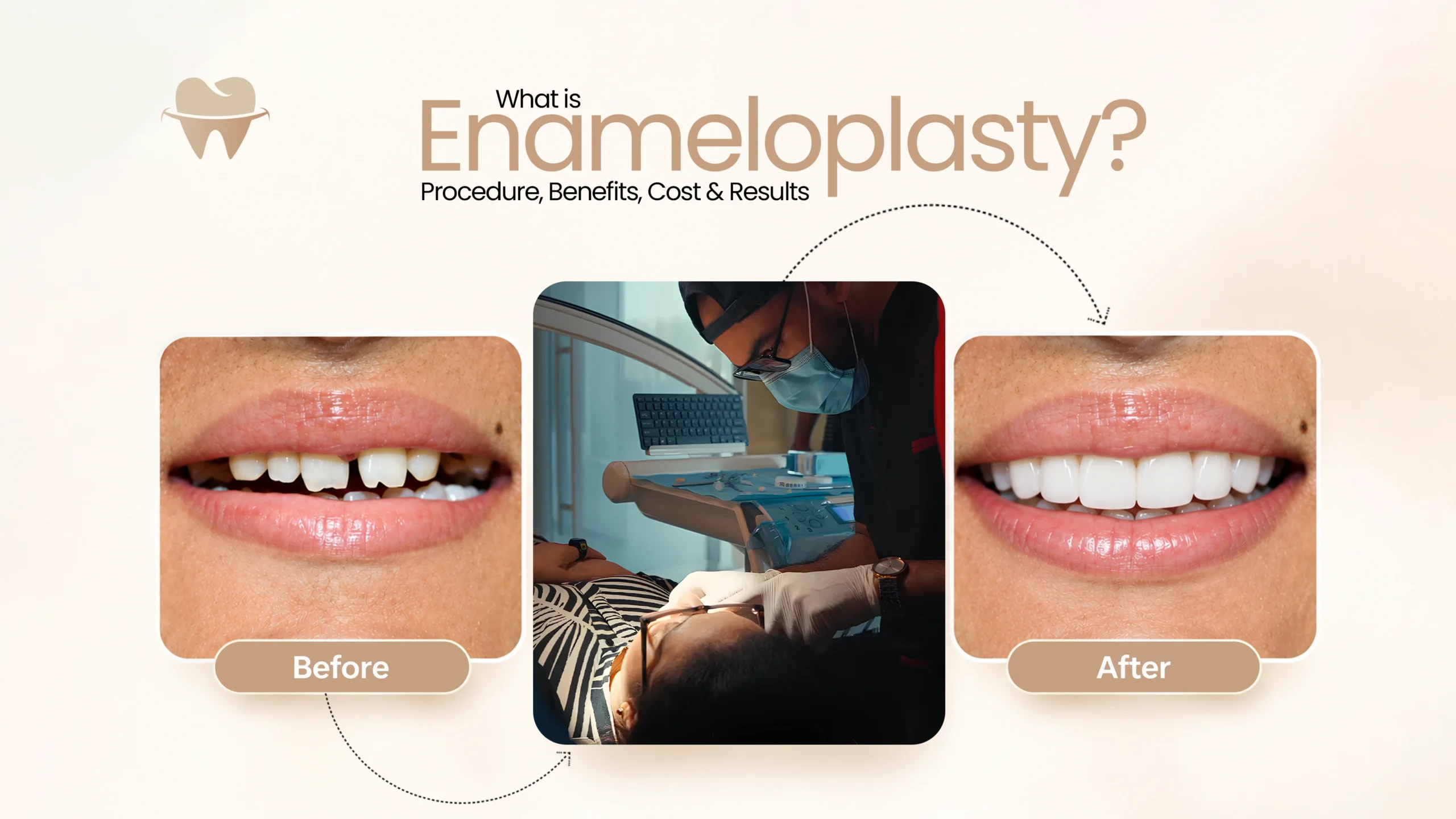
- Enameloplasty is a minimally invasive cosmetic procedure that reshapes teeth by removing tiny amounts of enamel.
- It takes 30 minutes per tooth, requires no anaesthetic and has no recovery time.
- Enameloplasty cost in Pakistan range from PKR 3,000 to PKR 12,000 per tooth at established cosmetic clinics.
- It is safe when performed by a qualified dentist. Enamel thickness is always checked before treatment.
- Enameloplasty is not suitable for teeth with thin enamel, significant decay, or structural damage. Veneers or bonding are better alternatives in those cases.
- The procedure is permanent, removed enamel does not grow back.
Big results do not always require big procedures
Most patients who come in asking about veneers or bonding walk out having learned about something they never knew existed. A chipped edge. An uneven canine. A slightly overlapping incisor. Small problems that have quietly bothered them for years. And sometimes, the answer is not a veneer, a brace, or a filling. It is a 30-minute procedure with no needles, no downtime, and no drama.
That procedure is enameloplasty. And it is one of the most underused tools in cosmetic dentistry.
What Is Enameloplasty?
Enameloplasty is a cosmetic dental procedure that reshapes teeth by removing a controlled amount of tooth enamel. The word comes from two parts: enamel (the outer protective layer of a tooth) and plasty (a suffix meaning surgical reshaping).
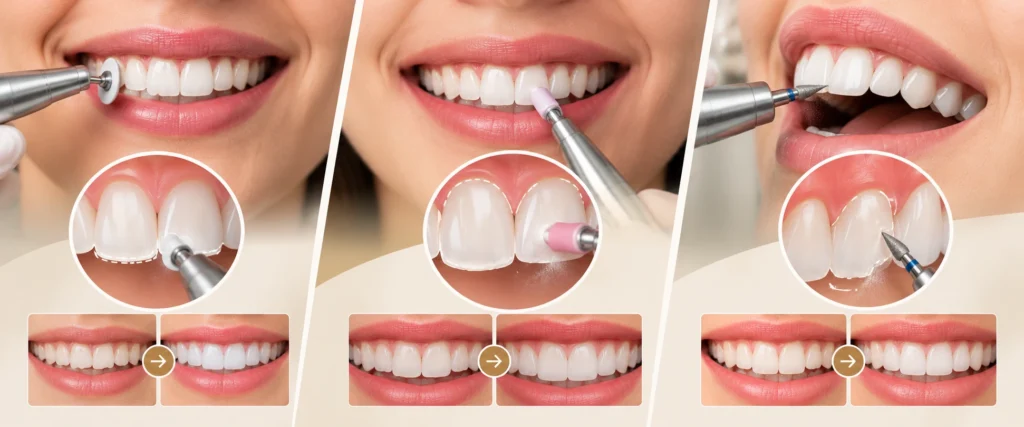
A dentist uses a fine abrasive disc, diamond bur, or dental drill to gently file or contour the enamel surface. The result is a tooth that is smoother, more symmetrical, or better proportioned; without any injections, crown preparations, or laboratory work involved.
Enameloplasty is also known as odontoplasty, tooth contouring, teeth reshaping, or dental reshaping. These terms are largely interchangeable in clinical and patient-facing contexts, though there are subtle technical differences covered below.
The procedure addresses cosmetic concerns only. It removes tooth structure, which means it must be planned carefully and is not appropriate for every case. A proper clinical assessment always comes before any enamel is removed.
Tooth Contouring vs Enameloplasty vs Odontoplasty: What Is the Difference?
These three terms are used interchangeably by most dentists and patients. But they do have slightly different technical meanings.
| Term | Technical Meaning | Scope |
|---|---|---|
| Enameloplasty | Reshaping or removing enamel | Cosmetic and preparatory use |
| Odontoplasty | Reshaping any part of a tooth | Broader — includes enamel and some dentine |
| Tooth Contouring | Common patient-facing term for the same procedure | Cosmetic use |
| Dental Reshaping | General term covering all enamel modification | Cosmetic and functional |
In everyday practice, all four terms mean the same thing to most patients: a dentist files or smooths a tooth to improve its shape or appearance. The procedure is the same. The clinical scope is the main distinction.
When your dentist says “enameloplasty,” they mean a targeted procedure focused on enamel. When they say “odontoplasty,” they may be indicating slightly deeper work that touches the dentine layer beneath.
Enameloplasty in Cavity Preparation: The Clinical Role
Enameloplasty is not only a cosmetic procedure. It has an important role in restorative dentistry, specifically in cavity preparation.
In enameloplasty in cavity preparation, the dentist removes or modifies unsupported enamel rods at the margins of a cavity before placing a filling. This step prevents the thin, undermined enamel at the edges from fracturing under biting pressure after the restoration is placed.
It ensures:
- A clean, well-defined cavity margin
- Better adhesion of the filling material to sound tooth structure
- Reduced risk of marginal breakdown and secondary decay
When performed in this restorative context, enameloplasty is a clinical necessity — not a cosmetic choice. It directly influences the longevity of the restoration placed afterwards.
Enameloplasty Procedure: What Actually Happens
The enameloplasty procedure is one of the simplest in cosmetic dentistry. Here is what to expect at each stage.
Step 1: Assessment and X-Ray
Before any enamel is touched, your dentist will assess the tooth visually and with X-ray. The X-ray confirms enamel thickness at the intended reshaping site. Enamel is typically 1 to 2.5 millimetres thick, and only a fraction of that can be safely removed. If enamel is already thin, the procedure is not appropriate for that tooth.
Step 2: Marking the Reshaping Area
Your dentist marks the areas to be adjusted. This is usually done by eye for small corrections, or with a study model for more complex multi-tooth cases.
Step 3: Reshaping
Using a fine abrasive disc, diamond bur, or dental laser, your dentist carefully removes enamel in controlled increments. The work is done a small amount at a time. Your dentist checks the shape and symmetry repeatedly throughout.
No anaesthetic is required. Enamel has no nerve supply. The procedure is completely painless for most patients. Some people with naturally sensitive teeth feel mild sensitivity during reshaping, which stops immediately when the instrument is removed.
Step 4: Polishing
Once the desired shape is achieved, the tooth surface is polished with a fine abrasive paste. This restores the smooth, light-reflective surface that enamel naturally has. A well-polished result looks completely natural.
Step 5: Fluoride Application
Many dentists apply a fluoride varnish or gel to the reshaped surface after polishing. This strengthens the remaining enamel and reduces post-procedure sensitivity.
The entire appointment typically takes 30 minutes for a single tooth. Multiple teeth can often be treated in one session.
Why Patients Choose It
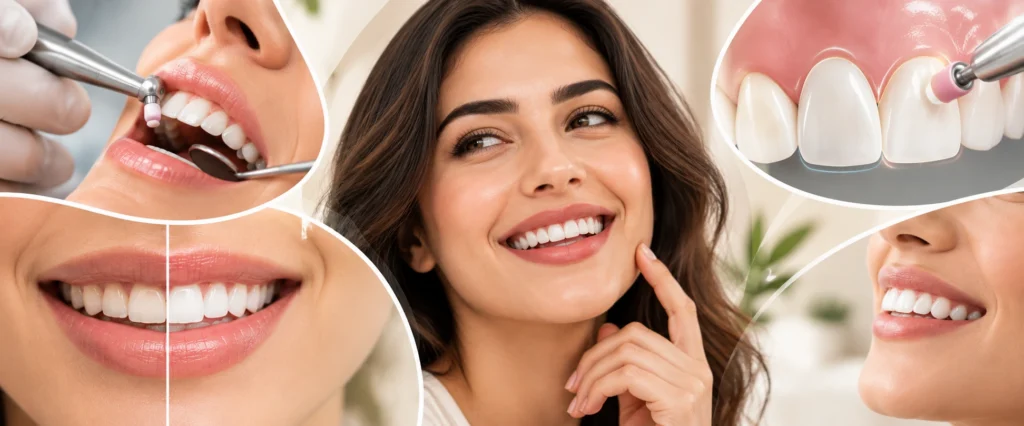
Enameloplasty has a specific set of advantages that make it the right choice for the right cases.
| Benefit | Detail |
|---|---|
| No anaesthetic needed | Enamel has no nerve supply — the procedure is painless |
| No downtime | Patients return to normal activity immediately after |
| Fast | 30 minutes per tooth; multiple teeth in one session |
| Permanent results | One treatment per tooth — enamel does not regrow |
| Affordable | Significantly cheaper than veneers or bonding |
| Improves bite | Can eliminate minor occlusal interferences |
| Reduces fracture risk | Smoothing sharp edges prevents chipping and cracking |
| Can avoid orthodontics | Minor crowding or overlap sometimes corrected without braces |
| Natural result | The modified tooth looks like natural enamel — no material added |
What Enameloplasty Can and Cannot Fix
This is where honest clinical communication matters. Enameloplasty is genuinely useful but only for the right problems.
What It Can Fix
- Small chips on the edges of front teeth
- Slightly overlapping or uneven teeth
- Minor length discrepancies between teeth
- Sharp or rough edges that catch the tongue or cheek
- Overly pointed canine teeth
- Minor asymmetry between the left and right sides of the smile
- Enamel irregularities causing bite interferences
What It Cannot Fix
- Significant tooth misalignment or crowding
- Teeth with deep chips or structural cracks
- Stained or discoloured teeth; enameloplasty does not affect colour
- Teeth with decay or active gum disease
- Patients with very thin enamel (verified on X-ray)
- Severe length differences requiring material to be added (bonding or veneers are needed instead)
Is Enameloplasty Safe?
Yes, when performed by a qualified dentist who has assessed enamel thickness beforehand.
The key safety parameter is how much enamel is removed. Removing too much weakens the tooth, increases sensitivity, and risks exposing the dentine beneath. A safe enameloplasty never removes more than 0.3 millimetres of enamel in a single procedure.
An X-ray before treatment confirms whether the tooth has sufficient enamel thickness to accommodate the planned reshaping. If it does not, enameloplasty is not recommended for that tooth.
Concerns patients commonly raise:
Does it damage the tooth? Not when performed correctly and conservatively.
Does it cause sensitivity? Some patients experience mild sensitivity for a few days. It resolves on its own.
Does it weaken the tooth? Removing sub-0.3mm of enamel does not meaningfully affect tooth strength.
Is it reversible? No. Removed enamel does not grow back. This is why pre-treatment assessment is non-negotiable.
Enameloplasty Risks: What to Know Before Proceeding
Every clinical procedure carries some risk. For enameloplasty, those risks are minor when the procedure is done correctly — but worth understanding.
| Risk | How Common | How It Is Managed |
|---|---|---|
| Sensitivity | Common, short-term | Fluoride application; resolves within days |
| Over-removal of enamel | Rare with experienced dentist | X-ray assessment; conservative increments |
| Colour mismatch | Possible if underlying dentine is exposed | Avoided by staying within enamel only |
| Unsatisfactory shape | Rare | Careful pre-treatment planning and patient agreement |
| Irreversibility | Permanent | Ensures patient understands outcome before proceeding |
The most significant risk is irreversibility. Unlike bonding or veneers, enameloplasty cannot be undone. This makes the initial consultation and honest patient communication critical.
Enameloplasty Recovery: What to Expect After Treatment
One of the genuine advantages of enameloplasty is the absence of a meaningful recovery period.
Immediately after: You can eat and drink normally within the hour. There are no wound sites, no sutures, and no swelling.
First 24–48 hours: Some patients notice mild sensitivity, particularly to cold drinks or temperature changes. This is a normal response to the newly exposed enamel surface.
Days 3–7: Sensitivity typically resolves completely as the enamel surface settles. The fluoride applied at the appointment accelerates this.
Long-term: No special maintenance is required. The reshaped tooth is cared for exactly like any other tooth, standard brushing, flossing, and regular check-ups.
What to avoid post-treatment:
- Very hot or very cold drinks for 24 to 48 hours
- Hard or crunchy foods on sensitive areas for the first day
- Acidic foods and drinks for 48 hours (these can irritate the freshly reshaped surface)
That is the full extent of enameloplasty recovery. For most patients, it is effectively zero.
Enameloplasty Cost in Pakistan: 2026 Guide
Enameloplasty is one of the most affordable cosmetic dental procedures available. No laboratory work, no anaesthetic, no materials; just skilled clinical time.
Enameloplasty Cost by Scope (Pakistan, 2026)
| Procedure | Approximate Cost (PKR) |
|---|---|
| Single tooth — minor chip/edge | PKR 3,000 – 6,000 |
| Single tooth — moderate reshaping | PKR 5,000 – 10,000 |
| Multiple teeth (2–4 teeth) | PKR 10,000 – 25,000 |
| Full smile contouring (6–8 teeth) | PKR 20,000 – 45,000 |
| Enameloplasty + bonding (combined) | PKR 15,000 – 40,000 |
| Enameloplasty in cavity preparation | Included in restoration fee |
Pricing estimates for established cosmetic dental clinics in Lahore as of 2026.
Pakistan vs International Cost Comparison
| Location | Single Tooth Enameloplasty |
|---|---|
| Lahore, Pakistan | PKR 3,000–10,000 (~£7–£22) |
| United Kingdom | £80–£250 |
| United States | $50–$300 (national average: ~$215) |
| Dubai, UAE | AED 300–800 |
For diaspora patients visiting Pakistan, even combining flights and accommodation, the cost of cosmetic dental work, including enameloplasty, remains substantially lower than back home.
Enameloplasty Before and After: What Real Results Look Like
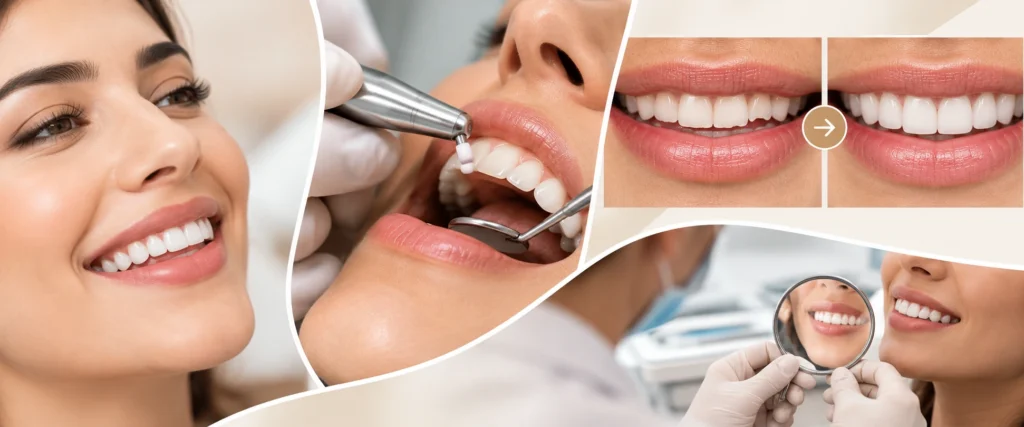
Enameloplasty results are defined by subtlety. The point is rarely a dramatic transformation. It is a refined, natural-looking correction that removes what was bothering the patient without introducing anything artificial.
Typical Before and After Changes
| Concern | Before | After |
|---|---|---|
| Chipped front tooth edge | Jagged, asymmetrical edge | Smooth, matched to adjacent tooth |
| Overlapping canine | Pointed, catching the lip | Contoured, flush with smile line |
| Uneven incisal edges | Mixed lengths, unbalanced | Levelled, harmonious smile line |
| Rough enamel surface | Irregular surface texture | Polished, natural shine restored |
| Sharp molar cusp | Causing bite discomfort | Smoothed, improved bite comfort |
When Enameloplasty Is Not Enough: Alternatives
Enameloplasty works brilliantly within its scope. Outside that scope, other options produce better results.
| Concern | Better Alternative |
|---|---|
| Stained or discoloured teeth | Teeth whitening or porcelain veneers |
| Significant chips or cracks | Dental bonding or veneers |
| Severely short teeth needing material | Composite bonding |
| Significant misalignment | Clear aligners or orthodontic braces |
| Very thin enamel | Porcelain veneers (protect rather than remove) |
| Missing teeth | Dental implants |
Enameloplasty is often combined with bonding in a single appointment. The dentist removes irregular enamel with reshaping, then adds composite resin to areas where volume or colour needs building up. The combination covers a wider range of concerns than either procedure alone.
Who Is a Good Candidate for Enameloplasty?
A good candidate for enameloplasty:
- Has minor, specific cosmetic concerns about tooth shape or edge
- Has sufficient enamel thickness confirmed on X-ray
- Has no active decay or gum disease
- Has realistic expectations. This is a refinement procedure, not a transformation
- Is not pregnant (not a contraindication, but elective procedures are generally deferred)
- Does not grind teeth severely (grinding accelerates enamel wear and would counteract reshaping results over time)
If you grind your teeth at night, discuss this with your dentist before proceeding. A custom night guard worn post-treatment protects the newly shaped enamel from excessive wear.
Final Word
Enameloplasty does not get the attention it deserves. It is fast, affordable, painless, and permanent. For the right concerns a chip, a sharp edge, a slightly uneven smile line, it produces results that patients often describe as the simplest fix they have ever had done.
It will not whiten your teeth, close a large gap, or move a misaligned tooth into place. But for what it does do, nothing else in cosmetic dentistry comes close in terms of simplicity and cost.
Enameloplasty at Teeth & Gums, Lahore
At Teeth & Gums in DHA Phase 6, enameloplasty is assessed and performed as part of our broader cosmetic dentistry service. Every case begins with an X-ray and clinical assessment; enamel thickness is always confirmed before any reshaping is planned.
Many of our enameloplasty cases arise from cosmetic consultations where the patient expected more extensive treatment. When the concern is genuinely minor, and the enamel permits it, we always recommend the most conservative option first.
Small changes. Real results. One appointment.
Book a Cosmetic Consultation at Teeth & Gums
Find out whether enameloplasty, bonding, or veneers is the right fit for your smile — with a full assessment and cost plan before any work begins.
FAQs
What is enameloplasty in dentistry?
Enameloplasty is a cosmetic dental procedure that involves reshaping and contouring the enamel (outer layer) of teeth to improve their appearance, smooth rough edges, or correct minor irregularities.
Is enameloplasty the same as tooth contouring?
Yes, enameloplasty is commonly known as tooth contouring or odontoplasty. These terms are used interchangeably to describe the same procedure.
What dental problems can enameloplasty fix?
Enameloplasty can fix minor chips, uneven tooth edges, slight overlaps, small pits or grooves in enamel, and minor shape irregularities. It is also used to smooth sharp edges that irritate the tongue or cheeks.
Does enameloplasty hurt?
No, enameloplasty is generally painless. Only a tiny amount of enamel is removed, and the procedure typically requires no anesthesia. Some patients may feel mild vibration or pressure.
Is enameloplasty safe for your teeth?
Yes, enameloplasty is safe when performed by a qualified dentist. Only a minimal amount of enamel (usually less than 0.5 mm) is removed, preserving the tooth’s structural integrity.
How much does enameloplasty cost in Lahore, Pakistan?
Enameloplasty cost in Lahore ranges from PKR 5,000 to PKR 15,000 per tooth, depending on the clinic, the dentist’s experience, and the complexity of the reshaping needed.
How long does an enameloplasty procedure take?
Enameloplasty is a quick procedure, typically taking 15 to 30 minutes per tooth. Multiple teeth can often be treated in a single appointment.
What is the difference between enameloplasty and dental bonding?
Enameloplasty removes small amounts of enamel to reshape teeth, while dental bonding adds composite resin to build up or repair teeth. Bonding can address larger imperfections than enameloplasty.
What is the difference between enameloplasty and veneers?
Enameloplasty involves minimal enamel removal for subtle reshaping, while veneers require more significant enamel removal and cover the entire front surface of the tooth for comprehensive cosmetic improvement.
Can enameloplasty cause tooth sensitivity?
Enameloplasty rarely causes sensitivity because only a tiny amount of enamel is removed. If sensitivity occurs, it is usually temporary and resolves within a few days.
Who is a suitable candidate for enameloplasty?
Good candidates have minor cosmetic concerns like slightly uneven, chipped, or overlapping teeth, along with healthy enamel and no active decay or gum disease.
What should I avoid after enameloplasty?
Avoid very hot or cold foods and drinks for a few days if sensitivity occurs. Maintain good oral hygiene and avoid biting hard objects that could damage the reshaped enamel.
Can enameloplasty be performed on multiple teeth?
Yes, enameloplasty can be performed on multiple teeth during the same appointment. It is often used to create a more uniform and symmetrical smile across several teeth.