
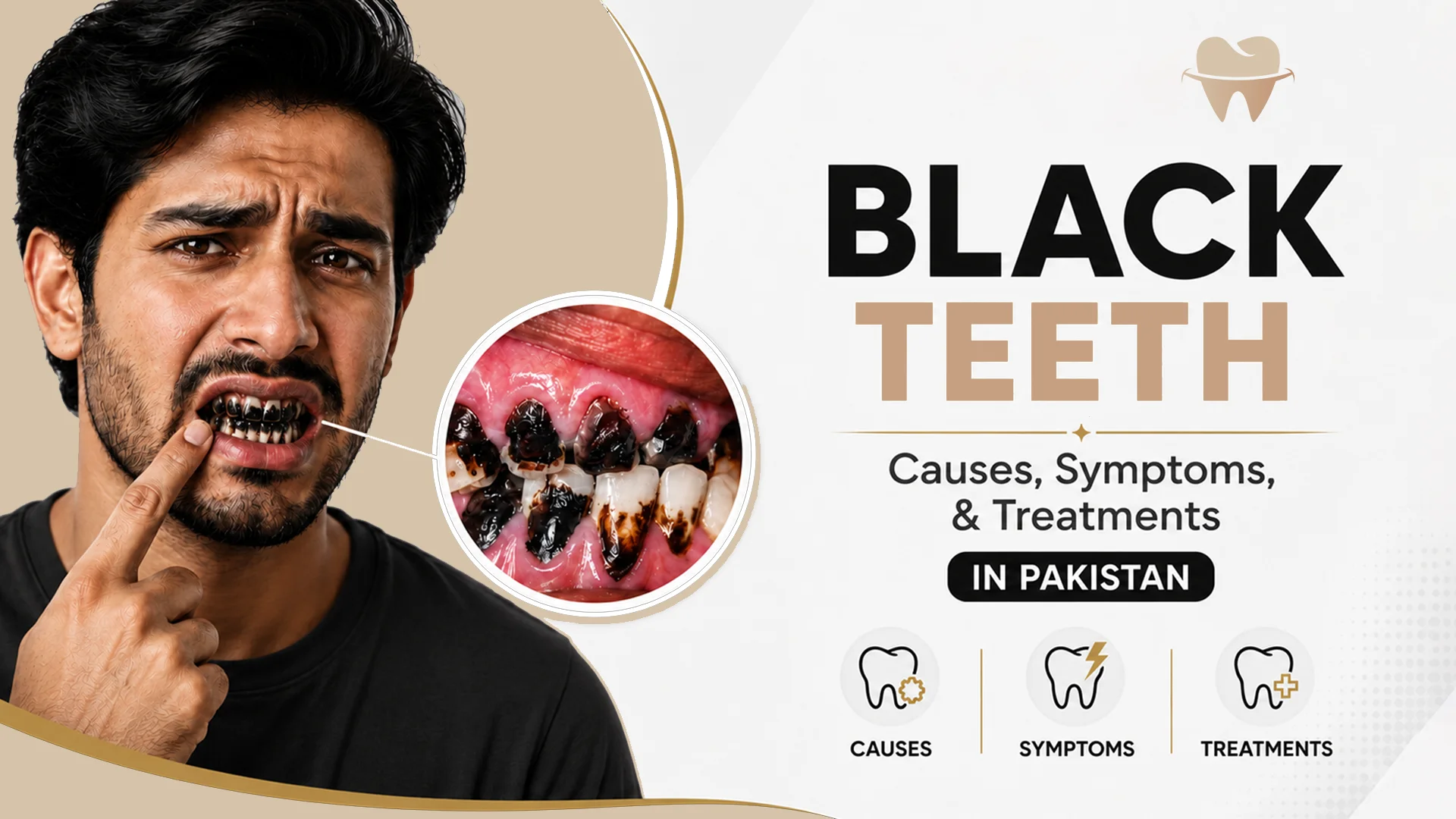
TL;DR
- Black teeth can result from external stains, tartar buildup, trauma, or internal decay.
- Black lines on teeth are often a sign of tartar that has built up and become stained, especially at the gumline.
- Black spots vs. cavities: A spot may be a stain, but a cavity is structural damage. A dentist must diagnose the difference.
- Do not try to remove black tartar at home. It is too hard and dangerous to scrape off yourself. You need a dentist to remove it with professional tools.
- The treatment for a black tooth includes professional cleaning, fillings, root canals, crowns, or in some cases, extraction.
You glance in the mirror and notice a dark, almost black spot on your tooth. Perhaps it is a black line at the gumline, or your entire tooth has taken on a darkened hue. Your first thought might be that you have a cavity that needs filling — but black teeth can have several underlying causes, some of which require more than a simple filling.
Black discoloration is not just a cosmetic concern. While a dark stain from coffee or tea is one thing, a tooth turning black often indicates a problem that needs prompt professional attention. This guide explores why teeth turn black, explains the difference between black lines and stains, and outlines the most effective treatments available in Pakistan.
Quick answer: Teeth turn black from external causes (staining from coffee, tea, or tobacco, and hardened black tartar) or internal causes (severe decay, trauma that kills the nerve, or old leaking fillings). Stains and tartar are removed with professional scaling; decay needs a filling, and a dead nerve needs root canal treatment. Black teeth cannot be fixed safely at home.
Why Are My Teeth Turning Black?
It depends on whether the cause is external (extrinsic) or internal (intrinsic). External causes affect the outer enamel, while internal causes start inside the tooth and progress outward.
Black Lines on Teeth vs Black Spots
Understanding the difference helps you judge how urgent your situation is.
| Feature | Black lines on teeth | Black spots / stains |
|---|---|---|
| Location | Usually along the gumline or between teeth | Anywhere on the tooth surface |
| Common cause | Tartar buildup, plaque calcification | External stains (coffee, tea) or early decay |
| Texture | Hard, rough, crusty | Smooth or slightly pitted |
| Pain | Usually painless unless gums are inflamed | May cause sensitivity if decay is present |
| Can it be brushed away? | No — it is hardened and requires professional removal | Surface stains may reduce, but deep stains need professional care |
| Treatment | Scaling and polishing by a dentist | Scaling, polishing, or whitening |
Common Causes of Black Teeth
| Cause | Description |
|---|---|
| Severe tooth decay (cavities) | Bacteria produce acids that destroy enamel, creating dark holes. Decay can eventually expose the inner layers, leading to a black appearance. |
| Black tartar (calculus) | Hardened plaque that has absorbed pigments from food, drinks, or blood from inflamed gums — often a dark, crusty mass below the gumline. |
| Trauma or injury | A blow to the mouth can damage the tooth’s blood supply, causing the pulp (nerve) to die. This necrosis can turn the tooth dark grey or black over time. |
| Staining from foods & drinks | Regular coffee, tea, red wine, and dark berries deposit pigments that accumulate, especially if oral hygiene is poor. |
| Smoking and tobacco use | Tar and nicotine stick to teeth, causing persistent dark discoloration that usually requires professional removal. |
| Certain medications & supplements | Liquid iron supplements and some mouthwashes such as chlorhexidine can leave black stains. In children, tetracycline antibiotics can grey or blacken developing teeth. |
| Old or leaking restorations | Silver amalgam fillings can deteriorate and leach colour, staining the surrounding tooth structure black. |
Black Spots vs Black Lines vs Black Tartar
Understanding what you are looking at is the first step toward the right solution.
Black Lines on Teeth
These are thin, dark pigmented stains usually found at the gumline, most commonly on the back teeth or between them. They are often caused by plaque that has hardened into tartar and become stained. Alarming as they look, they are frequently unrelated to serious decay and can be removed with a professional scaling and polishing.
Black Stains vs. Black Tartar
Black stains usually come from external sources such as tea, coffee, or tobacco. They sit on the outer surface but can become deeply embedded in microscopic cracks and pits in the enamel. Black tartar is a hard, calcified deposit on the teeth — far harder to remove and usually requiring professional scaling.
Black Spots vs. Cavities
Black spots (stains) are external discolorations on the outer layer of the tooth and can often be removed with professional cleaning or whitening. Cavities (decay) are holes and pits where acid has eroded the enamel; they need fillings, crowns, or even root canals. A cavity is structural damage, not just a stain.
Black at the Base of a Tooth: What It Means
| Possible cause | Description | Action needed |
|---|---|---|
| Black tartar | Hardened plaque that has absorbed pigments from food, drinks, or blood from inflamed gums, often below the gumline | Professional scaling and root planing |
| Tooth decay at the gumline | Decay starting at the gumline, creating a dark shadow or hole near the base of the tooth | Filling or crown |
| Internal tooth death | Trauma or decay that has killed the pulp, darkening the tooth from the inside out | Root canal treatment |
| Leaking restoration | Old amalgam (silver) fillings can corrode and leach black colour into the tooth over time | Replacement of the filling |
| Staining from food/drinks | Pigments accumulating at the gumline due to inadequate cleaning | Professional cleaning |
How Dentists Remove Black Tartar
If you have black tartar between your teeth or along the gumline, here is what professional removal involves.
1. Examination
Your dentist uses a mirror and periodontal probe to locate tartar buildup and measure pocket depths around each tooth. This assessment determines how much cleaning is required and identifies any underlying gum disease.
2. Ultrasonic Scaling
A vibrating scaler breaks up large tartar deposits while a fine water spray washes debris away. This is particularly effective for heavy buildup above the gumline and is comfortable for most patients.
3. Hand Scaling
Fine hand instruments scrape away smaller, harder-to-reach deposits, including those extending below the gumline, ensuring no area is missed.
4. Polishing
A mild abrasive paste applied with a rotating rubber cup smooths the tooth surfaces and lifts remaining stains, making it harder for plaque to adhere in future.
5. Root Planing (If Needed)
If tartar extends deep below the gumline, root planing smooths the root surfaces so the gums can reattach and bacteria are discouraged from returning. It is usually performed under local anaesthesia.
6. Follow-Up
A follow-up is scheduled at 4–6 weeks so your dentist can reassess gum healing, recheck pocket depths, and confirm the treatment worked.
Black Cavity vs. Black Stain: How to Tell the Difference
| Feature | Black stain | Black cavity |
|---|---|---|
| Appearance | Smooth, discoloured surface | Pit, hole, or rough area |
| Texture | Smooth when probed | Soft, sticky, or crumbly |
| Pain / sensitivity | Usually none | Often sensitive to hot, cold, or sweet foods |
| Can it be brushed away? | Surface stains may be partially reduced | No — the enamel is destroyed |
| Requires a filling? | No — it can often be polished or cleaned | Yes — filling or more advanced treatment |
| Progression | Does not grow or deepen | Grows larger and deeper over time |
Treatment Options for Black Teeth
Treatment depends entirely on the underlying cause, so a dentist must examine you to make a proper diagnosis.
1. Professional Dental Cleaning (Scaling & Polishing)
If the discoloration comes from external stains or tartar, a professional cleaning is usually all that is needed. Ultrasonic scalers break up tartar, then hand scalers remove finer deposits. The procedure is generally painless and can be completed in one or two sessions. Our guide to teeth scaling explains the process in more detail.
2. Composite Bonding or Fillings
If decay has created a small hole, the dentist removes the decayed portion and fills it with tooth-coloured composite resin, restoring the tooth’s structure and eliminating the black spot.
3. Root Canal Treatment (Endodontics)
If the pulp inside the tooth is dead or infected — often after trauma — a root canal is required. The infected pulp is removed, the canals cleaned, and the tooth sealed, often followed by a crown to protect it and improve its appearance.
4. Dental Crowns
Where decay is extensive or a tooth has had a root canal, a crown covers the entire tooth, restoring its shape, size, and colour.
5. Tooth Extraction
When a tooth is too damaged to save, extraction may be the only option. Replacement options such as implants or bridges are then discussed.
6. Professional Teeth Whitening
For teeth that are structurally sound but deeply stained, professional whitening (in-office or take-home kits) can lighten them significantly.
How to Avoid Black Teeth
Preventing black teeth is far easier than treating them.
| Prevention method | How it helps |
|---|---|
| Brush twice daily | Removes plaque before it can harden into tartar |
| Floss daily | Removes plaque from between teeth where brushing cannot reach |
| Use fluoride toothpaste | Strengthens enamel and prevents decay |
| Visit your dentist every 6 months | Professional scaling removes tartar and detects problems early |
| Limit stain-causing foods and drinks | Reduces coffee, tea, red wine, and dark berry pigments |
| Avoid tobacco | Smoking and smokeless tobacco directly stain teeth |
| Drink water after meals | Helps wash away food particles and neutralise acids |
Removing Black Stains at Home: What Works and What Doesn’t
The internet is full of whitening hacks. It is important to know the difference between a safe remedy and a dangerous myth.
| Method | Safe? | Works? | Why / why not |
|---|---|---|---|
| Baking soda | Use with caution | Temporary | A mild abrasive — it can scrub off some surface stains, but frequent use wears down enamel |
| Oil pulling | Safe | Unlikely | May remove some surface plaque, but cannot dissolve hard tartar or fix decay |
| Salt & vinegar | Dangerous | No | The acid erodes enamel, making teeth sensitive and more prone to decay |
Black Teeth Treatment Cost in Pakistan
| Treatment | Approximate cost (PKR) |
|---|---|
| Professional scaling & polishing | 3,000 – 8,000 |
| Composite filling (per tooth) | 4,000 – 12,000 |
| Root canal treatment (per tooth) | 15,000 – 35,000 |
| Dental crown (per tooth) | 20,000 – 60,000 |
| Tooth extraction | 3,000 – 10,000 |
| Professional teeth whitening | 12,000 – 30,000 |
Prices vary based on clinic location, dentist experience, and case complexity.
When to See a Dentist
Black spots and lines should not be ignored. If a dark spot does not go away with regular brushing, or you see a dark line along the gumline, book an appointment.
What to Expect at Your Dental Visit
Knowing what happens can ease anxiety and help you feel prepared. Each step is designed to diagnose the cause and provide the most effective treatment.
- Consultation: your dentist asks about your symptoms, dental history, and concerns.
- Examination: a visual inspection plus probing of the affected teeth to see whether the discoloration is on the surface or deeper.
- Diagnosis: identifying whether it is a surface stain, hardened tartar, active decay, or internal damage.
- Treatment plan: discussing options, costs, and the expected timeline for your case.
- Treatment: scaling and polishing, a filling, a root canal, or another appropriate procedure.
- Follow-up: a review appointment to check healing and confirm the treatment succeeded.
Key Reasons to Visit a Dentist
- A black spot on your tooth: you need to know whether it is a stain or a cavity.
- Black lines on your teeth: you may need a professional cleaning to remove tartar.
- An entire tooth turning black: this often means a dead nerve or deep decay needing immediate attention, possibly a root canal.
- Pain or swelling: any pain or swelling alongside a black tooth is a dental emergency.
Conclusion
Black teeth are never normal and should never be ignored. Whether caused by external stains, hardened tartar, or internal decay, discoloration is often a sign that something is wrong beneath the surface. Some black marks are cosmetic and can be removed with professional cleaning; others indicate serious decay or damage that needs immediate attention.
The good news is that modern dentistry offers effective solutions for every type of black tooth, from simple scaling and polishing to root canals and crowns. The best approach, though, is always prevention — good oral hygiene and regular dental visits help you avoid black teeth altogether. This article is for general education and is not a substitute for a dental examination.
Noticed black spots, lines, or tartar on your teeth?
At Teeth & Gums, we provide comprehensive diagnosis and treatment for black teeth — including professional scaling, fillings, root canals, and cosmetic restorations.
Frequently Asked Questions
Why are my teeth turning black?
Teeth turn black due to external factors such as staining (coffee, tea, tobacco) or tartar, and internal factors like severe decay, trauma, or medication. A dentist must examine you to find the root cause.
How do you remove black stains from teeth?
Black stains from tartar or external sources require professional dental cleaning (scaling). For stubborn stains, professional teeth whitening may also be needed.
Can black teeth be fixed?
Yes, in most cases. Treatment depends on the cause: fillings for small cavities, root canals for internal damage, crowns for large areas, or scaling for tartar. Extraction is the last resort.
Can I remove black stains from my teeth at home?
No. Home remedies such as baking soda or salt are not effective against black tartar or decay — they cannot dissolve hard deposits and may damage your enamel. Leave it to a professional.
How do dentists remove black tartar between teeth?
Dentists use professional instruments: ultrasonic scalers that vibrate the deposits loose, and hand scalers for detailed scraping, often below the gumline.


0 Comments