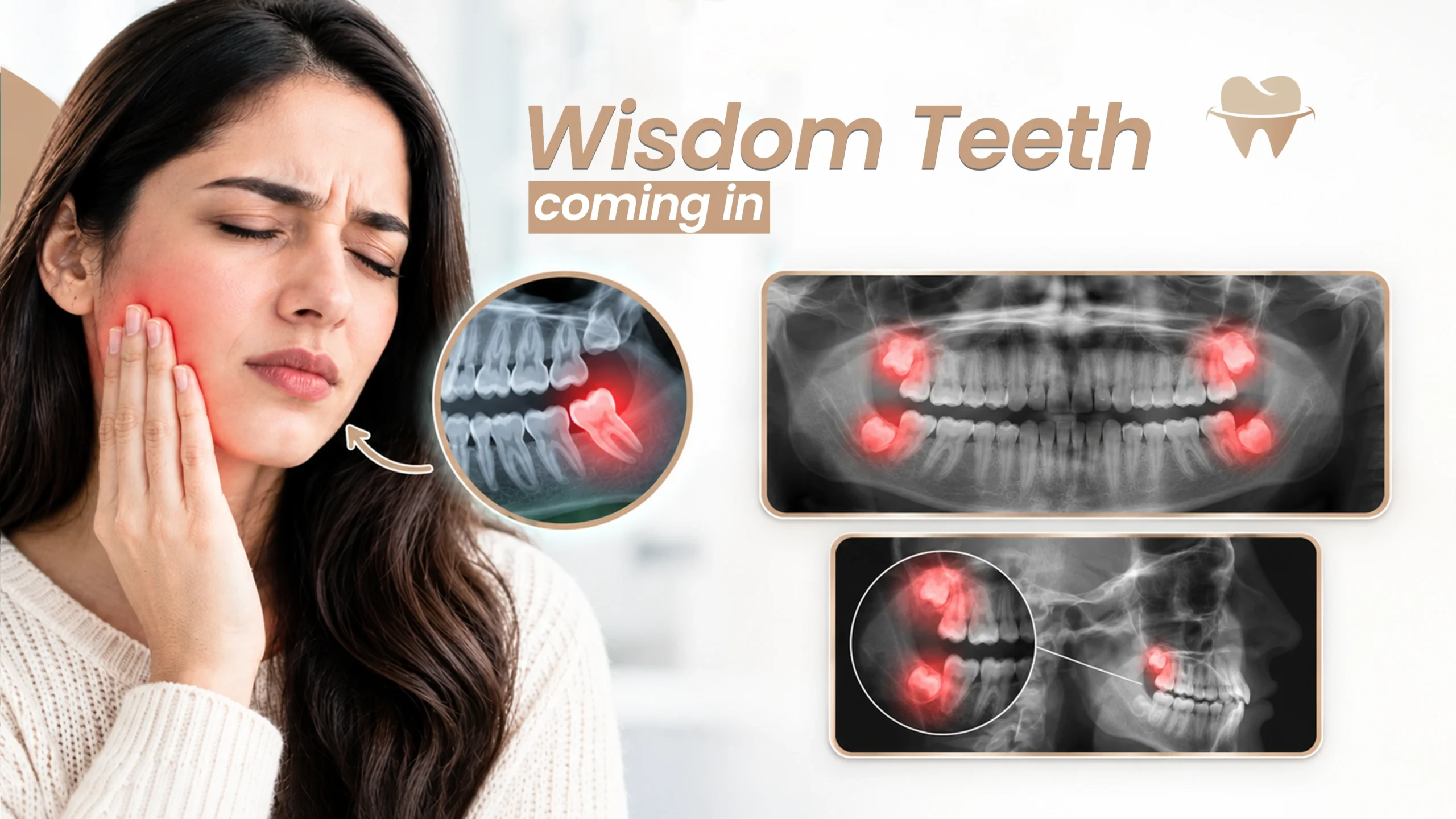
KEY TAKEAWAYS
- Wisdom teeth typically begin erupting between the ages of 17 and 25, though some people experience them earlier or later.
- The first signs of wisdom teeth coming in include pressure at the back of the jaw, mild gum tenderness, and slight swelling behind the second molars.
- Wisdom tooth pain ranges from mild background ache to severe, throbbing discomfort depending on how much space is available and whether the tooth is impacted.
- Infection around a partially erupted wisdom tooth is a dental urgency. Swelling, discharge, fever, and difficulty opening the mouth require prompt assessment.
- Not all wisdom teeth need to be removed. Fully erupted, properly aligned wisdom teeth that can be cleaned are often left in place.
- Any wisdom tooth causing recurring pain, infection, or damage to adjacent teeth should be assessed by a dentist.
That dull ache at the back of your jaw is not in your head.
Most people notice it in their late teens or early twenties. A pressure building somewhere behind the last visible molar. Gums that feel tender in a place nothing has bothered before. Sometimes it resolves on its own in a few days. Sometimes it gets significantly worse.
Wisdom teeth eruption is one of the most commonly misunderstood dental events. This guide explains exactly what is happening, what symptoms are normal, which ones are warnings, and when to stop waiting and book an appointment.
What Are Wisdom Teeth?
Wisdom teeth are the third molars; the final set of permanent teeth to develop in the human mouth. Most people have four of them: one in each corner of the mouth, upper and lower, left and right.
They are called wisdom teeth because of the age at which they typically arrive. By the late teens and early twenties, a person is considered old enough to have acquired some wisdom; hence the name.
Evolutionarily, wisdom teeth were functional. Early humans needed a full set of 32 teeth to chew a tougher, less processed diet. Over thousands of years, the human jaw has become smaller; but the wisdom teeth have not disappeared. They continue to develop and attempt to erupt into jaws that often do not have enough room for them.
This mismatch between tooth size and jaw space is the root of most wisdom tooth problems.
Wisdom Teeth Age: When Do They Come In?
Wisdom teeth eruption does not follow a single fixed timeline. But there are reliable patterns.
| Age Range | What Typically Happens |
|---|---|
| 14–17 years | Wisdom teeth begin forming in the jaw beneath the gumline |
| 17–21 years | Most people begin to feel the first signs of wisdom teeth coming in |
| 18–25 years | Peak eruption window — most wisdom teeth fully or partially erupt |
| 25–30 years | Some late-erupting cases; X-rays may confirm impaction |
| 30+ years | Wisdom teeth that have not erupted by this point rarely will without intervention |
According to a 2024 study published in Esculapio; a peer-reviewed Pakistani medical journal, the eruption status of wisdom teeth correlates strongly with age in the 19-to-23-year range, confirming this as the primary window for eruption assessment.
Not everyone develops all four wisdom teeth. Some people develop only two or three. A small percentage develop none at all. An OPG (panoramic X-ray) confirms how many are present and their position in the jaw.
First Signs of Wisdom Teeth Coming In
The early signs of wisdom teeth are easy to miss. They can feel like general jaw fatigue or mild gum irritation. Most people do not immediately connect the discomfort to their third molars.
Here is what the first signs of wisdom teeth coming in actually feel like:
Pressure Behind the Second Molars
This is usually the earliest signal. A vague, building pressure at the very back of the jaw, behind the last visible tooth. It is not sharp pain. It feels like something is pushing from inside the bone.
It often comes and goes in the early stages. Some days it is noticeable. Others, it disappears entirely.
Gum Tenderness
The gum tissue at the back of the mouth becomes sensitive to touch. Brushing the area stings. Biting down on hard food in that region is uncomfortable.
The gum may look slightly raised or swollen in a small area directly behind the second molar. This is the gum beginning to yield to the tooth pushing through from beneath.
Jaw Stiffness
Early wisdom teeth erupting can cause mild stiffness in the jaw, particularly noticeable when waking up in the morning or after eating. The muscles around the back of the jaw work harder to compensate for the discomfort, which causes a familiar aching or tightening sensation.
Mild Headache
Some patients describe headaches during early wisdom teeth eruption, typically around the temples or at the back of the head. This is referred pain from the trigeminal nerve, which serves the jaw and surrounding structures.
Sensitivity in Adjacent Teeth
The second molar, the tooth immediately in front of the erupting wisdom tooth, can become temporarily sensitive. The pressure from the erupting tooth pushes on its root. This sensitivity usually resolves once the wisdom tooth has moved further into position.
Signs and Symptoms of Wisdom Teeth
As eruption progresses, symptoms become more defined. These are the established signs and symptoms of wisdom teeth coming in that dentists use to assess what is happening.
| Symptom | What It Indicates |
|---|---|
| Pressure at back of jaw | Tooth beginning to push through bone and gum |
| Gum swelling behind second molar | Active eruption — tissue stretching to accommodate the tooth |
| Intermittent ache | Normal eruption progressing through gum tissue |
| Persistent throbbing pain | Impaction or infection developing |
| White protrusion at gum line | Visible cusp of wisdom tooth breaking through gum |
| Jaw stiffness or reduced opening | Muscle guarding around an inflamed eruption site |
| Ear ache or sore throat | Referred pain from impacted lower wisdom tooth |
| Bad taste or smell from back of mouth | Possible pericoronitis or infection under gum flap |
| Swollen lymph nodes under jaw | Infection spreading to adjacent tissue |
Not all of these symptoms appear together. A tooth erupting with plenty of space may cause only mild gum tenderness and some pressure. A tooth trying to erupt into insufficient space (or emerging at an angle) causes more significant and persistent symptoms.
Wisdom Tooth Pain: What It Feels Like and Why It Happens
Wisdom tooth pain is one of the most common dental complaints among people aged 17 to 25. But the nature of the pain varies considerably depending on what is actually happening.
Normal Eruption Pain
When a wisdom tooth has adequate space and is erupting at the correct angle, the pain is typically:
- A dull ache or pressure at the back of the jaw
- Intermittent, comes and goes over days or weeks
- Manageable with standard over-the-counter pain relief
- Located specifically at the eruption site
This is the body’s normal response to a tooth moving through dense bone and gum tissue. It is uncomfortable but not alarming.
Impaction Pain
When a wisdom tooth does not have enough room to erupt fully, or is angled incorrectly, it becomes impacted. Impacted wisdom teeth cause a different kind of pain:
- Persistent, often throbbing
- Can radiate to the ear, temple, or jaw
- Worsens when biting or chewing
- Does not fully resolve between episodes
- May be accompanied by swelling
Impaction is the most common reason wisdom teeth need to be removed. The tooth cannot emerge properly and continues to put pressure on adjacent structures indefinitely.
Pericoronitis Pain
Pericoronitis is infection of the gum tissue surrounding a partially erupted wisdom tooth. It is one of the most common complications of wisdom teeth coming through gums.
When a wisdom tooth partially erupts, it creates a flap of gum tissue that sits over part of the tooth. This flap traps food and bacteria. The bacteria cause infection beneath the flap, and the infection causes:
- Intense, throbbing pain at the back of the mouth
- Swelling of the gum around the erupting tooth
- An unpleasant taste or smell
- Difficulty opening the mouth fully
- Pain when swallowing
- Sometimes fever
Pericoronitis is not self-resolving. It requires professional treatment. Rinsing with warm salt water may temporarily ease the discomfort, but it does not clear the underlying infection.
Coming Through Gums: What It Looks Like
When wisdom teeth are actively erupting, the gum at the back of the mouth changes visibly.
Early stage
The gum appears slightly raised or bumpy behind the second molar. It may be pinkish or slightly redder than surrounding tissue. There is no visible tooth yet.
Active eruption
The tip of the tooth (usually a single white cusp) begins to protrude through the gum surface. The surrounding tissue is swollen and sensitive. There may be a small gap between the emerging tooth and the gum edge.
Partial eruption
Part of the crown is visible, but the tooth has not fully emerged. A hood of gum tissue, called the operculum, covers the back of the tooth. This is the highest-risk stage for infection.
Full eruption
The entire clinical crown of the tooth is visible above the gum line. The surrounding tissue settles as long as there is no infection, and the tooth can be cleaned effectively.
Wisdom Teeth Swelling: Normal vs Concerning
Some swelling is a normal part of wisdom teeth eruption. The gum tissue is under pressure. Blood flow increases to the area as part of the body’s response. Mild local swelling is expected.
Normal Swelling
- Limited to the gum tissue immediately around the eruption site
- Mild, not dramatically altering the appearance of the face
- Tender to touch but not hot
- Reduces with rest and saltwater rinse
Concerning Swelling — Seek Assessment
| Warning Sign | Why It Matters |
|---|---|
| Swelling spreading to the cheek or jaw | Infection may be spreading beyond the gum |
| Face visibly asymmetrical | Significant spread of infection or abscess |
| Swelling is hot to touch | Active infection with elevated local inflammation |
| Difficulty opening the mouth | Trismus — muscle spasm from spreading infection |
| Swelling under the jaw or neck | Infection has reached deeper tissue spaces — urgent |
| Fever alongside dental swelling | Systemic infection developing |
Swelling that spreads below the jaw line or into the neck is a medical emergency. This pattern (called Ludwig’s angina in severe cases) can compromise the airway. Do not wait for a routine appointment. Go to the emergency department.
Infection: First Signs of Wisdom Teeth Coming In With Complications
Infection around an erupting wisdom tooth is the complication that most often brings patients to the dental chair in genuine distress. Knowing the infection first signs of wisdom teeth coming in allows patients to act before the problem escalates.
Early Infection Signs
- A persistent, bad taste at the back of the mouth
- Pus visible at the gum line around the wisdom tooth
- Gum that bleeds easily when touched or brushed
- Increasing rather than intermittent pain
- Mild swelling that does not reduce with saltwater rinse
Signs That Infection Is Spreading
- Pain extending into the ear, throat, or jaw
- Swelling of the cheek or under the jaw
- Difficulty opening the mouth (less than two finger widths)
- Difficulty swallowing
- Fever above 38°C
- Feeling generally unwell alongside dental pain
Infection at a wisdom tooth eruption site is treated with professional irrigation, antibiotics, and either removal of the gum flap causing the problem or extraction of the tooth, depending on the clinical picture.
Self-management with painkillers and rinsing alone is not appropriate once infection signs are present. The underlying cause does not resolve without clinical intervention.
Symptoms of Erupting Wisdom Teeth: Normal vs Abnormal
This table summarises the key distinction between what is expected during normal wisdom teeth eruption and what requires professional attention.
| Symptom | Normal | Needs Assessment |
|---|---|---|
| Mild pressure at back of jaw | Yes | — |
| Tender gum behind second molar | Yes | — |
| Intermittent dull ache | Yes | — |
| Visible white cusp breaking through gum | Yes | — |
| Mild jaw stiffness on waking | Yes | — |
| Persistent throbbing pain | — | Yes |
| Swelling spreading beyond eruption site | — | Yes |
| Persistent bad taste or smell | — | Yes |
| Ear pain lasting more than 2 days | — | Yes |
| Difficulty opening mouth | — | Yes |
| Fever alongside dental symptoms | — | Yes |
| Pain not responding to over-the-counter relief | — | Yes |
| Visible pus around gum | — | Yes |
The guiding principle is simple. Pain and swelling that is mild, local, and improving over two to three days is consistent with normal eruption. Pain and swelling that is worsening, spreading, or accompanied by systemic symptoms requires same-day or urgent dental assessment.
What Happens If Wisdom Teeth Do Not Erupt Properly?
Some wisdom teeth partially erupt and stop. Others erupt at an angle that pushes against the adjacent molar. Others remain entirely submerged in the jawbone. All three scenarios have clinical consequences.
Impacted Wisdom Teeth
An impacted wisdom tooth is one that cannot fully emerge because of insufficient space or incorrect angulation. Types of impaction include:
- Mesial impaction — the tooth tilts toward the front of the mouth at an angle, pushing into the second molar. Most common type.
- Horizontal impaction — the tooth lies entirely on its side, pointing directly at the second molar’s root.
- Vertical impaction — the tooth is upright but blocked from erupting by the bone above it.
- Distal impaction — the tooth tilts toward the back of the mouth.
Impacted wisdom teeth do not always cause immediate pain. But they can cause long-term damage, including decay in both the wisdom tooth and the second molar, cyst formation, and loss of bone around adjacent teeth.
Partial Eruption
A tooth that partially erupts and stalls is at perpetual risk of pericoronitis. The gum flap created by partial eruption traps bacteria and food every single day. Repeated infections are the most common consequence.
Full Impaction with No Symptoms
Some fully impacted wisdom teeth remain symptom-free for years and are found only on routine X-ray. These require monitoring. If a cyst or other pathology develops around them, intervention becomes necessary regardless of symptoms.
Managing Wisdom Tooth Pain at Home While Waiting for Your Appointment
If you are experiencing wisdom tooth discomfort and cannot see a dentist immediately, these measures reduce pain and reduce infection risk in the short term.
Saltwater rinse
Dissolve half a teaspoon of salt in a glass of warm water. Rinse gently for 30 seconds, targeting the back of the mouth, three to four times daily. This reduces bacterial load and soothes inflamed gum tissue.
Over-the-counter pain relief
Ibuprofen and paracetamol are both effective for wisdom tooth pain. Ibuprofen has an anti-inflammatory effect that specifically helps with swelling-related discomfort. Take as directed on the packaging.
Cold compress
Applying a cold pack to the outside of the jaw for 15 minutes at a time reduces swelling and numbs the area.
Clove oil
Eugenol (the active compound in clove oil) has a mild anaesthetic and antibacterial effect. Dilute clove oil in a carrier oil and apply a small amount to the affected gum with a cotton bud for temporary relief.
Avoid triggers
Very hot drinks, chewy food, and anything that requires hard biting on the back teeth all aggravate eruption-related pain. Soft foods and cool drinks reduce irritation while the area is inflamed.
These are management strategies for mild discomfort. They are not treatment. They do not resolve impaction, infection, or structural problems.
When to See a Dentist About Wisdom Teeth
There is a tendency to wait and see with wisdom teeth. That approach is reasonable for mild, improving symptoms. It is not reasonable in the following situations:
- Pain has persisted for more than three days without improvement
- Swelling is not reducing or is getting worse
- You cannot open your mouth as wide as normal
- You have a bad taste that does not go away after rinsing
- Swallowing or eating has become difficult
- You have a temperature alongside dental pain
- You are unsure whether what you are feeling is normal
Final Word
Wisdom teeth arriving is not a dental emergency by default. Many people pass through this phase with mild discomfort and no complications. The tooth erupts, the gum settles, and life continues.
But impaction, pericoronitis, and spreading infection do not resolve on their own. They require assessment. They require treatment. And the earlier that treatment is initiated, the simpler it is.
The symptoms covered in this guide give you the information to tell the difference between normal eruption and a developing problem. Use them. If you are in any doubt about which side of that line you are on, the safest decision is to get it checked.
Why Teeth and Gums?
At Teeth & Gums, wisdom tooth assessments include a clinical examination, OPG X-ray to assess all four wisdom teeth and their relationship to adjacent structures, and a clear recommendation on whether monitoring, treatment, or extraction is appropriate.
Not every wisdom tooth needs to come out. But every wisdom tooth that is causing recurring problems, posing infection risk, or damaging adjacent teeth should be assessed and managed, not waited out.
Book a wisdom tooth assessment at Teeth & Gums if you feel the signs
Frequently Asked Questions
How to know if your wisdom teeth are coming in?
Signs include jaw pain at the back of the mouth, swollen or tender gums, difficulty opening your mouth, and a sensation of pressure behind your molars. A dental X-ray provides the most accurate confirmation.
What does a wisdom tooth feel like coming in?
It often feels like a dull ache or pressure at the back of the jaw. You may experience gum tenderness, swelling, and occasional sharp pain when chewing or touching the area.
Can wisdom teeth come in without symptoms?
Yes. Some wisdom teeth erupt fully and normally without causing any pain or noticeable symptoms. However, they can still cause problems later, so regular check-ups are important.
Do all wisdom teeth need to be removed?
No. Wisdom teeth that erupt fully, are properly aligned, and do not cause problems can remain. Removal is recommended when they are impacted, cause pain, infection, or damage neighboring teeth.
When should I see a dentist about wisdom teeth?
See a dentist if you experience persistent pain, swelling, difficulty chewing, bad breath, or a bad taste. Also schedule a check-up if you are between 17 and 25, as this is when wisdom teeth typically emerge.
How can I relieve wisdom tooth pain at home?
Use saltwater rinses, apply ice packs to reduce swelling, take over-the-counter pain relievers, and eat soft foods. Avoid hot, spicy, or hard foods that can irritate the area.
Can wisdom teeth cause bad breath or an unpleasant taste?
Yes. Partially erupted wisdom teeth create pockets where food and bacteria get trapped, leading to bad breath and a foul taste in the mouth.
What do wisdom teeth look like when they first emerge?
They appear as small, white bumps at the very back of the gums, behind the second molars. They may emerge straight, tilted, or partially covered by gum tissue.
Can wisdom teeth cause headaches or ear pain?
Yes. The pressure and inflammation from erupting or impacted wisdom teeth can radiate to the ears, temples, and jaw, causing headaches and earaches.
How long does it take for wisdom teeth to come through the gums?
Wisdom teeth can take several months to years to fully erupt. Some remain partially erupted or impacted indefinitely if there is not enough space.
At what age do wisdom teeth usually come in?
Wisdom teeth typically emerge between the ages of 17 and 25. However, some people develop them earlier or later, and some never develop them at all.
Can wisdom teeth cause crowding or shift other teeth?
Yes. Impacted or erupting wisdom teeth can push against adjacent molars, potentially causing crowding or shifting of previously straight teeth. This is particularly concerning for patients who have undergone orthodontic treatment. Regular monitoring with X-rays helps detect this early.