SUMMARY
- A diastema is a visible gap between teeth, most commonly between the upper front incisors.
- Diastema causes include tooth-jaw size mismatch, oversized labial frenum, missing teeth, gum disease, and childhood habits.
- Diastema treatment is not always medically necessary, but many seek it for cosmetic reasons.
- Diastema closure with composite is a fast, minimally invasive, and affordable option for small to moderate gaps.
- Orthodontic treatment with braces or clear aligners offers long-lasting results for complex cases.
- Gum disease must be treated before any cosmetic teeth spacing treatment begins.
You smile, and your eyes drift to the space between your front teeth. For some, it’s a charming feature — think of the celebrities who have embraced their gap. For others, it’s a quiet source of self-consciousness, a reason to smile with closed lips or turn away from the camera.
A gap between the teeth, clinically known as diastema, is one of the most common dental concerns worldwide. While it affects millions, the reasons behind it vary widely — and so do the solutions.
In fact, roughly two-thirds of children have a visible gap between their central incisors when their permanent teeth first erupt. By adulthood, these gaps often close naturally or become a permanent feature that many choose to address. Understanding what diastema is and which teeth-spacing treatments exist helps you make an informed decision about your smile.
Quick Definitions
| Term | Definition |
|---|---|
| Diastema | A visible gap or space between two or more teeth, most commonly the upper front incisors |
| Midline diastema | A gap specifically between the two upper front teeth |
| Labial frenum | The band of tissue connecting the inside of the upper lip to the gum above the front teeth |
| Diastema closure | The process of closing or narrowing the gap between teeth through various treatments |
Understanding Diastema
What Is Diastema?
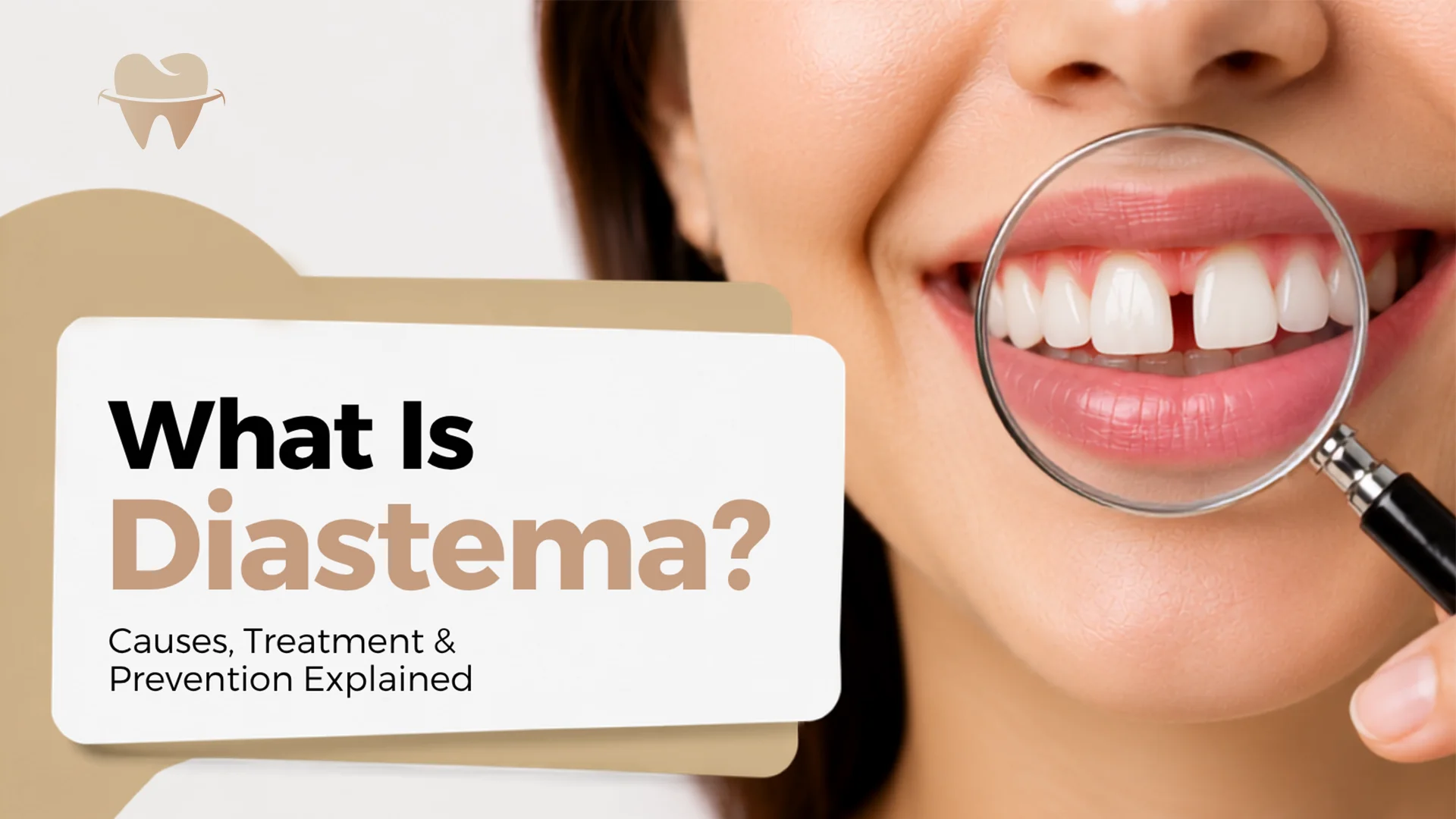
A diastema is a gap between two adjacent teeth that is wider than normal. These spaces can occur anywhere in the mouth, but they are most often seen between the two upper front teeth — a midline diastema. It is usually a cosmetic variation rather than a disease, though in some cases it points to an underlying issue worth checking.
Diastema in Children vs Adults
In children, diastemas are often a normal part of dental development. When baby teeth fall out and permanent teeth begin to erupt, temporary gaps frequently appear and usually close on their own as the rest of the adult teeth come through. In adults, however, a diastema tends to persist unless it is treated. If you are curious about what helps, our guide on reducing the gap between teeth at home explains what is (and isn’t) realistic.
Symptoms: How Do You Know You Have One?
The main sign of a diastema is simply a visible gap, usually noticed while brushing, flossing, or looking in the mirror; a dentist can confirm it during a routine examination. When a diastema is linked to gum disease, you may also notice:
- Bright red, swollen, or tender gums
- Bleeding gums
- Receding gums
- Loose teeth
- Persistent bad breath
- Pain or discomfort while eating
If any of these appear, see a dentist promptly — gum disease must be treated before any cosmetic gap closure can be done safely.
Is a Gap Between Teeth Harmful?
In most cases, no. Diastemas are not harmful to oral health, and many people live comfortably with a gap and never need treatment. It becomes a concern only when it is tied to an underlying problem such as gum disease or a missing tooth. The best prevention is early attention: correcting childhood habits like thumb sucking and keeping gums healthy reduces the chance of a gap forming or widening later in life.
What Causes Diastema?
Understanding why a gap forms is the key to choosing the right fix. Several factors can be involved.
Size Mismatch Between Teeth and Jawbone
One of the most common reasons is a mismatch between tooth size and jaw size. If the teeth are too small relative to the jawbone, gaps develop naturally between them. This is often genetic, which is part of why diastemas can run in families.
An Oversized Labial Frenum
The labial frenum is the band of tissue connecting the upper lip to the gum above the two front teeth. If it is especially large or attached too low, it can keep the front teeth from closing together, creating a gap. This cause is often addressed with a minor procedure called a frenectomy.
Missing or Undersized Teeth
If some teeth are missing or smaller than usual, neighbouring teeth may drift to fill the space, opening gaps. The upper lateral incisors (either side of the two front teeth) are commonly involved — when they are missing or peg-shaped, a diastema can develop.
Gum Disease (Periodontitis)
Gum disease is a serious cause of diastema in adults. As it progresses, inflammation damages the bone supporting the teeth, causing them to loosen and shift, which opens new gaps or widens existing ones. Treating the gum disease must come before any cosmetic teeth-spacing work.
Habits — Thumb Sucking and Tongue Thrusting
Childhood habits can cause diastemas that carry into adulthood. Thumb sucking and lip sucking push the front teeth forward, while an incorrect swallowing reflex — the tongue pressing against the front teeth instead of the roof of the mouth — can push teeth apart over time.
Genetics and Other Factors
Some people simply inherit a predisposition to gaps through their tooth size, jaw structure, or frenum attachment. Conditions such as hyperdontia (extra teeth) can also disrupt alignment and contribute to spacing.
| Cause | Description | Prevalence |
|---|---|---|
| Size mismatch | Teeth too small for the jawbone | Common |
| Oversized frenum | Tissue prevents front teeth from closing | Common |
| Missing teeth | Adjacent teeth shift into empty spaces | Less common |
| Gum disease | Bone loss leads to tooth migration | Common in adults |
| Habits | Thumb sucking, tongue thrusting | Common in children |
| Genetics | Inherited tooth or jaw size | Common |
Diastema Treatment: How to Close a Gap
Treatment is not always medically necessary, but many people choose to close a gap for aesthetic reasons. The right option depends on the size of the gap, its underlying cause, and your preferences.
1. Diastema Closure with Composite
Diastema closure with composite is one of the most popular and cost-effective treatment options. Dental bonding involves applying a tooth-coloured composite resin to the edges of the teeth and sculpting it to close the gap.
Advantages of this treatment include:
- Same-day results: The procedure is typically completed in a single visit
- Minimally invasive: Little to no tooth preparation is required
- Affordable: Less expensive than veneers or orthodontics
- Reversible: The procedure can be modified or reversed if needed
A 2025 case report published in the Libyan Journal of Medical Research demonstrated that direct composite resin restorations are a conservative, adaptable, and minimally invasive solution for midline diastema closure. Studies suggest that such diastemas may negatively affect social perceptions, leading to judgments regarding an individual’s intelligence or social competence.
Diastema closure with composite is best suited for small to moderate gaps. For larger gaps, orthodontic treatment or a combination approach may be recommended.
2. Orthodontic Treatment (Braces and Clear Aligners)
Braces are the most common way to close gaps across multiple teeth, gradually shifting them into alignment with gentle, continuous pressure. Clear aligners offer a discreet alternative for adults. Results are long-lasting and bite issues are corrected too, though treatment usually takes 12–24 months.
3. Porcelain Veneers
Veneers are thin, custom porcelain shells bonded to the front of the teeth. They suit patients who want a full smile makeover, since they improve colour, shape, and size while closing the gap. Results look natural and resist staining, but some enamel must be removed and the cost is higher.
4. Frenectomy
If an oversized labial frenum is the cause, a minor surgical procedure called a frenectomy removes the excess tissue, releasing tension so the teeth can close. Orthodontic or restorative treatment is usually needed afterwards to close the remaining gap.
5. Dental Implants or Bridges
When a gap is caused by a missing tooth, a dental implant or a dental bridge can replace the tooth and close the space, restoring both function and appearance.
| Treatment | Best for | Time | Cost |
|---|---|---|---|
| Composite bonding | Small to moderate gaps | Same day | Low |
| Orthodontics | Multiple or complex gaps | 12–24 months | Moderate–high |
| Veneers | Complete smile makeover | 2–3 visits | High |
| Frenectomy | Frenum-related gaps | Minor surgery | Moderate |
| Implants / bridges | Missing teeth | Multiple visits | High |
A diastema can be a natural variation or a sign of something that needs attention. Diastemas aren’t harmful, but many people close them for cosmetic reasons or to improve function — and modern dentistry offers a route for every gap, from fast composite bonding to long-lasting orthodontics. The right choice depends on the gap’s size, its cause, and your goals, so a consultation is the best first step.
Want to close the gap in your smile?
At Teeth & Gums, our team offers comprehensive diastema treatment — from composite bonding to veneers and orthodontics. Don’t let a gap hold you back.
Frequently Asked Questions
What is the main cause of diastema?
The main causes are a mismatch between tooth size and jawbone, an oversized labial frenum, missing teeth, gum disease, and habits like thumb sucking or tongue thrusting.
Is diastema treatment necessary for health reasons?
No. Diastemas are not harmful to oral health in most cases. Treatment is usually chosen for cosmetic reasons, unless the gap is caused by gum disease or missing teeth.
How can diastema be fixed?
It can be fixed with composite bonding, orthodontic treatment (braces or clear aligners), porcelain veneers, or a frenectomy. The best option depends on the gap’s size and cause.
Is diastema bad?
Not for oral health in most cases — it is primarily a cosmetic concern. However, if the gap is caused by gum disease or missing teeth, it may signal an underlying issue that needs professional attention.
What is diastema closure with composite?
It is a dental bonding procedure where tooth-coloured resin is applied to the edges of the teeth to close the gap. It is fast, minimally invasive, and usually completed in a single visit.
Can braces fix a gap between teeth?
Yes. Braces or clear aligners are highly effective at closing gaps, especially when several teeth are involved or bite issues exist. Treatment typically takes 12–24 months.
How much does teeth gap treatment cost in Pakistan?
Costs vary by treatment: composite bonding around PKR 5,000–15,000 per tooth; orthodontics PKR 60,000–200,000; veneers PKR 15,000–35,000 per tooth. A consultation is recommended for accurate pricing.
Is diastema in children normal?
Yes. About two-thirds of children have a gap between their front teeth when their permanent incisors first erupt, and these gaps usually close naturally as the other adult teeth come through.
Can a gap between teeth close on its own?
In children, gaps often close naturally as permanent teeth emerge. In adults, gaps do not close on their own and need professional treatment.